A customer who has just signed up needs something different from one who has bought five times, and different again from one who has gone quiet. Treating all three with the same weekly newsletter wastes the best chances you have. Customer lifecycle marketing is the habit of recognising where each person is in their relationship with you and sending what suits that stage. This guide explains the stages, the goal and the key message at each one, the metrics to watch, how to build the journeys and a worked example you can adapt.
What is customer lifecycle marketing?
Customer lifecycle marketing plans communication around the stages a customer moves through, from first hearing about you to becoming a loyal advocate, or leaving. It builds on the idea of the customer lifecycle and on funnel thinking, but it goes beyond the sale: the stages after the first purchase usually matter more for profit than the ones before it. Where a campaign calendar asks “what should we send this week?”, lifecycle marketing asks “what does this person need next?”. It is closely related to customer journey mapping, which draws the path, while lifecycle marketing decides what to say along it.
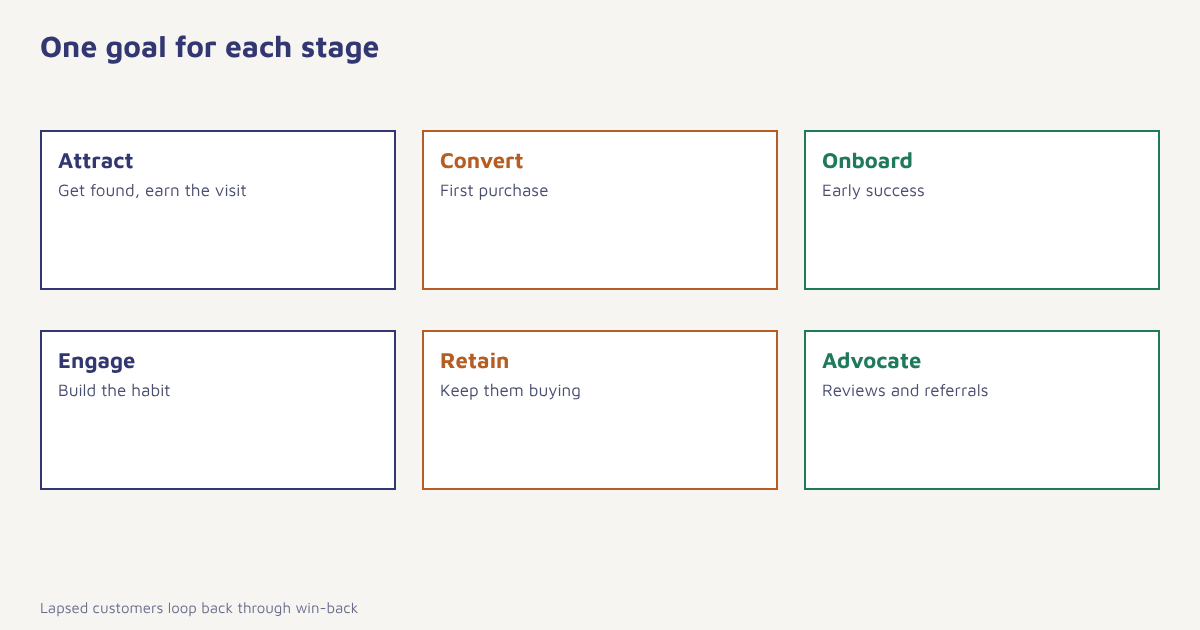
The stages and what each one needs
| Stage | Goal | Typical messages | Key signal |
|---|---|---|---|
| Attract | Get found and earn a first visit or sign-up | Content, ads, social, referral invitations | Visits, sign-ups |
| Convert | Turn interest into a first purchase | Welcome offer, product reviews, cart reminders | First order |
| Onboard | Help the new customer succeed early | Setup guides, usage tips, delivery updates | First use, activation |
| Engage | Build a habit and deepen the relationship | Recommendations, new arrivals, education | Repeat visits, clicks |
| Retain | Keep them buying and growing | Replenishment reminders, loyalty rewards, cross-sell | Repeat orders |
| Advocate | Turn happy customers into promoters | Review requests, referral programme, community | Reviews, referrals |
| Win back | Recover those slipping away | Check-ins, incentives, preference updates | Falling activity |
The names vary between businesses, and some use five stages while others use eight. What matters is that each stage has one clear goal and a signal in your data that tells you the customer has entered it.
Why lifecycle thinking pays
- Relevance. Messages match what the person needs now, which supports engagement and lowers unsubscribes.
- Retention. Most of the value sits after the first order. See customer retention rate and customer lifetime value.
- Efficiency. Automated stage journeys keep working without a manual campaign each week.
- Clarity. Teams share a common map of the customer, so product, support and marketing stop working at cross purposes.
Metrics to track at each stage
| Stage | Metrics | Where to learn more |
|---|---|---|
| Attract | Visitors, sign-ups, cost per lead | Lead generation strategies |
| Convert | Conversion rate, cart recovery rate | Conversion rate optimization |
| Onboard | Activation rate, time to first value | Customer onboarding |
| Engage | Active customers, click rate, sessions | Email marketing metrics |
| Retain | Repeat purchase rate, retention rate | Retention rate |
| Advocate | Reviews, referral rate, NPS | NPS, CSAT and CES |
| Win back | Reactivation rate, churn rate | Win-back campaigns |
How to build lifecycle journeys
- Define your stages. Keep to five to seven and write one sentence on the goal of each.
- Set the entry rule for each. Use data you hold. “New” may mean first order in the last 14 days. “At risk” may mean no order in twice the usual gap.
- Check your data. You need events for views, carts, orders and message responses on one profile. See the data model.
- Write the first message for each stage. One idea, one call to action, in the tone suited to the stage.
- Add a short sequence. Two to four messages with waits between them. See drip campaigns.
- Set exit and priority rules. A customer should leave a journey when the goal is met, and only one journey should own them at a time.
- Measure each stage against a holdout group. Hold back a small random share so you can see what the journey really adds.
In Flowfox, the segment builder places people into stages from live events, and journeys send the right message through email, WhatsApp, SMS or push within each person’s consent. The onboarding and retention use cases show complete flows, and the marketing automation guide covers the basics.
A worked example: an online tea shop
The following example is invented to show the method. An online tea shop with 25,000 customers maps six stages. New subscribers receive a short welcome series with a first-order offer. First-time buyers move to onboarding, where they get brewing guides and a reminder to rate the order a week after delivery. Customers with two or more orders join the engage stage and hear about seasonal harvests. Customers who bought a 250 g pack are due for replenishment at about week five, so a reminder goes out then. Customers who have not ordered in 90 days, which is roughly double their usual gap, enter win-back with a question about taste preferences before any discount.
| Stage | Entry rule | Message | Channel |
|---|---|---|---|
| Onboard | First order delivered | How to brew, ask for rating | Email, then WhatsApp |
| Engage | 2+ orders | Seasonal harvest stories | |
| Retain | 35 days since a 250 g pack | Reorder reminder with one-tap link | WhatsApp, email |
| Advocate | Rating of 5 | Invite to share a photo, referral code | |
| Win back | 90 days, no order | Preference check, then small incentive | Email, push |
Notice the discipline. Each stage has one rule, one message and a preferred channel. Customers who rate an order low are routed to support and removed from the advocate journey. And the win-back stage asks before it discounts, which protects margin and listens to the customer. Our behavioral segmentation and RFM analysis guides help you set thresholds like the 90-day gap with data instead of guesswork.
Choosing channels by stage
Different stages suit different channels. Email carries stories and guides well in the attract and engage stages. WhatsApp and SMS work for short, timely moments such as delivery updates and replenishment reminders, as long as the person has agreed to hear from you there. Push and in-app messages are strong during onboarding, when the person is already using the app. Compare the options in our guide to email, SMS and WhatsApp, and keep total frequency in check with a cap across all channels. A person in three journeys at once is a person about to unsubscribe, which is why priority rules matter as much as the messages.
Privacy belongs in the design too. Lifecycle marketing relies on tracking behaviour, so give clear notice, record consent per channel and let people change preferences. See the DPDP Act guide for India-specific points. For more reading on the underlying idea of staged relationships, the article on customer relationship management gives useful background.
Review the lifecycle every quarter
Customers and products change, so revisit your stages, entry rules and thresholds each quarter. Look at where people stall: if many customers enter onboarding but few reach a second order, the gap between stages is the place to work. Compare cohorts by month of first purchase to see whether newer customers move through the lifecycle faster or slower than older ones, a method explained in our cohort analysis guide. For wider background on how businesses think about customer value over time, see the overview of customer lifetime value, and share the stage map with support and product teams so that everyone speaks about customers in the same terms.
Common mistakes
- Stopping at the first sale. Retention and advocacy hold most of the value.
- Too many stages. If you cannot treat two stages differently, merge them.
- Fixed day counts for everyone. Use each customer’s own rhythm where you can.
- Overlapping journeys. Without priority rules, customers get duplicate messages.
- No holdout. You cannot prove the journey worked.
A calendar tells customers what you want to say. A lifecycle tells them you noticed where they are.
Send the right message at every stage. Place customers into stages from live behaviour and automate the journeys across channels.
Read next: customer retention strategies, churn prediction and the blog.
Frequently asked questions
What is customer lifecycle marketing?
Customer lifecycle marketing plans communication around the stages a customer passes through, from first awareness to loyalty or departure, sending each person what suits their current stage.
What are the stages of the customer lifecycle?
Common stages are attract, convert, onboard, engage, retain and advocate, with a win-back loop for customers who are slipping away. The names and number vary by business.
How is lifecycle marketing different from a marketing funnel?
A funnel ends at the sale. Lifecycle marketing continues after it, covering onboarding, repeat purchase, advocacy and win-back, where much of the long-term value sits.
What data do I need for lifecycle marketing?
You need events such as views, carts, orders and message responses linked to one customer profile, plus consent per channel, so that customers can be placed into stages automatically.
How many lifecycle stages should I use?
Five to seven is usually enough. Each stage should have a distinct goal, an entry rule from your data and a different message.
Which channels work best for lifecycle marketing?
It depends on the stage. Email suits stories and guides, WhatsApp and SMS suit short timely updates, and push or in-app messages suit onboarding, all within the customer’s consent.
How do I measure lifecycle marketing?
Track a metric per stage, such as activation rate, repeat purchase rate and reactivation rate, and compare against a holdout group that does not receive the journey.