Two customers can share the same age, city and income and still behave in completely opposite ways. One buys every month, opens every email and refers friends. The other signed up once and vanished. Behavioral segmentation groups people by what they do rather than who they are, which makes it the most practical kind of segmentation for digital businesses. This guide explains the idea, the behaviors worth using, ten segments you can build today, how to act on each and the data you need to get started.
What is behavioral segmentation?
Behavioral segmentation divides customers into groups based on actions: purchases, browsing, product use, message engagement, loyalty and responses to offers. It is one of the four classic bases of market segmentation, alongside demographic, geographic and psychographic. Its strength is that behavior is observed, not guessed, and it is available the moment someone interacts with your site, app or messages. It also predicts future action better than demographics, because past behavior is the best clue to what a person will do next.
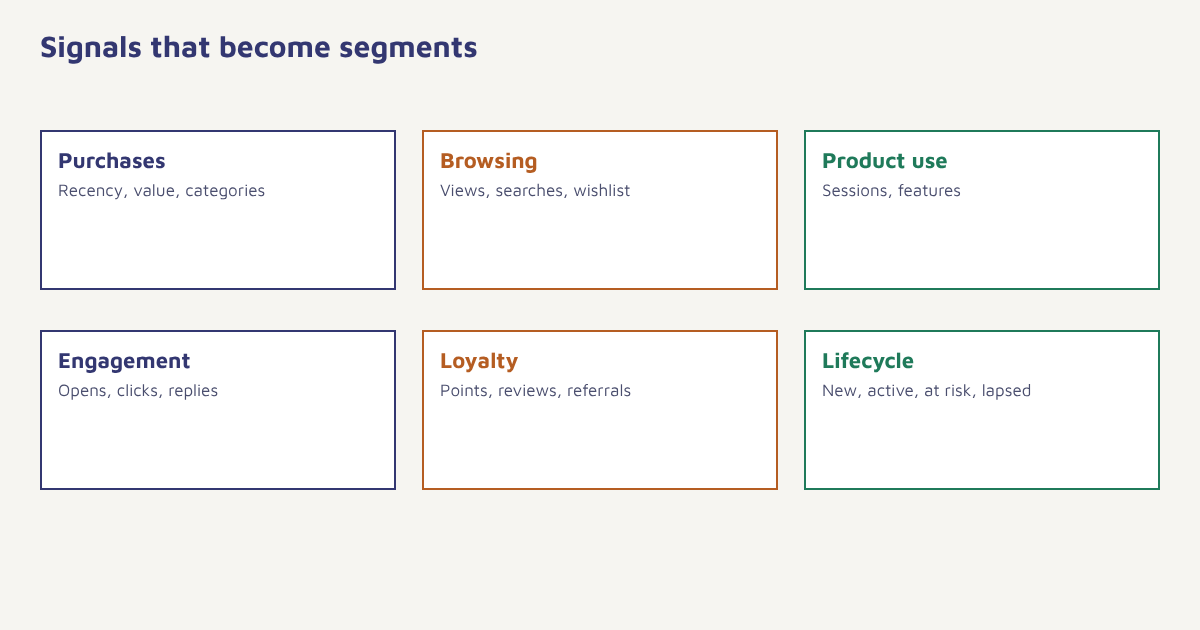
Behaviors you can segment on
| Signal | Examples | What it tells you |
|---|---|---|
| Purchase behavior | Order count, value, recency, categories, discounts used | Value and price sensitivity |
| Browsing behavior | Pages viewed, searches, time on page, wishlist adds | Interest and intent |
| Product usage | Features used, sessions per week, depth of use | Activation and risk of churn |
| Engagement | Opens, clicks, replies, push taps, channel preference | Which messages and channels work |
| Cart and checkout | Abandoned cart, payment failure | Purchase intent with friction |
| Loyalty and advocacy | Points, reviews, referrals | Your best customers |
| Lifecycle stage | New, active, at risk, lapsed | What message is due next |
Ten behavioral segments to build first
| Segment | Rule (example) | Message idea |
|---|---|---|
| New customers | First order in last 14 days | Welcome, how-to, ask for a review |
| Loyal buyers | 3 or more orders in 6 months | Early access, thank-you |
| Big spenders | Top 10% by order value | Premium range, personal service |
| Discount hunters | 80% of orders used a coupon | Sale alerts, bundles |
| Window shoppers | Viewed 3+ products, no purchase in 30 days | Reviews, social proof, small nudge |
| Cart abandoners | Added to cart, no order in 2 hours | Reminder with the cart. See cart recovery |
| Category fans | 3+ orders in one category | Related and new products in that category |
| At risk | No order in twice the usual gap | Check-in or small incentive |
| Lapsed | No activity in 180 days | Win-back. See win-back campaigns |
| Unengaged subscribers | No opens in 120 days | Re-permission, then suppress |
You can combine rules for sharper groups, for example “loyal buyers who have not ordered in 60 days”. Methods like RFM analysis and cohort analysis help you decide where to cut the lines instead of guessing.
Segment by channel behavior too
Behavior also tells you how to reach someone. A customer who always opens WhatsApp messages but never email should hear from you on WhatsApp, as long as they have consented. Someone who taps push notifications at lunchtime can be reached then. Our guides to choosing a channel and the best time to send email cover the details.
How to set up behavioral segmentation
- List your goals. Retention, repeat purchase, activation or reducing churn. Goals decide which behaviors matter.
- Check your data. Make sure the events you need are tracked: views, carts, orders, app actions, message responses. See the data model.
- Start with five segments. Pick from the table above, those closest to your goals.
- Write clear rules. Use fixed time windows and thresholds so everyone understands membership.
- Attach one action to each. A message, an offer or a suppression rule.
- Measure against a control. Hold back a small random group and compare results.
- Review monthly. Adjust thresholds as behavior and seasons change.
In Flowfox, the segment builder evaluates rules on events and attributes continuously, so people move in and out of segments as they act, and journeys respond immediately. Sector examples are on our ecommerce and fintech pages.
Dynamic vs static segments
| Type | How it works | Use when |
|---|---|---|
| Dynamic | Membership updates automatically as behavior changes | Triggers, ongoing journeys, always-on audiences |
| Static | A fixed list captured at one moment | One-off campaigns, analysis, exports |
Dynamic segments are the heart of behavioral marketing, since a customer who buys today should stop receiving the cart reminder tomorrow.
Privacy and good practice
Behavioral data is personal data, so tell people what you track, record consent, respect opt-outs and keep only what you need. See our guide to the DPDP Act and avoid targeting that feels intrusive, such as referring to private browsing in a message. Personalization works best when it feels helpful, as discussed in marketing personalization. For more on how the approach fits a wider strategy, read about the STP framework and consumer behavior.
A short worked example
Consider a fashion app with 40,000 customers. The team defines five behavioral segments: new buyers (first order in the last 14 days), loyal buyers (three or more orders in six months), window shoppers (viewed several products, no order in 30 days), at-risk customers (no order in 90 days when they usually order every 45) and lapsed customers (nothing in 180 days). Each gets one journey. New buyers receive a welcome series with styling tips and a review request. Loyal buyers get early access to new collections. Window shoppers get a gentle reminder with reviews and a size guide. At-risk customers hear from the brand with a small, time-limited incentive, and lapsed customers enter a win-back sequence with a clear opt-out.
The result is not just more messages but more relevant ones. Loyal buyers are no longer shown discount banners they do not need, which protects margin. Window shoppers get help with their hesitation rather than a hard sell. And because the at-risk rule is relative to each person’s own buying rhythm instead of a fixed number of days, a monthly buyer and a seasonal buyer are treated fairly. These figures and the brand are invented for illustration, but the approach is typical. A comparable idea is described under behavioral targeting, which applies similar signals to advertising; in your own messaging you have the advantage of first-party data and direct consent.
To keep the programme honest, measure each segment against a holdout group and track outcomes that matter: repeat purchase rate, revenue per recipient, unsubscribe rate and complaint rate. If a segment performs no better than the holdout, change the message or retire the segment. Behavioral segmentation is worth the effort only when it changes what you do, so end every segment definition with a sentence that starts “therefore we will…”. Related reading includes customer retention rate, growth rate and customer analytics.
Common mistakes
- Too many segments. If you cannot treat them differently, merge them.
- Fuzzy rules. Without time windows, membership becomes meaningless.
- Static lists that age. Use dynamic segments for ongoing programmes.
- Ignoring frequency. A high-value segment still needs limits on how often it is messaged.
- No control group. You cannot prove the segment made a difference.
Who a customer is tells you where to look. What they do tells you what to say.
Build segments from real behavior. Create live audiences from events and respond automatically.
Read next: customer segmentation, customer engagement and the blog.
Frequently asked questions
What is behavioral segmentation?
Behavioral segmentation groups customers by what they do, such as purchases, browsing, product use and message engagement, instead of who they are.
What are examples of behavioral segments?
New customers, loyal buyers, big spenders, discount hunters, window shoppers, cart abandoners, at-risk customers and lapsed customers.
How is behavioral segmentation different from demographic segmentation?
Demographic segmentation uses traits such as age and location. Behavioral segmentation uses observed actions, which usually predict future behavior better.
What data do I need for behavioral segmentation?
You need event data such as views, cart actions, orders, app activity and message responses, linked to a customer profile.
What is the difference between dynamic and static segments?
Dynamic segments update automatically as behavior changes. Static segments are fixed lists taken at one moment.
How many behavioral segments should I start with?
Start with about five that match your goals and attach a clear action to each, then add more as needed.
Is behavioral segmentation allowed under privacy law?
It can be, if you give clear notice, obtain consent where required, honour opt-outs and collect only what you need. Check current rules with your legal advisor.