Everyone wants the answer to one question: when should I send my email? Articles give confident times, such as Tuesday at 10 am, yet the truth is more modest. There is no universal best time, because it depends on who your subscribers are, what you are sending and where they live. What you can do is find your own best time with a small, honest test. This guide explains why general rules fall short, what usually works as a starting point, how to run the test, how to use send-time optimisation and how to plan around Indian festivals, salaries and time zones.
Why there is no universal best time
Studies of send times tend to disagree because the audiences, countries and goals differ. A bank sending salary-day reminders, a fashion store announcing a sale and a B2B newsletter all behave differently. Mid-morning on weekdays is often given as a safe starting point, and evenings or weekends can work well for consumer offers, but treat these as hypotheses. Your list is the only evidence that counts. Remember too that open rates are an imperfect signal, as discussed in our guide to email marketing metrics, so judge by clicks and revenue as well.
Sensible starting points
| Audience | Starting window to test | Reasoning |
|---|---|---|
| B2B professionals | Weekday mornings and early afternoons | Inboxes are checked during work hours |
| Consumers, retail | Weekday evenings, weekend late mornings | People browse in leisure time |
| Students | Late afternoon and evening | After classes |
| Finance and bills | Around salary and due dates | Intent is tied to the date |
| Food and delivery | Just before meal times | Decision moment |
| Travel | Evenings and weekends | Planning happens in free time |
Use these only to decide what to test first.
Read your own engagement heatmap
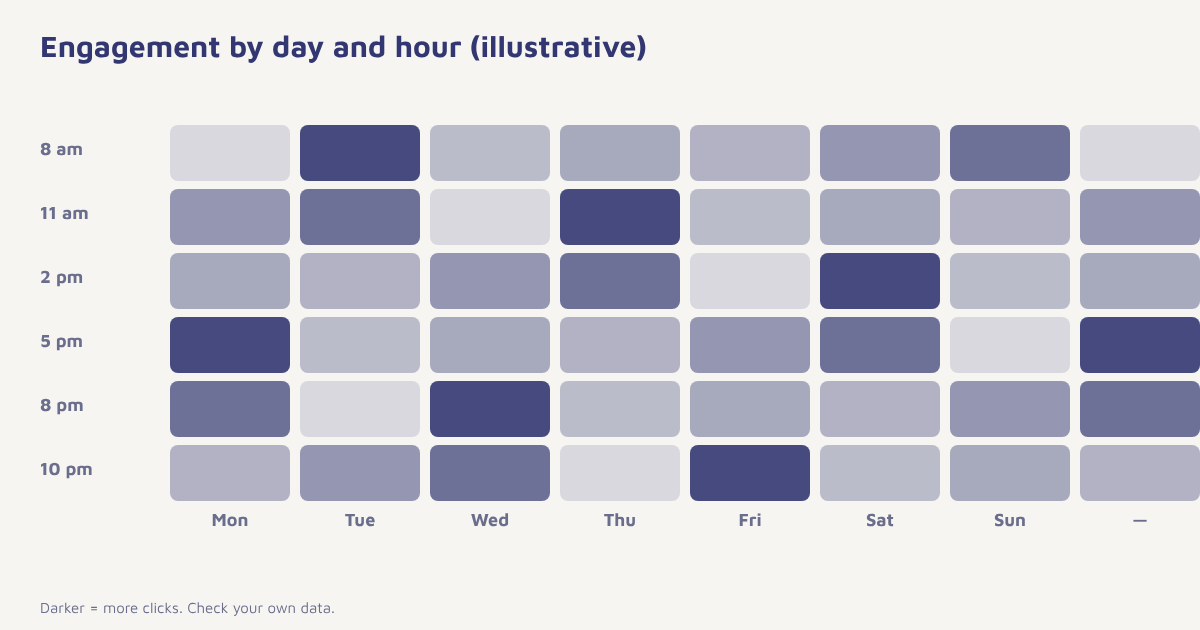
Export clicks (or conversions) by day of week and hour from your past campaigns, in your subscribers’ local time. Bright cells show when people actually act. Because clicks are less affected by privacy features that pre-load images, they are a steadier guide than opens. Check that you have enough sends in each cell, since a small sample can show a pattern that is only noise. In Flowfox, analytics lets you break campaign results down by send time, and the campaign scheduler lets you act on what you find.
How to find your best send time
- Pick one email type. A weekly newsletter or a promotional campaign, not everything at once.
- Choose 3 to 4 candidate windows. For example Tuesday 10 am, Thursday 7 pm, Saturday 11 am.
- Split the list at random. Equal groups of similar size and quality. See A/B testing.
- Keep everything else the same. Same subject, content and offer.
- Run it more than once. Repeat for several sends so a single odd day does not mislead you.
- Judge on clicks and revenue. Opens alone can be inflated by automated image loading.
- Adopt and recheck. Use the winner, then retest every quarter, since behaviour changes.
A good test needs a decent sample. If your list is small, test fewer windows and run the test for more weeks. The ideas behind this are the same as in any A/B test.
Send-time optimisation
Instead of one time for everyone, send-time optimisation sends each person their message at the hour they usually engage. It looks at each subscriber’s past opens and clicks and picks a personal window. It tends to help most for large lists with enough history per person, and least for new subscribers, who have no history yet. For them, use your overall best time as the default. Whatever method you use, keep a small control group on the standard time, so that you can prove the optimisation actually helps.
Indian context: festivals, salary days and time zones
| Factor | What to consider |
|---|---|
| Festivals | Demand peaks before Diwali, Eid, Christmas and regional festivals. Start earlier than you think. See festival marketing campaigns |
| Salary cycle | Many people spend more in the first week of the month |
| Exam and school calendars | Education brands should plan around results and admission dates |
| IPL and big events | Evening attention can shift to matches |
| Time zones | India has one, but overseas customers do not. Use the recipient’s local time |
| Language | Messages in regional languages may follow different reading habits |
Then think about frequency as well as time. Sending at a perfect hour does not help if you send too often. Read our guide to email newsletters for cadence advice, and to deliverability for why consistent sending patterns protect your reputation. If you send in bursts, large volumes at once can strain your sending reputation; spreading a large send over a few hours is sometimes kinder to both servers and your support team.
Other channels have their own rhythm
- SMS. Time-sensitive and personal. Avoid late nights and respect regulatory quiet hours. See SMS marketing.
- WhatsApp. Conversational, so reply windows matter. See WhatsApp broadcast.
- Push. Best when the person is likely to be active on their phone. See push notifications.
- Transactional messages. Send immediately, with no timing games. See transactional emails.
A worked example of a send-time test
A home-décor store with 60,000 subscribers wants to settle its weekly newsletter time. It picks four windows: Tuesday 10 am, Thursday 7 pm, Saturday 11 am and Sunday 8 pm. For four weeks in a row it splits a random sample of the list into four equal groups and sends the identical email in each window, rotating which group gets which window so that no group is always first. At the end it compares clicks per delivered email and orders per thousand emails. Thursday evening and Saturday late morning come out ahead on clicks, while Sunday evening gets many opens but few orders. The store adopts Thursday 7 pm as its default and keeps Saturday for big announcements. The numbers and store are invented to show the method.
Notice what the test avoided. It did not trust opens alone, which Sunday evening would have won. It did not rely on a single send, which could have been distorted by a holiday. And it did not change the content between groups. It also kept the other days in mind: the best window for a newsletter may be a poor one for a flash sale, where urgency matters more than habit, so test each message type separately when the volume allows. See the general principles of email marketing for background, and our guide to subject lines for the next thing to test.
Two practical details help. First, record each subscriber’s time zone or infer it from their location and sign-up data, so that scheduling in local time is possible. Second, avoid sending your largest campaigns exactly on the hour like everyone else does, since inboxes are busiest then; moving a send by fifteen minutes can reduce competition for attention. If you send to a very large list, stagger the delivery over a window so that your servers and your landing page are not hit all at once, a habit also described in our email warm-up guide. Time zones are covered in the reference on time zones. Finally, keep a simple log of the results of each test, with the date, the audience, the windows and the winner, so that the next person on the team does not repeat the same experiment from scratch.
Common mistakes
- Copying a published “best time”. It is someone else’s audience.
- Judging by opens only. Clicks and revenue are sturdier.
- Testing too many things at once. Change only the time.
- Ignoring time zones. Send in the recipient’s local time.
- Never retesting. Habits shift through the year.
The best time to send is when your readers are ready to act, and only your data can tell you when that is.
Schedule by what your data shows. Test send times, then automate the winners across email, WhatsApp and SMS.
Read next: email subject lines, email design and the blog.
Frequently asked questions
What is the best time to send an email?
There is no universal best time. Weekday mornings are a common starting point, but the right time depends on your audience, so test several windows and judge by clicks and revenue.
What is the best day to send marketing emails?
Weekdays such as Tuesday to Thursday are common starting points, but consumer brands often do well on evenings and weekends. Test with your own list.
How do I find the best send time for my list?
Split your list at random, send the same email at three or four different windows, repeat the test several times and compare clicks and conversions.
What is send-time optimisation?
Send-time optimisation sends each person your email at the time they usually engage, based on their individual history.
Should I send emails in the recipient’s time zone?
Yes, if your audience spans time zones. Scheduling in local time avoids messages arriving in the middle of the night.
Are open rates reliable for choosing send time?
Not entirely, because privacy features can pre-load images and inflate opens. Clicks and conversions are a more dependable guide.
How often should I retest send times?
About every quarter, and after big changes to your list or audience, since behaviour shifts over time.