People trust other people more than they trust brands. A customer photo wearing your jacket, a review that mentions the fast delivery or a video unboxing says things your own copy cannot. That is the appeal of user-generated content, or UGC. This guide explains what UGC is, the main types, why it works, how to collect it, how to ask permission properly, where to use it across email, WhatsApp, your website and ads, and how to measure the results without running into legal or reputational trouble.
What is user-generated content?
User-generated content is any content, such as text, images, video or reviews, created by customers or fans rather than by the brand itself. It differs from paid influencer work, where a creator is commissioned, though the two can overlap. The common thread is authenticity: the content comes from real use of the product, in the person’s own words and settings.
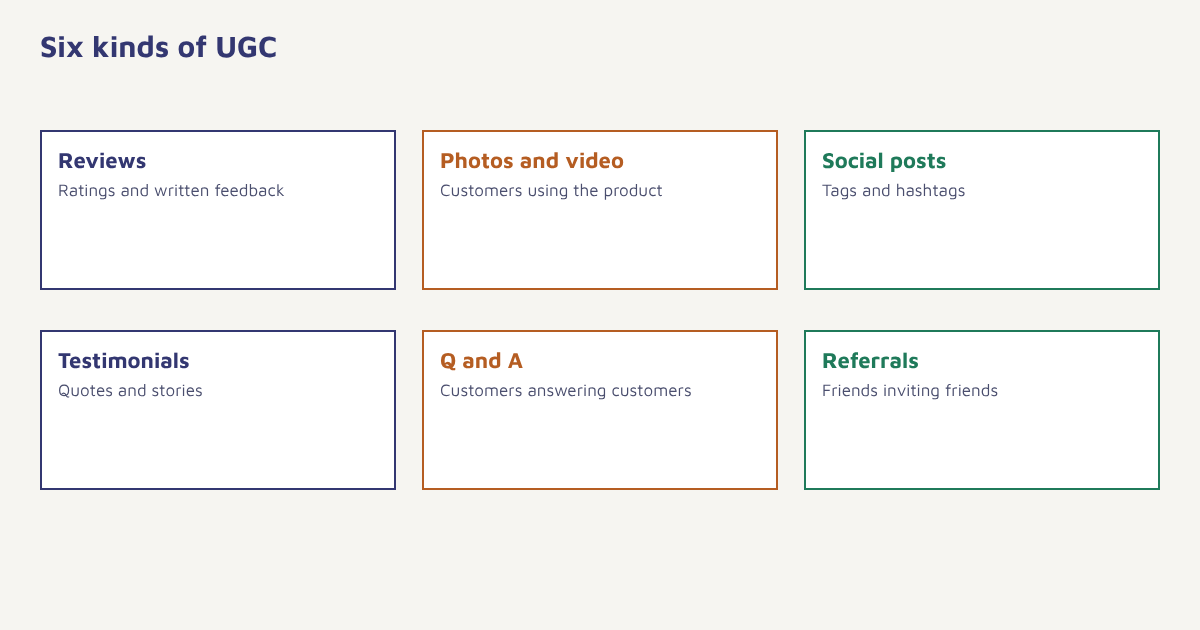
Types of UGC
| Type | Example | Best used in |
|---|---|---|
| Reviews and ratings | Star rating and written feedback | Product pages, email, ads |
| Photos and videos | Customer wearing or using the product | Social, product pages, campaigns |
| Social posts and tags | Mention with a brand hashtag | Social feeds, galleries |
| Testimonials and stories | A short quote or case story | Landing pages, sales emails |
| Questions and answers | Customers answering other customers | Product pages, support |
| Referrals and recommendations | Friend invites with a reward | Email, WhatsApp, app |
Why UGC works
- Trust. Shoppers look for proof from people like themselves before buying. This feeds the evaluation stage described in our guide to consumer behavior.
- Relevance. Real customers show the product in real situations and settings.
- Cost. It reduces the cost of producing fresh content.
- Conversion. Social proof can reduce hesitation at the product page and in checkout. See conversion rate optimization.
- Community. Featuring customers makes them feel valued, which supports engagement and loyalty.
How to collect UGC
- Ask at the right moment. After delivery or after the customer has used the product for a while, not at the moment of purchase.
- Make it easy. A one-tap rating, then an optional photo upload, from a link in email or WhatsApp.
- Give a reason. Explain how the content will be used, and offer a small thank-you that does not depend on a positive review.
- Create a hashtag or prompt. Give people a simple theme: “show us your morning routine”.
- Run a contest, carefully. Follow platform rules and local law on contests and disclosures.
- Respond. Thank people, answer questions and handle complaints in public with care.
In Flowfox you can trigger a review request a set number of days after an order is delivered, using a journey that checks the order event and the customer’s channel consent, and send it through email or WhatsApp. Skip customers with an open support issue, and follow up once, not repeatedly. See also our guide to NPS, CSAT and CES for feedback surveys.
Permission, rights and honesty
UGC belongs to its creator, so you need permission before you reuse it. A photo posted publicly is not automatically free to use in an advert. Ask clearly, in writing, for the specific use, such as your website, email and paid ads, and keep a record. Credit the creator where appropriate. Never edit reviews to change their meaning, hide negative ones to fake a perfect rating or write fake reviews yourself. Rules against misleading endorsements exist in many places, and in India the Consumer Protection Act, 2019 addresses unfair trade practices, so take advice for your own case. If you give an incentive, say so openly. Personal data in submissions, such as names and faces, is also covered by privacy law; read our guide to the DPDP Act for marketers.
| Do | Do not |
|---|---|
| Get written permission for each use | Reuse a post just because it is public |
| Show negative reviews along with positive ones | Delete criticism to inflate ratings |
| Disclose incentives | Hide that a review was rewarded |
| Credit creators | Crop out names or edit meaning |
| Moderate for harmful content | Publish anything that is submitted unchecked |
Where to use UGC
| Channel | How |
|---|---|
| Product pages | Ratings summary, photo gallery, customer Q&A |
| A “what customers say” block in newsletters. See email newsletters | |
| Cart and checkout | Short reviews near the buy button to reduce doubt |
| WhatsApp and SMS | A customer quote in a product message, within consent |
| Ads and social | Customer photos with permission |
| Onboarding | Stories from similar customers to help new ones succeed |
| Abandoned-cart reminders | Reviews of the items left behind. See cart recovery |
Measuring UGC
Measure what UGC changes, not how much of it you have. Compare conversion on product pages with and without reviews or photos, click rate on emails that include customer quotes against those that do not, the share of customers who submit content after a request, and revenue per visitor for people who interacted with UGC. Use A/B tests to isolate the effect, and watch quality as well as quantity: a few detailed, honest reviews often help more than many one-word ratings. In Flowfox, analytics can compare campaigns that include UGC with those that do not.
Finally, think of UGC as a conversation. Ask questions, feature stories that match your brand’s values and tell contributors when you use their content. The general idea of social proof is explained in the article on social proof, and it works best when it is real and specific. Pair it with other ideas from our guide to loyalty programs so that your best customers are recognised in more ways than one.
A worked example: a skincare brand
A small skincare brand wants more real photos and reviews. It sets up a journey that waits until 14 days after delivery, then sends a short email and a WhatsApp message to customers who opted in, asking for a one-tap rating. Customers who rate four or five stars are invited to add a photo and are told clearly how it may be used. Those who rate lower are routed to a support conversation instead of a public review request. After a few months the product pages carry dozens of genuine photos, the team has a library of permissioned images for emails, and support has caught several problems early. The brand and numbers are invented to illustrate the approach.
Notice the care in the design. The request waits long enough for the product to show results. It respects channel consent. It does not hide unhappy customers from the brand’s attention, even though it treats them differently in the request. Be careful, though, about steering only happy customers to public review sites, because some platforms and regulators treat selective solicitation as misleading. When in doubt, ask everyone the same question and publish what comes back. The practice of online reviews is widely studied, and honest, balanced feedback tends to build more trust than a flawless score that shoppers instinctively doubt.
Common mistakes
- Using content without permission. It risks legal trouble and trust.
- Asking too early or too often. Wait until the customer has used the product.
- Rewarding only positive reviews. It biases results and may break rules.
- Ignoring negative feedback. A thoughtful reply can win trust.
- Not moderating. Spam and abuse harm the brand.
Your best marketing copy may already be sitting in a customer’s message. Ask for it, and say thank you.
Ask for reviews at the right moment. Trigger review requests after delivery and follow up automatically.
Read next: retention strategies, email design and the blog.
Frequently asked questions
What is user-generated content?
User-generated content is text, images, video or reviews created by customers or fans rather than by the brand.
What are examples of user-generated content?
Product reviews, customer photos and videos, social posts with a brand hashtag, testimonials, and customer questions and answers.
Why is UGC effective in marketing?
It provides authentic social proof, reduces hesitation, is more relevant to shoppers and lowers content production costs.
Do I need permission to use customer content?
Yes. Get clear, written permission for each specific use, and keep a record. A public post is not automatically free to reuse.
How do I get more customer reviews?
Ask after delivery or successful use, make submission quick from email or WhatsApp, explain how it will be used and follow up once.
Can I offer rewards for reviews?
Many platforms and laws restrict this. If allowed, do not make rewards depend on positive feedback, and disclose incentives clearly.
How do I measure the impact of UGC?
Compare conversion, click rate and revenue per visitor with and without UGC, using A/B tests, and track how many customers submit content.