Customer engagement is one of those terms everyone uses and few define. Is it opens and clicks? App sessions? Reviews? The truth is that engagement is the ongoing relationship between a customer and your business, and it shows up differently in different places. This guide defines it in practical terms, shows how to measure it with a simple score, lists strategies that work across channels, and explains how to build an engagement programme without drowning customers in messages.
What is customer engagement?
Customer engagement is the sum of interactions between a customer and a brand across all touchpoints, and the emotional and practical connection that results. It includes visits, purchases, messages opened and answered, reviews, referrals, support conversations and use of a product. The point is not activity for its own sake. Engaged customers buy more often, stay longer, cost less to serve and recommend you, which makes engagement a leading indicator for retention and customer lifetime value.
The engagement loop
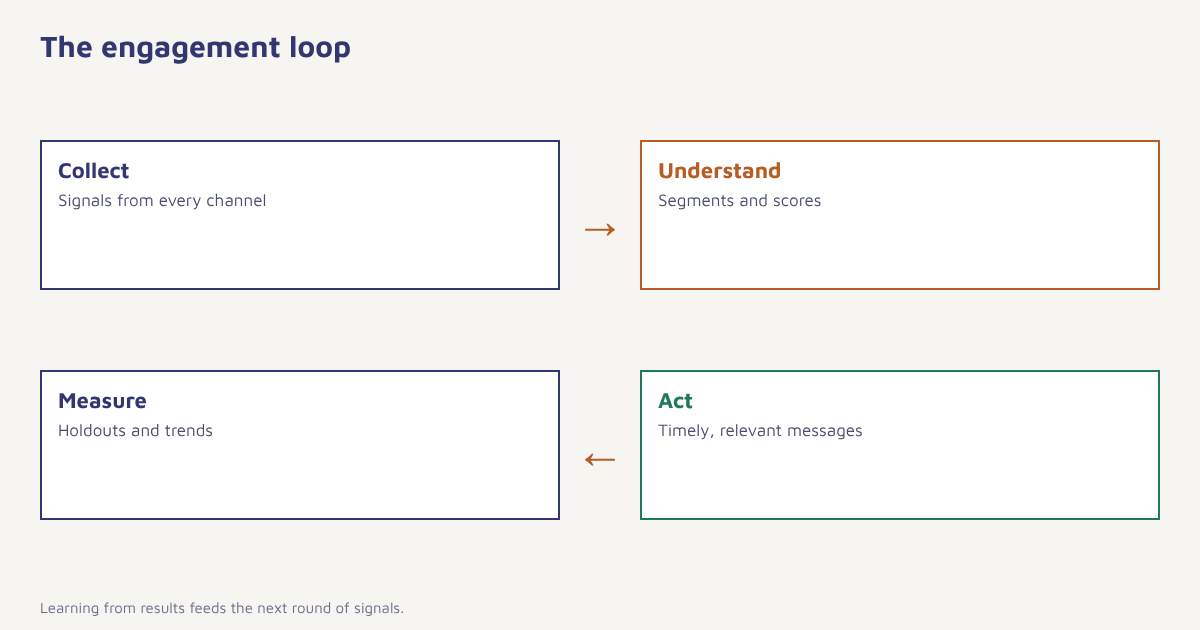
Think of engagement as a loop and not a campaign. You collect signals, such as purchases, visits and message responses. You make sense of them with segments and scores. You act with timely, relevant messages and experiences. You measure what happened, and you feed the result back. Platforms that keep all signals on one profile, as described in our guide to the customer data platform, make the loop much easier to run.
How to measure customer engagement
No single number captures engagement, and the right mix depends on your business. Choose three to five measures from different groups.
| Group | Examples | Source |
|---|---|---|
| Activity | Visits, sessions, logins, feature use | Web and app events |
| Commerce | Repeat purchase rate, order frequency, basket size | Orders |
| Messaging | Clicks, replies, conversions (opens only as a rough guide) | Email, WhatsApp, SMS, push |
| Advocacy | Reviews, referrals, NPS | Surveys and events. See NPS, CSAT and CES |
| Support | Contact rate, resolution time, satisfaction | Helpdesk |
| Retention | Churn, cohort retention | See cohort analysis |
A practical approach is an engagement score on the contact profile. Give points for recent, meaningful actions, such as a purchase in the last 30 days, a click this month or a login this week, and subtract for inactivity. Then group customers into bands such as highly engaged, active, cooling and dormant. The numbers are yours to tune, and they only need to be consistent. In Flowfox the contact profile can hold the score, and segments turn the bands into audiences.
{
  "engagement_score": {
    "purchase_last_30_days": 40,
    "app_session_last_7_days": 20,
    "email_click_last_30_days": 15,
    "reply_or_review_last_90_days": 15,
    "no_activity_60_days": -30
  },
  "bands": { "high": ">= 60", "active": "30-59", "cooling": "10-29", "dormant": "< 10" }
}
Strategies that raise engagement
- Welcome and onboard well. The first weeks set the habit. See customer onboarding.
- Personalise. Use behaviour and preferences, not just a first name. See marketing personalization.
- Meet customers on their channel. Mix email, WhatsApp, SMS and push, with consent. See omnichannel marketing.
- Send useful content. Tips, guides and updates that help, not only offers.
- Reward loyalty. Recognition and perks. See loyalty programs.
- Ask and listen. Surveys and replies show what people want.
- Fix what frustrates. Fast, helpful support is engagement too.
- Win back the quiet ones. See win-back campaigns.
Engagement by channel
| Channel | Strength | Use it for |
|---|---|---|
| Depth and low cost | Newsletters, guides, receipts, lifecycle series | |
| Conversation and high attention | Order updates, support, personal offers | |
| SMS | Reach and speed | Time-sensitive alerts and codes |
| Push and in-app | Context inside the product | Nudges, feature tips, reminders |
| Web and on-site | Browsing intent | Recommendations and banners |
See the pages on email, WhatsApp, SMS, push and in-app messaging for what each can do in Flowfox. The best choice usually depends on what a customer has responded to before, and a journey can try one channel first and fall back to another.
Fewer, better messages. Engagement is not the same as volume. A frequency cap and a quiet-hours rule protect the relationship, and customers who feel respected stay subscribed longer.
How to build an engagement programme
- Define engagement for your business. Pick the two or three behaviours that show a healthy customer.
- Unify the data. Bring web, app, store and messaging events onto one profile. See the data model.
- Score and segment. Create bands from recent behaviour.
- Map the lifecycle. New, active, loyal, cooling and dormant, with a goal for each stage.
- Create a journey per stage. Onboarding for new customers, recognition for loyal ones, win-back for cooling ones.
- Set guardrails. Frequency caps, quiet hours and consent checks across all channels.
- Measure and test. Use holdouts and A/B tests. See A/B testing.
- Review monthly. Look at band movement: who is moving up, who is slipping.
A simple example
A fitness app has 50,000 users. It defines engagement as at least two workouts a week. Users with four or more are “high”, one or two are “active”, and none in 14 days are “cooling”. New users get a seven-day onboarding series. Active users get weekly goal reminders and an occasional challenge. Cooling users get a friendly check-in and a short, easy workout suggestion by push, then an email, then a WhatsApp message if they agreed to it. High users get early access to new programmes and are asked for a review. After a quarter the team compares the share of users in each band and the share of cooling users who return within 14 days, with a 10 percent holdout. The numbers here are invented to show the structure, but the method is the one most teams use.
Pitfalls to avoid
Engagement metrics can be gamed. A push notification that invites people to open the app generates sessions without value, and a clickbait subject line raises opens at the cost of trust. Watch for Goodhart’s law: when a measure becomes a target, it stops being a good measure. Tie engagement to outcomes such as repeat purchase, retention and satisfaction, and keep an eye on unsubscribes and complaints as the counterweight. Also remember privacy: collect only what you use, record consent and give people control, as described in the guide to the customer data platform.
Data and tools you need
You do not need a large technology stack to start. You need a single customer identifier, events from your website, app and store, consent status per channel and a tool that can build segments and run journeys. A CRM usually holds sales and service history, while an engagement platform joins it with behaviour and messaging. If your data lives in many places, start with the two sources that matter most, usually orders and messaging responses, and add the rest later. The practical test of a good setup is simple: can a marketer, without asking an engineer, build an audience such as customers who bought in the last 60 days, clicked an email this month and have not opened the app in two weeks, and send them a message on the channel they prefer?
Common mistakes
- Equating engagement with opens. Opens are a weak and noisy signal.
- Messaging everyone the same. Bands exist so that messages can differ.
- Ignoring the quiet customers. Cooling is the cheapest time to act.
- Too many messages. Over-contact drives unsubscribes.
- Measuring without acting. A score nobody uses is just a number.
Engagement is not how often you speak. It is how often customers have a reason to answer.
Turn signals into relationships. Score engagement, segment by band and run a journey for every stage.
Continue with email marketing metrics and lead nurturing, and browse the blog.
Frequently asked questions
What is customer engagement?
Customer engagement is the ongoing interaction and connection between a customer and a brand across all touchpoints, including visits, purchases, messages, reviews, referrals and support.
How do you measure customer engagement?
Combine measures from different groups, such as activity, repeat purchases, message clicks and replies, advocacy such as NPS and reviews, and retention. A simple engagement score on the customer profile helps.
What is a good customer engagement strategy?
Welcome and onboard well, personalise using behaviour, meet customers on their preferred channels, send useful content, reward loyalty, ask for feedback and win back quiet customers.
What is the difference between customer engagement and customer experience?
Customer experience is how customers perceive all their interactions with you. Customer engagement is the ongoing interaction and relationship, which experience influences.
How often should I contact customers?
There is no fixed number. Use frequency caps and quiet hours, vary by segment and watch unsubscribes and complaints as signs that you are sending too much.
Which channels are best for customer engagement?
It depends on the customer. Email suits depth, WhatsApp and SMS suit immediacy, and push and in-app messages work for app users. Use consent and past response to choose.
Is open rate a good engagement metric?
Not on its own. Privacy features inflate opens, so rely more on clicks, replies, purchases and retention.