A customer adds a jacket to the cart on their phone, gets a WhatsApp reminder, opens your email on a laptop, asks a question in the web chat and finally buys in the app. If your systems treat each of those as a separate person, the customer gets duplicate messages, repeated questions and a discount for something they have already bought. Omnichannel marketing is the approach that stops this by treating every channel as part of one conversation. This guide explains what it is, how it differs from multichannel, the building blocks you need, a worked example and how to start without rebuilding everything.
What is omnichannel marketing?
Omnichannel marketing is a strategy that connects all the places a customer meets your brand (email, SMS, WhatsApp, push, web, app, store, support) into a single, consistent experience built around one customer profile. The test is simple: does what the customer did on one channel change what happens on the others? If they bought in store, the abandoned cart email stops. If they asked for help on chat, the promotional push waits.
Omnichannel vs multichannel
| Multichannel | Omnichannel | |
|---|---|---|
| Focus | Being present on many channels | Connecting channels around the customer |
| Data | Separate per channel | One unified profile |
| Messaging | Each channel runs its own campaigns | Channels coordinate through shared rules |
| Customer experience | Repeated or conflicting messages | Consistent and context-aware |
| Measurement | Channel by channel | Across the whole journey |
| Typical sign | Three tools, three customer lists | One platform, one profile |
Many companies are multichannel by accident. They added channels one at a time, and each came with its own tool and list. Omnichannel is the work of tying those together.
The building blocks
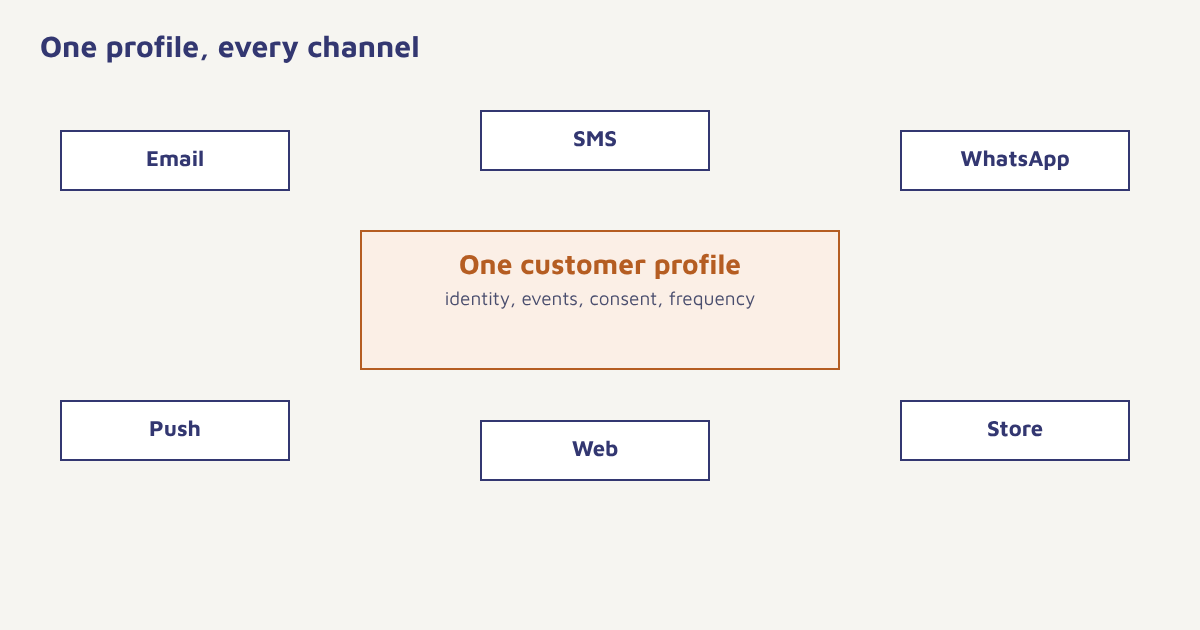
- A unified customer profile. One record per person, merging identifiers such as email, phone number and device ID. See our guide to the data model.
- Event tracking everywhere. Site, app, store and support events flow into the same place. See sending events.
- Shared consent. Permission for each channel stored on the profile and respected by every journey.
- Orchestration. Rules that decide which message goes on which channel and when. This is what journeys do.
- Frequency and quiet hours across channels. One cap per person, not one per channel.
- Unified measurement. Results attributed across channels, not siloed.
A worked example: abandoned cart across channels
- Event arrives. The customer adds an item and leaves. The store sends
cart_updatedand the profile updates. - Check status and consent. The journey checks that no purchase has happened and which channels the customer allows.
- Pick the channel. WhatsApp if opted in and active there. Otherwise email. Otherwise a push if the app is installed.
- Wait and re-check. After a day, if no purchase, send an email with delivery details and reviews.
- Stop on any purchase. A purchase in store, app or web ends the journey, and the post-purchase journey begins.
- Record the outcome. Which message influenced the sale is stored for reporting.
The full structure of this flow is described in our abandoned cart recovery guide.
Benefits
- Fewer irritating messages. No duplicates, no reminders for things already done.
- Higher conversion. Messages follow behaviour wherever it happens.
- Better use of budget. Spend on paid channels such as SMS and WhatsApp only where cheaper channels fail.
- A complete view of the customer. Sales, marketing and support see the same history.
Roles for each channel
| Channel | Strength | Typical role in the mix |
|---|---|---|
| Detail and low cost | Education, receipts, newsletters | |
| SMS | Reach and urgency | OTPs, alerts, last reminder |
| Personal conversation and rich media | Updates, support, offers to opted-in customers | |
| Push and in-app | Real-time for app users | Time-sensitive nudges, feature education |
| Web messaging | Engagement while browsing | Questions, lead capture |
| RCS | Rich, verified, no app | Rich cards with SMS fallback |
Our channel guides cover each one in detail: email, SMS, WhatsApp, push and RCS.
How to start omnichannel marketing, step by step
- Audit what you have. List every channel, tool and customer list. Note where the same person appears more than once.
- Pick the identity key. Decide how you will match people: email, phone number or customer ID, and clean the data.
- Unify events and consent. Bring the key events and the permission status into one platform.
- Start with one cross-channel journey. Cart recovery or onboarding are good first choices.
- Set global frequency rules. One weekly cap per person across channels, with quiet hours.
- Measure at journey level. Compare conversion and revenue for the whole journey, not each message alone.
- Expand step by step. Add channels and use cases as results justify.
Start small. Omnichannel does not need a giant replatforming project. A single cross-channel journey with one profile and shared consent already delivers most of the benefit, and shows where data needs cleaning.
Metrics
| Metric | Why it matters |
|---|---|
| Conversion by journey | Shows the combined effect of channels |
| Revenue per customer across channels | Highlights the value of multi-channel customers |
| Duplicate message rate | Shows how well channels coordinate |
| Opt-out rate per channel | Warns of over-messaging |
| Channel fallback rate | How often the first choice failed and another channel took over |
Omnichannel in Flowfox
Flowfox was built around one profile per customer. Events from your site, app and store update it through FlowConnect and the API, contacts hold identifiers and consent, segments build audiences across channels, and journeys choose the channel per step with fallbacks. See the channels overview for what each channel supports and the platform overview for how the pieces fit.
Identity: the hard part nobody mentions
Everything above depends on recognising the same person across channels. In practice a customer may appear as an email address in your newsletter tool, a phone number in your SMS list and an anonymous device in your app. Linking them is called identity resolution. Start with deterministic matches, where two records share an identifier such as the same email or phone number, and be cautious with guesses. Decide which identifier wins when records conflict, keep a log of merges so you can undo mistakes, and never merge two people because they share a household device. A clean identity layer is what makes a customer data platform or a unified marketing profile useful, and it is the single biggest reason omnichannel projects succeed or stall.
Bringing offline into the picture
Stores, events and call centres matter too. Capture a phone number or email at the till with consent, send the order as an event, and the same rules apply: a customer who buys in a shop should not receive an online abandoned cart reminder for that item. Even a simple import of store purchases each night is a useful first step toward a better customer experience. The difference between multichannel and omnichannel often comes down to whether offline data reaches the profile at all.
What to look for in tools
- One profile that all channels read and write.
- Cross-channel journeys with fallbacks.
- Consent and frequency rules applied globally.
- Reporting that follows a customer across channels.
Common mistakes
- Buying more tools. More channels without a shared profile deepens the silo problem.
- Ignoring identity. If you cannot match the same person, you cannot coordinate.
- Treating every channel the same. Each has its own strengths, rules and costs.
- Skipping consent. Orchestration must respect per-channel permission.
- Measuring last click only. It undervalues channels that help early.
Omnichannel is not about being everywhere. It is about being coherent wherever the customer happens to be.
Connect every channel to one customer view. Orchestrate email, SMS, WhatsApp, push and RCS from a single profile.
Keep going with marketing automation, segmentation and personalization, and browse the blog for more.
Frequently asked questions
What is omnichannel marketing?
Omnichannel marketing connects all customer touchpoints, such as email, SMS, WhatsApp, push, web and store, around one customer profile so the experience is consistent and context-aware across channels.
What is the difference between omnichannel and multichannel marketing?
Multichannel means being present on many channels, often managed separately. Omnichannel connects those channels using shared data and rules so they work together around the customer.
What do I need for omnichannel marketing?
A unified customer profile, event tracking across channels, shared consent records, orchestration rules, cross-channel frequency limits and unified measurement.
Is omnichannel marketing only for large companies?
No. A small business can start with one cross-channel journey, such as cart recovery, using a platform that keeps one profile and connects email, SMS and WhatsApp.
What are examples of omnichannel marketing?
Stopping an abandoned cart reminder when the customer buys in store, sending a push when an email is not opened, or routing a support chat history into the next marketing message.
How do I measure omnichannel marketing?
Measure conversion and revenue at journey level, revenue per customer across channels, duplicate message rate, opt-out rate per channel and how often fallbacks are used.
Does omnichannel marketing need a customer data platform?
You need a unified profile and event data. A marketing platform with built-in profiles can provide this, or you can use a separate customer data platform feeding it.