Most people know the plain grey text bubble. RCS, short for Rich Communication Services, is the upgrade that lets the same default messaging app behave more like WhatsApp: images, carousels, buttons, read receipts and a verified brand name, all without installing anything. For businesses it promises SMS reach with app-like richness. This guide explains what RCS is, how it differs from SMS and WhatsApp, what a business RCS message can contain, how sending works, and where it still falls short, so you can decide whether it belongs in your mix.
What is RCS messaging?
Rich Communication Services (RCS) is a messaging standard defined by the mobile industry body GSMA, intended as a successor to SMS and MMS. Messages travel over mobile data or Wi-Fi rather than the old signalling channel, so they can carry high-resolution media, typing indicators, delivery and read receipts, and group chats. Google drives most of the Android rollout through the Messages app, and it acts as an RCS hub for many carriers. Apple added support for RCS in the iPhone Messages app with iOS 18, which widened reach for person-to-person messaging.
For brands there is a separate product, usually called RCS Business Messaging. It lets a verified business send rich cards, carousels and quick-reply buttons to customers whose phone and carrier support it, and it replaces the unknown number with your logo and name.
RCS vs SMS vs WhatsApp
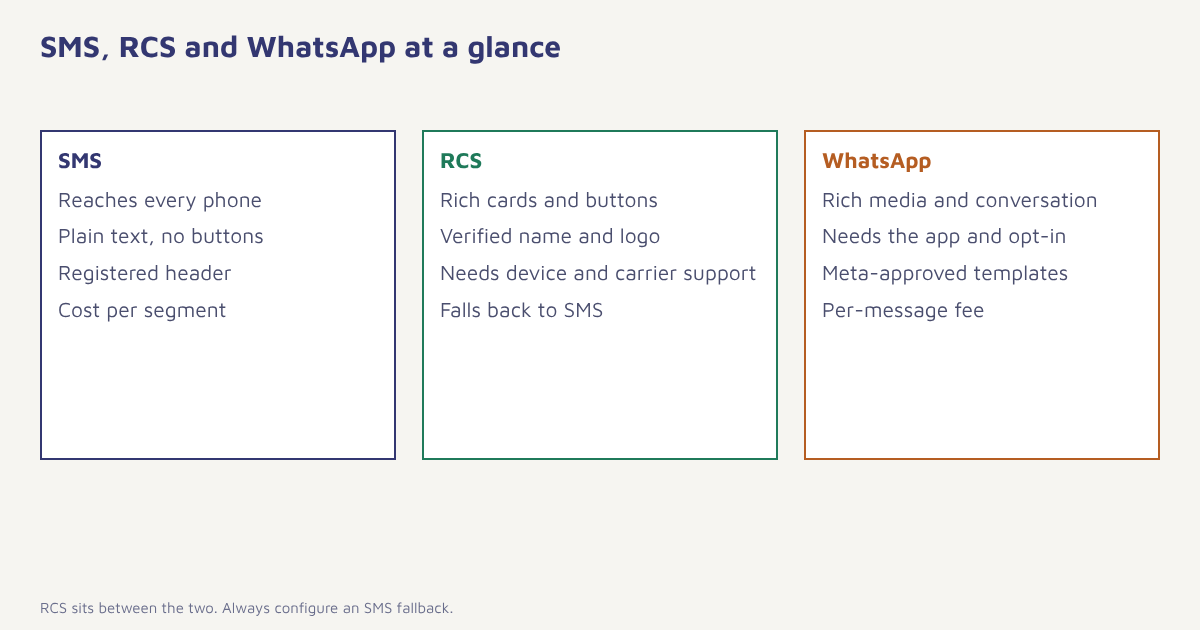
| SMS | RCS | ||
|---|---|---|---|
| Reaches | Every phone | RCS-capable phones and carriers | People with the app and an opt-in |
| Rich media and buttons | No | Yes | Yes |
| Verified brand sender | Registered header only | Verified name and logo | Verified business account |
| Needs a separate app | No | No, uses default messaging app | Yes |
| Fallback if not supported | Not needed | Falls back to SMS | No fallback |
| Approval setup | DLT in India | Brand verification with the RCS provider | Meta business verification and templates |
The practical difference is reach versus richness. SMS reaches everyone but looks plain. WhatsApp is rich but needs the person to use it and opt in. RCS lives in the default app, so there is nothing to install, but a message only arrives as RCS when the handset and the network both support it. When it does not, a good platform falls back to SMS automatically.
What an RCS business message can contain
| Format | What it is | Good for |
|---|---|---|
| Text with suggested replies | Message plus tap-to-answer chips | Quick surveys, confirmations |
| Rich card | Image, title, description and buttons | Offers, product highlights |
| Carousel | Several swipeable rich cards | Catalogues, collections |
| Suggested actions | Open a URL, dial a number, share a location, add a calendar event | Booking, directions, support |
| Verified sender | Brand name, logo and verification badge | Trust and recognition |
| Read and delivery receipts | Confirmation the message was seen | Measuring engagement |
The verified sender is a major draw. Many people ignore messages from unknown six-digit headers, but a recognised logo and brand name builds trust, which matters for payment reminders and banking alerts.
Where RCS makes sense
- Retail and ecommerce: a carousel of new arrivals with a “Shop now” button beats a long link in an SMS.
- Travel: boarding passes, itinerary changes and check-in reminders with action buttons.
- Banking and fintech: verified alerts that reduce fear of phishing.
- Healthcare: appointment reminders with “Confirm” and “Reschedule” buttons.
- Delivery: tracking and delivery slot selection inside the thread.
See how these play out in our ecommerce, travel, fintech and healthcare solutions.
Limitations to plan for
- Uneven reach. Coverage depends on device, messaging app version and carrier. Check the current status for your audience and country before committing a budget.
- Brand verification takes time. You must be approved as a sender, and the process involves documents and review.
- Iphone business messaging. Apple’s RCS support began with person-to-person chats, and business features depend on Apple and the carriers. Confirm the current position before assuming iPhone reach.
- Different pricing. Providers typically charge per message, and rates differ by country and message type.
Always set an SMS fallback. Because not every recipient can receive RCS, route the same message to SMS when RCS is unavailable. In India, that fallback needs a DLT-registered header and template, which our SMS marketing guide explains.
How to send RCS messages, step by step
- Choose a provider. RCS business messages are sent through a Google-approved partner or a platform that already connects to one. Ask about country coverage and fallback behaviour.
- Create and verify your agent. An agent is your branded sender. Submit your business details, logo, brand colours and a privacy policy. Verification can take days to weeks.
- Design your message types. Build card and carousel templates with images sized for the format and short, clear button labels.
- Capture consent. Treat RCS like any marketing channel: record permission, include an opt-out and respect local rules.
- Configure SMS fallback. Map each RCS message to an equivalent SMS template so delivery does not depend on device support.
- Send a pilot. Test on several Android versions and carriers before a large campaign.
- Measure. Compare delivery, read, tap and conversion rates against your SMS and WhatsApp baselines.
In Flowfox, the RCS channel sits next to SMS and WhatsApp, so a journey can try RCS first, fall back to SMS and add a WhatsApp follow-up, while segments keep the audience consented. Analytics lets you compare channels on conversions, not just delivery.
{
  "channel": "rcs",
  "to": "91XXXXXXXXXX",
  "agent": "flowfox-demo",
  "message": {
    "carousel": [
      { "title": "Trail Runner", "description": "Lightweight. Free delivery.",
        "media": "https://cdn.example.com/rcs/trail-runner.jpg",
        "actions": [{ "type": "url", "label": "Shop now", "value": "https://shop.example.com/p/tr-07" }] }
    ]
  },
  "fallback": { "channel": "sms", "template": "offer_sms_v2" }
}
The sketch above shows the idea: one logical message, a rich primary version and a plain fallback. The field names are illustrative and the exact format depends on your provider.
How to measure RCS
| Metric | What it tells you |
|---|---|
| RCS reach | Share of your audience that actually received RCS rather than fallback |
| Read rate | Share who opened the message (receipts only work on RCS) |
| Tap rate | Share who pressed a button or card |
| Conversion rate | Orders or bookings from taps |
| Cost per conversion | Total send cost divided by conversions, compared with SMS and WhatsApp |
RCS in India and other markets
RCS availability is a market-by-market story. Google runs the RCS service on Android in many countries, and carriers in some markets run their own or join a shared hub. Business messaging rules also differ: some countries treat RCS marketing like SMS and expect registered templates or consent records, others rely on the provider’s agent verification. In India, check how your telecom operators and your provider handle RCS business traffic, and ask whether you also need DLT entries for the SMS fallback. Google publishes the technical side in its RCS Business Messaging documentation, and the industry body GSMA maintains the standard itself.
Thinking about cost
RCS is usually priced per message, and richer formats can cost more than a plain text. Do not decide on the headline price alone. Work out cost per conversion instead: take what you pay for a campaign, divide by the orders or bookings it produces, and compare the result with SMS and WhatsApp on the same audience. A carousel that doubles click-through can be cheaper per sale even if each message costs more. Run a small test with a holdout group, as described in our A/B testing guide, and keep the SMS fallback in both arms so the comparison is fair.
| Question | How to answer it |
|---|---|
| What share of my audience can receive RCS? | Send a pilot and read the RCS versus fallback split in the report |
| Does rich content lift conversion? | Test a card against the same offer as plain SMS |
| Is it worth the setup effort? | Compare incremental orders with verification and design time |
Common mistakes
- Skipping the fallback. Customers without RCS get nothing.
- Overloading cards. One image, a short title and one or two buttons work best.
- Ignoring consent. Rich messages do not exempt you from permission rules.
- Judging by delivery alone. Compare read and conversion rates between channels.
- Waiting for perfection. Start with a small, high-value flow such as order updates.
RCS is not a replacement for SMS or WhatsApp. It is another rung on the ladder, and the fallback is what makes it safe to use.
Try RCS with an SMS safety net. Combine RCS, SMS and WhatsApp in one journey and compare results by channel.
If you are comparing channels, read about WhatsApp marketing and omnichannel marketing, and browse more guides on the blog.
Frequently asked questions
What is RCS messaging?
RCS, or Rich Communication Services, is a messaging standard that upgrades SMS with images, carousels, buttons, read receipts and verified business senders, delivered through the phone’s default messaging app over mobile data or Wi-Fi.
What is the difference between RCS and SMS?
SMS sends plain text and works on every phone. RCS supports rich media, buttons, typing indicators and read receipts, but only reaches phones and networks that support it, so it needs an SMS fallback.
Is RCS better than WhatsApp?
Neither is better for every case. WhatsApp has wider app-level reach among its users and rich features but requires the app and opt-in. RCS needs no app and uses the default messaging app, but depends on device and carrier support.
Do customers need an app for RCS?
No. RCS messages arrive in the default messaging app on supported phones, such as Google Messages on Android and Messages on newer iPhones.
What is RCS Business Messaging?
It is the business version of RCS, where a verified brand sends rich cards, carousels and suggested replies from a branded sender with a logo and name.
Does RCS work on iPhone?
Apple added RCS support to the iPhone Messages app with iOS 18, starting with person-to-person messages. Business messaging support depends on Apple and carriers, so check the current status for your market.
How much does RCS messaging cost?
Providers usually charge per message, and the price varies by country, message type and volume. Compare quotes against your SMS and WhatsApp cost per conversion.