SMS is still the channel that reaches almost every phone in India, with no app to install and no data connection needed. That reach is also why it is tightly regulated. If you are searching for SMS marketing, you probably want to know what it is, what it costs, whether it still works next to WhatsApp, and what you must register before the first message goes out. This guide covers all of that, with the Indian rules (DLT) explained step by step and a set of message examples you can adapt.
What is SMS marketing?
SMS marketing means sending promotional or informational text messages to people who agreed to receive them. A short message is limited to 160 characters in the basic GSM alphabet, or 70 when it contains non-Latin characters such as Hindi, which is why longer texts are billed as multiple segments. Businesses use it for offers, order updates, payment reminders, appointment alerts and one-time passwords.
It sits in two broad groups. Transactional and service messages are triggered by something the customer did: an OTP, a booking confirmation, a delivery update. Promotional messages are marketing: a sale, a launch, a reactivation offer. The two are routed, priced and regulated differently, and mixing them up is the commonest reason an Indian sender gets messages blocked.
Why SMS still works
- Near-universal reach. It works on feature phones and smartphones, in cities and in places with weak data.
- Fast attention. Messages are typically seen within minutes, which suits time-limited offers and alerts.
- No app or opt-in to a platform. You need a phone number and permission, not a social account.
- Simple to measure. Delivery reports, link clicks and conversions are easy to attribute.
The weakness is richness. You cannot send a catalogue or a button, and each message costs money. That is why most teams pair SMS with WhatsApp and email rather than choosing one.
SMS marketing rules in India: DLT in plain English
The Telecom Regulatory Authority of India (TRAI) (background) requires every business sender to register on the Distributed Ledger Technology (DLT) platforms run by the telecom operators. The aim is to block spam and make every message traceable to a registered sender and an approved template. Registration happens once per business and has four parts.
- Register your entity. On any operator’s DLT portal (Jio, Airtel, Vi, BSNL and others), create an account as a principal entity with your PAN, company details and an authorised signatory. You receive a principal entity ID (PE ID).
- Register your header (sender ID). The header is the six-character name customers see, for example FLWFOX. Promotional and transactional headers are separate, and you pick them to match your use.
- Register content templates. Each message type needs an approved template with variables marked, for example “Your order {#var#} has shipped”. A message that does not match an approved template is rejected.
- Record consent. Keep proof of when and where each person agreed to receive messages. Operators now let you register consent templates and, for promotional traffic, check the customer’s preferences.
- Connect through a registered sender. Your SMS provider maps your PE ID, headers and template IDs to its routes. After that, every message carries the template ID.
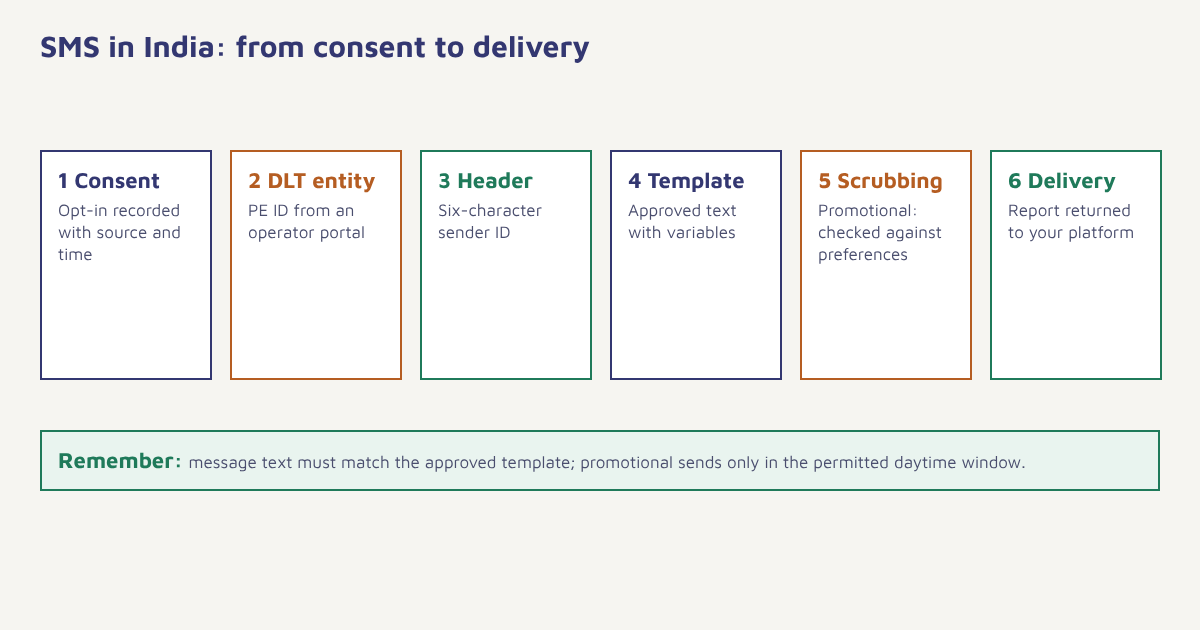
Rules that catch people out. Promotional messages can only be sent in a permitted daytime window (currently 9 am to 9 pm), links in a message generally need to be registered and whitelisted, and content must match the approved template word for word apart from variables. Check the current TRAI directions before you launch, because they have changed several times.
Our guide to DLT registration in Flowfox walks through each form, and DLT and Meta approvals covers how this fits with WhatsApp template approval.
Promotional vs transactional vs service SMS
| Promotional | Transactional | Service | |
|---|---|---|---|
| Purpose | Marketing: offers, launches, win-back | Customer-triggered: OTP, order, payment | Account information and alerts |
| Consent needed | Explicit opt-in; checked against preferences | Implied by the customer action | Registered consent or existing relationship |
| Sending hours | Daytime window only | Any time | Any time |
| Sender ID | Promotional header | Transactional header | Service header |
| Cost | Usually the lowest per message | Usually higher, priority route | Between the two |
| Example | Flat 20% off this weekend | Your OTP is 482913 | Your EMI is due on 5 Nov |
Do not disguise a promotion as a transactional message. If an order confirmation also advertises a sale, operators can reclassify it, and repeated violations can cost you your header.
SMS marketing examples that work
Good SMS copy is short, says who is writing, gives one reason to act and makes opt-out easy. Here are patterns you can adapt. Remember each one must be registered as a template first.
| Goal | Example message | Why it works |
|---|---|---|
| Welcome | Welcome to Asha’s Kitchen. Show this SMS for a free dessert on your first visit. Reply STOP to opt out. | Immediate value and clear identity |
| Cart nudge | Your cart is waiting, Ravi. Free delivery above Rs 499 till tonight: {#var#} | Specific benefit and a deadline |
| Payment reminder | Hi Meera, your premium of Rs 4,200 is due on 5 Nov. Pay securely: {#var#} | Plain and useful |
| Festival offer | Diwali sale is live. Extra 15% off on all orders today. Shop: {#var#} | Seasonal, one clear offer |
| Win-back | We miss you, Karan. Come back and enjoy Rs 150 off your next order: {#var#} | Personal and incentivised |
You can see how seasonal sends are planned across channels in our festival campaign use case, and how the abandoned cart message fits into a whole sequence in this recovery guide.
How much does SMS marketing cost?
Pricing is per SMS segment and depends on the route (promotional, transactional or service) and your volume. A message that runs past 160 characters, or uses Hindi or emoji, is billed as several segments, so the cheapest way to cut cost is to write shorter. Remember to budget for DLT registration fees charged by the operator portals and for the platform fee your provider adds. Compare quotes on a like-for-like basis: ask for the rate per delivered segment, the route type and whether delivery reports are included.
How to run an SMS campaign step by step
- Build a consented list. Collect numbers at checkout, sign-up and in store, with a clear sentence about SMS. Store source and timestamp.
- Complete DLT registration. Entity, header, templates and consent, as above.
- Segment your audience. Send to people who are relevant. Our segment rules guide shows how to filter by behaviour, location and last purchase.
- Write and register the template. Keep it under one segment, put the brand name first and add an opt-out line on promotions.
- Send a test, then schedule inside the allowed window. Check the link works on a phone and the sender name displays correctly.
- Measure and iterate. Look at delivery rate, click-through and revenue per message, not only sends.
In Flowfox you do this in the SMS channel: templates and headers are stored with your DLT IDs, campaigns handle one-off sends, and journeys add SMS as a step after an email or WhatsApp message that was not opened. The send a campaign guide covers the first send.
SMS vs WhatsApp vs email
| SMS | |||
|---|---|---|---|
| Reach | Every mobile number | Customers on WhatsApp who opted in | Customers with a checked inbox |
| Content | Text and a link | Rich media, buttons, catalogue | Full design and long content |
| Setup | DLT registration | Meta approval and templates | Domain authentication |
| Cost per message | Low to moderate | Per-message fee by category | Lowest |
| Best use | Alerts, OTPs, short offers | Conversations and rich updates | Newsletters and detailed content |
The practical answer is a sequence: WhatsApp or email first for rich content, SMS as a fallback or last reminder. Read the WhatsApp Business API guide and the notes on email authentication to set up the other two.
Common mistakes
- Sending without recorded consent. Buying lists is both illegal for promotions and bad for results.
- Ignoring the sending window. Messages outside it are blocked or penalised.
- Long messages. Two segments cost twice as much and read worse.
- Generic blasts. A message meant for new customers sent to everyone gets ignored.
- No opt-out. It is a legal expectation and an easy way to protect your header.
A good SMS reads like a note from a shop you know, not a broadcast from a stranger.
Send compliant SMS without the paperwork headaches. Store your DLT details once and send campaigns and journeys with templates already mapped.
Retailers can find a ready plan in the ecommerce solution, and financial services teams in the fintech solution. For more channel playbooks, browse the Flowfox blog and compare plans on the pricing page.
Frequently asked questions
What is SMS marketing?
SMS marketing is sending promotional or informational text messages to people who agreed to receive them. Businesses use it for offers, reminders, order updates and OTPs.
Is SMS marketing legal in India?
Yes, if you follow TRAI rules: register as an entity on a DLT platform, register your sender header and message templates, get and record consent, honour opt-outs and send promotional messages only in the permitted window.
What is DLT registration for SMS?
DLT is the telecom operators’ Distributed Ledger Technology platform. Businesses register their entity, sender ID and templates there so every commercial SMS can be verified and traced.
How many characters are in one SMS?
A standard SMS holds 160 characters in the GSM alphabet, or 70 characters if it contains Hindi or other non-Latin characters or emoji. Longer messages are split and billed as multiple segments.
What is the difference between promotional and transactional SMS?
Promotional SMS is marketing and needs consent and a daytime sending window. Transactional SMS is triggered by a customer action such as an OTP or order confirmation and can be sent at any time.
Is SMS marketing better than WhatsApp?
Neither is better for every case. SMS reaches every phone and suits short alerts, while WhatsApp supports rich media and conversation. Most businesses use both in a sequence.
How do I stop my SMS from being blocked?
Use approved templates exactly, send only to consented numbers, register and whitelist your links, stay within the sending window and keep your messages relevant so complaints stay low.