Winning a customer costs money. Keeping one usually costs far less, and each repeat purchase is closer to pure profit. That is why retention gets more attention every year, and why a handful of well-chosen retention strategies often beats another round of acquisition spend. This guide covers what customer retention is, how to measure it, ten strategies that work, and how to put them into practice with real examples and a simple plan you can start this month.
What is customer retention?
Customer retention is your ability to keep customers buying from you or subscribed to you over time. A retained customer comes back, renews, upgrades or recommends you. The mirror image is churn, which we explain in our guide to customer churn rate. If you retain 90 customers out of every 100, your retention rate is 90 percent and your churn is 10 percent.
Why retention is worth the effort
The widely quoted research by Frederick Reichheld of Bain & Company found that raising retention by five percentage points can lift profits by 25 to 95 percent, a range discussed in Harvard Business Review. Treat the figure as direction rather than a promise, but the reasoning is sound. Existing customers already trust you, need less persuasion, tend to spend more per order over time and are more likely to refer others. They raise your customer lifetime value without another acquisition cost.
How to measure retention
| Metric | Formula | Use it for |
|---|---|---|
| Customer retention rate | ((customers at end − new customers) / customers at start) × 100 | The headline number for any period |
| Repeat purchase rate | Customers with 2 or more orders / all customers | Ecommerce and retail |
| Cohort retention | Share of a signup month still active after 1, 3, 6, 12 months | Seeing when people fall away |
| Net revenue retention | (Starting revenue + expansion − contraction − churn) / starting revenue | Subscription and B2B |
| Net Promoter Score | Share promoters minus share detractors | Sentiment and referral likelihood |
A cohort view is more useful than a single average because it shows when customers leave, which tells you where to act. The analytics module builds retention tables from your event data.
10 customer retention strategies that work
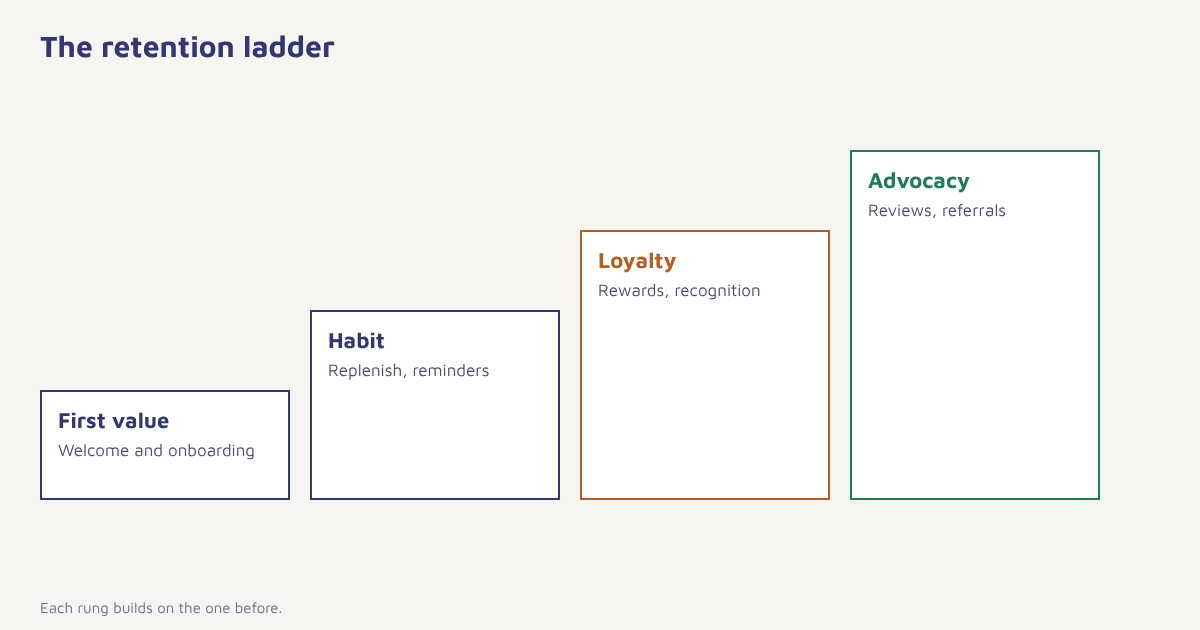
1. Nail the first 30 days
Early experience decides most future behaviour. Define the moment a new customer first gets value, then shorten the path to it. A welcome journey that guides people to that moment, in the channel they prefer, is the highest-return retention project for most teams. See the onboarding use case.
2. Segment and personalise
Treat new buyers, loyal customers and lapsing ones differently. Our guide to customer segmentation covers the rules, including RFM groups.
3. Reach out before they leave
Usage drops, longer gaps between orders and unopened messages are early warnings. Build a segment for each signal and send help, not a discount, first.
4. Build a loyalty or rewards programme
A good loyalty programme gives people a reason to come back: points, tiers, early access, free delivery. Keep the rules simple enough to explain in one sentence, and make the reward worth earning.
5. Make support fast and human
A resolved problem can increase loyalty more than no problem at all. Answer quickly on the channel the customer used, and follow up after the fix.
6. Ask for feedback and act on it
Send a short survey after key moments and read every free-text answer. Tell customers what changed because of their feedback.
7. Recover failed payments and expired cards
A surprising share of subscription loss is accidental. Retry payments sensibly and send secure update links by SMS or WhatsApp the same day.
8. Re-engage lapsed customers
Run a win-back sequence for people who have been quiet for 60 to 90 days: a check-in, a reason to return, and a clear last message. Stop after that, since mailing the unresponsive harms deliverability, as we explain in our deliverability guide.
9. Use post-purchase communication well
Delivery updates, care tips, how-to content and replenishment reminders keep your brand present between orders, and they are expected rather than intrusive.
10. Turn happy customers into advocates
Ask satisfied customers for reviews and referrals at the right moment, usually right after a good outcome. Make it a single tap, and thank them.
Retention examples by industry
| Industry | Retention move | Channel |
|---|---|---|
| Ecommerce | Replenishment reminder 25 days after delivery of a 30-day product | WhatsApp or email |
| SaaS | Alert the account owner when weekly active users fall 30 percent | Email and in-app |
| Edtech | Nudge learners who skip two sessions with a short lesson | Push and WhatsApp |
| Healthcare | Check-up reminder at six months with easy booking | SMS and WhatsApp |
| Travel | Personal offers on the anniversary of a past trip | Email and push |
You can start from the matching industry solution or the retention use case, which includes journeys you can install and edit.
Early warning signs a customer is slipping
People rarely leave without a hint. Watch for a longer gap than usual between orders, fewer logins or sessions, support tickets that go unresolved, a drop in email and WhatsApp engagement, a downgrade, and a failed payment that was not fixed. A customer who gives you a low score on a Net Promoter Score survey is also telling you something. Turn each signal into a segment, and give each segment its own response. A late-order gap deserves a helpful reminder. A support issue deserves a personal reply from a human, not an automated offer.
This is also where the economics of retention show up. Each customer who stays saves you the acquisition cost of replacing them, which for most paid channels is much higher than the cost of a thoughtful message. If your cost to acquire a customer is high, even a modest improvement in the share who place a second order changes the maths of the whole business.
A simple 30-day retention plan
- Week 1: measure. Calculate your retention rate and build a cohort table so you know where customers fall away.
- Week 2: fix the first experience. Set up or improve the welcome journey and define the first-value event.
- Week 3: add early warning. Create segments for lapsing customers and build one rescue journey.
- Week 4: add a feedback loop. Send a short post-purchase survey and route negative answers to a person.
- Then review monthly. Compare against a holdout group and keep what pays back.
Do not discount by default. Offers train customers to wait for them. Lead with help, convenience or recognition, and keep discounts for the moments where you have evidence they change behaviour.
Retention with Flowfox
Retention work comes down to knowing who is at risk and reaching them at the right moment. In Flowfox segments build lists such as “ordered twice, nothing in 60 days”, journeys send timed help across WhatsApp, email, SMS and push, and analytics shows retention by cohort and campaign. The churn prevention use case and SaaS solution include working examples, and FoxAI speeds up the writing and testing of messages.
Common mistakes
- Chasing acquisition and ignoring the leak. Fix retention first, then pour in more traffic.
- Measuring only an average. Cohorts show the real pattern.
- Treating all customers alike. Your best customers deserve better than a generic blast.
- Over-messaging. More touches are not more loyalty. Cap frequency.
- Forgetting to ask. Customers often tell you why they leave when asked.
Retention is not a campaign. It is the sum of every good experience after the sale.
Keep more of the customers you worked hard to win. Build segments, journeys and cohort reports in one workspace.
To go further, map the full path with our journey mapping guide, automate the touchpoints using marketing automation, and read the abandoned cart recovery guide for the checkout stage. More ideas are on the blog.
Frequently asked questions
What is customer retention?
Customer retention is a company’s ability to keep customers buying or subscribed over time. It is measured as the share of customers who remain over a period.
How do you calculate customer retention rate?
Customer retention rate = ((customers at the end of the period minus new customers acquired) divided by customers at the start) times 100.
What are the best customer retention strategies?
Strong onboarding, segmentation and personalisation, early-warning outreach, a simple loyalty programme, fast support, feedback loops, failed payment recovery, win-back campaigns and referral requests.
Why is customer retention important?
Retained customers cost less to serve than new ones, spend more over time and refer others. Research by Bain & Company suggests small gains in retention can raise profits significantly.
What is a good customer retention rate?
It depends on the business model. Subscription and enterprise software often aim for annual retention above 90 percent, while consumer and retail businesses see lower figures. Compare against your own trend by cohort.
What is the difference between customer retention and customer loyalty?
Retention is about whether customers stay. Loyalty is about why: emotional or practical attachment that makes them choose you again and recommend you.
How can I improve retention quickly?
Improve the first 30 days, build a segment for customers whose activity is dropping, send helpful outreach before they leave and recover failed payments the same day.