The first days after someone signs up or buys decide whether they ever become a real customer. Most people who leave never complain; they simply do not get started. Customer onboarding is the process of getting a new customer from “I signed up” to “I got value” as quickly and as smoothly as possible. This guide covers what onboarding is, the stages it should cover, a day-by-day sequence you can copy, a checklist, the metrics to track and the mistakes that cause early churn.
What is customer onboarding?
Onboarding is the structured process of bringing a new person into a product, service or organisation. For customer onboarding, the goal is time to first value: the shortest path between sign-up and the moment the customer experiences the benefit you promised. For a software product that might be sending a first message or seeing a first report. For an online store it might be receiving the first order and knowing how to use it. For a clinic it could be completing a first visit with all forms done.
Why onboarding matters
- It drives early retention. Customers who reach first value quickly are far more likely to stay, which feeds directly into churn and customer lifetime value.
- It lowers support load. Clear guidance answers questions before they become tickets.
- It sets expectations. People who understand what comes next feel in control and stay patient.
- It reveals product problems. Where people stall during onboarding shows you what to fix.
The stages of customer onboarding
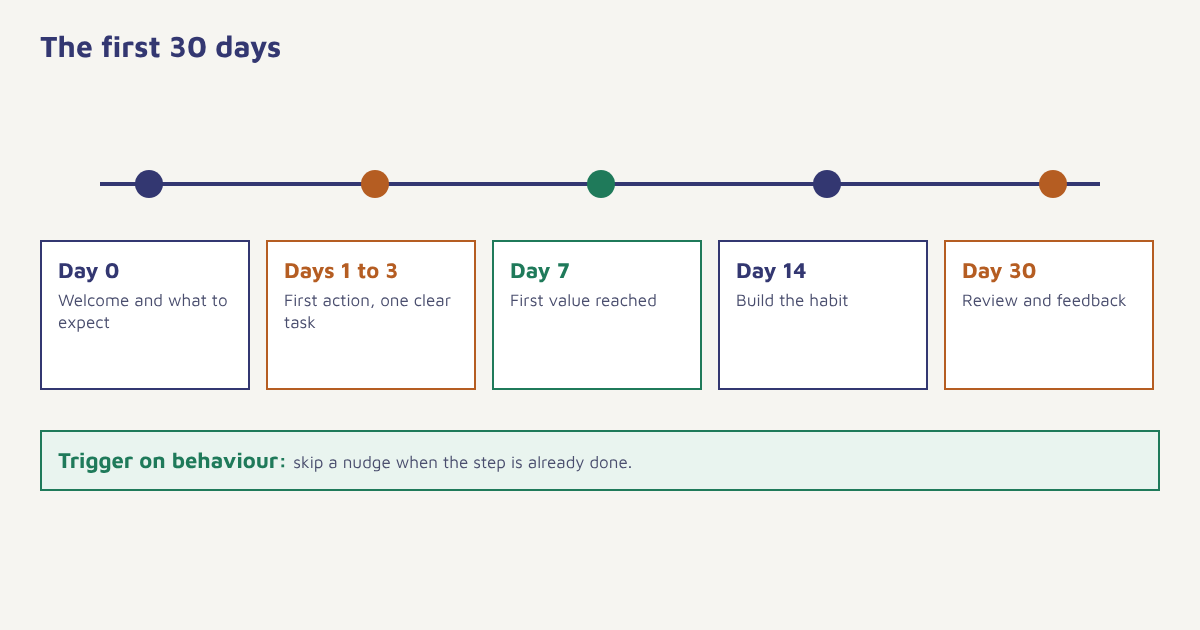
| Stage | Goal | Typical touch |
|---|---|---|
| Welcome (day 0) | Confirm the decision and set expectations | Welcome message, what happens next |
| First action (days 1 to 3) | Complete the key setup step | Short guide, one clear task |
| First value (about day 7) | Experience the main benefit | Success message, tip for the next step |
| Habit (about day 14) | Make it part of routine | Feature highlight, usage reminder |
| Review (day 30) | Check satisfaction and plan the next step | Feedback request, offer to help |
A sample onboarding sequence
Adapt the timing and channels to your product. The pattern below suits a software or subscription service, and the ideas transfer to retail and services.
| When | Channel | Message | Goal |
|---|---|---|---|
| Immediately | Welcome, what to expect and one link to start | Open the product | |
| Day 1 | WhatsApp or push | Quick tip with a link to the first task | Complete setup step 1 |
| Day 3 (if setup incomplete) | Short video or guide, offer of help | Recover stalled users | |
| Day 7 | In-app or email | Celebrate progress, suggest next feature | Reach first value |
| Day 14 | Customer story or advanced tip | Build the habit | |
| Day 30 | Two-question survey and a link to book a call | Learn and retain |
Trigger on behaviour, not dates. The most effective onboarding responds to what people actually do. If someone completes the key step on day 1, skip the nudge. If they have not, send help. Flowfox journeys let you branch on events like setup_completed rather than waiting for a fixed number of days.
How to build an onboarding programme, step by step
- Define first value. Decide the single event that proves a customer has gotten what they came for, for example “sent first campaign” or “placed second order”.
- Map the path. List every step between sign-up and that event, and note where people drop off. Our guide to customer journey mapping shows the method.
- Remove friction. Cut optional fields, pre-fill what you know and shorten the first task.
- Write the sequence. Short, specific messages tied to the next step, in the customer’s preferred channel.
- Track the key events. Send events such as signup_completed, setup_completed and first_value_reached. See sending your first event.
- Build it as a journey. Use waits and goals so people stop receiving nudges once they complete a step. See your first journey and goals and waits.
- Add a human option. Offer a call, chat or demo for high-value customers, as a visible option in the sequence.
- Review weekly at first. Watch drop-off between stages and fix the biggest leak.
Customer onboarding checklist
- Welcome message sent within minutes of sign-up.
- One clear first task, not a menu of ten.
- Consent captured for each channel you plan to use.
- Key events tracked from the first day.
- A stalled-user nudge with a different message from the first.
- Success message when first value is reached.
- A way to reach a person if the customer is stuck.
- A 30-day check-in and feedback request.
- Quiet hours and frequency caps applied across channels.
Metrics to track
| Metric | Definition | Why it matters |
|---|---|---|
| Activation rate | Share of new customers who reach first value | Headline onboarding result |
| Time to first value | Median time from sign-up to first value | Shows speed of the path |
| Step completion | Share completing each setup step | Finds the leaky step |
| Day 7 and day 30 retention | Share still active | Early signal of churn |
| Onboarding support tickets | Tickets from customers in their first 30 days | Shows unclear guidance |
Use analytics funnels to see where people stop and compare cohorts before and after you change the sequence.
Onboarding examples by industry
| Industry | First value moment | Onboarding tactic |
|---|---|---|
| SaaS | Connect data and see first report | Guided setup, in-app checklist, day 3 nudge |
| Ecommerce | First delivery received and used | Shipping updates, care tips, review request |
| Edtech | First lesson completed | Welcome note, schedule, streak reminders |
| Fintech | Account verified and first transaction | Document checklist, status updates on SMS |
| Healthcare | First appointment attended | Forms, reminders, directions |
You can see ready flows in the onboarding use case, and tailored versions in the SaaS, edtech and fintech solutions.
Onboarding message examples
| Moment | Message |
|---|---|
| Welcome | Welcome aboard, Asha. Your first step takes two minutes: connect your store. Here is the link. If you get stuck, reply to this message and a person will help. |
| Stalled on day 3 | Quick check-in. Most people finish setup in one sitting. This 90-second video shows the step you have left. |
| First value | You just sent your first campaign. Here is how to see who read it, and the one thing worth trying next. |
| Day 30 | You have been with us a month. What is one thing we could do better? Two questions, 30 seconds. |
Notice the pattern: each message names a single step, gives a reason and offers help. The tone is that of a helpful person, not a system notification.
When onboarding needs a person
Automation covers most customers, but accounts with high value or complex setup deserve a human. Define a trigger for that: for example a customer on a higher plan, a team of more than ten users, or someone who has not completed setup by day five. Route these to a customer success owner with the context from the journey attached. The idea of customer success is to make sure customers reach the outcome they bought for, not only to answer questions. Combine automated nudges with a personal note, and measure whether the human touch pays back in lower churn.
Mistakes that cause early churn
- Sending a product tour instead of a first task. People want to do something, not read about everything.
- Treating everyone the same. A power user and a beginner need different paths. See segmentation.
- Not stopping the nudges. Reminding someone to do something they already did is irritating.
- Hiding help. Make support easy to find in every message.
- Never measuring. Without activation data you cannot improve.
Onboarding is not a welcome email. It is a promise that the first week will feel easy.
Get new customers to first value faster. Build an event-driven onboarding journey with branches, waits and goals.
After onboarding, keep the momentum going with retention strategies and marketing automation, and find more guides on the blog.
Frequently asked questions
What is customer onboarding?
Customer onboarding is the process of guiding a new customer from sign-up or purchase to the point where they experience the core value of your product or service.
How long should customer onboarding take?
It depends on the product. Many teams plan a 30-day programme, with the first value moment reached within the first week, and shorter for simple products.
What should a customer onboarding email sequence include?
A welcome message, a first task with a clear link, a stalled-user nudge, a progress or success message, a tip to build the habit, and a feedback request around day 30.
What is time to first value?
It is the time between a customer signing up and first experiencing the benefit of the product. Shortening it usually improves retention.
How do I measure onboarding success?
Track activation rate, time to first value, step completion, day 7 and day 30 retention and onboarding-related support tickets.
Should onboarding be automated or personal?
Both. Automate the sequence and triggers for everyone, and offer a human option, such as a call or chat, for high-value or stuck customers.
What causes customers to drop off during onboarding?
Common causes are too many steps, unclear first tasks, slow time to value, generic messages and a lack of help at the moment of confusion.