Every customer base has a quiet group: people who bought once or twice, then stopped opening emails and stopped coming back. Winning one of them back usually costs far less than acquiring a stranger, because they already know you. A win-back campaign is a planned sequence aimed at these lapsed customers. This guide explains how to decide who counts as lapsed, what to say at each step, which offers work and which do not, how to time the sequence, and when to stop and let people go.
What is a win-back campaign?
A win-back campaign, also called a re-engagement or reactivation campaign, is a series of messages sent to customers or subscribers who have been inactive for a defined period. The aim is to bring them back to an action that matters, such as a purchase, a login or a reply. It is a form of customer retention work, and it sits at the end of the lifecycle described in our guide to retention strategies. Win-back is also a list-health tool: people who never respond are best removed, which protects your deliverability.
Step one: define “lapsed”
There is no universal cut-off. It depends on how often your customers normally buy. A grocery app might call a customer lapsed after three weeks, an online fashion store after four months, and a business that sells furniture after two years. A practical method is to look at the typical gap between orders, and set the lapsed threshold at about twice that gap. Define it for engagement as well: a subscriber who has not opened or clicked in 90 to 180 days is a candidate for re-engagement. Combining purchase history with engagement gives a better picture, and RFM analysis is a good way to rank who is worth the most effort.
| Business type | Typical purchase gap | Reasonable lapsed threshold |
|---|---|---|
| Food and grocery delivery | 1 to 2 weeks | 3 to 4 weeks |
| Beauty and personal care | 1 to 2 months | 3 to 4 months |
| Fashion | 2 to 3 months | 4 to 6 months |
| Electronics and home | 1 to 2 years | 18 to 24 months |
| SaaS subscription | Daily or weekly use | 14 to 30 days without login |
These thresholds are starting points. Check them against your own data, for example by finding the point after which the chance of a return purchase drops sharply.
A win-back sequence that works
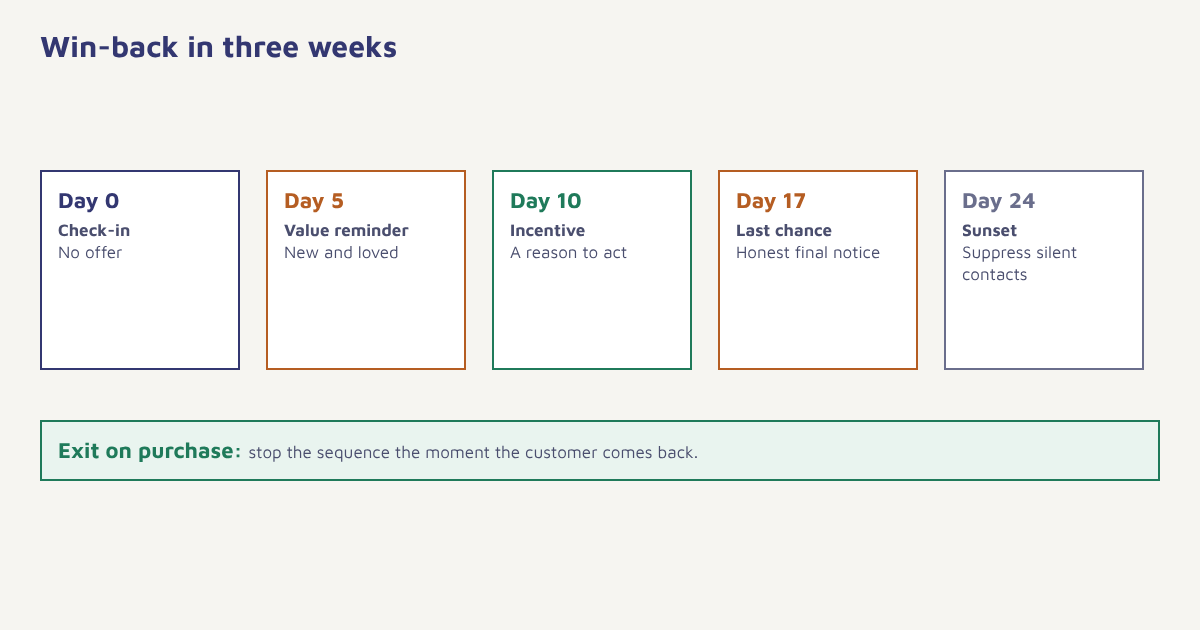
| Step | Timing | Purpose | Example subject |
|---|---|---|---|
| 1. Check-in | Day 0 | Friendly note, no pressure | It has been a while, Karan. How are things? |
| 2. Value reminder | Day 5 | Show what is new or what they loved | New since your last visit: three things you may like |
| 3. Incentive | Day 10 | A reason to act now | Rs 150 off your next order, just for you |
| 4. Last chance | Day 17 | Honest final notice | Last email unless you click. Should we keep in touch? |
| Sunset | Day 24 | Suppress non-responders | No message; remove from regular sends |
Notice that the sequence escalates gently. The first message does not discount at all, because some people only needed a nudge, and giving everyone a coupon trains customers to wait for one. Use the journey builder to set it up: enter on a segment, send, wait for a purchase or click, and exit people the moment they come back. The goals and waits guide shows how to end the journey automatically on a purchase.
Which offers work
- No discount at all. A personal note, new products or a useful guide often works for recent lapses.
- Free shipping or a small credit. Cheaper than a percentage off on a large basket.
- Early access or a gift. Rewards without cutting price.
- A survey. Ask what went wrong, then act on the answers. See NPS, CSAT and CES.
- A percentage discount for high-value customers. Use it where the lifetime value justifies it. Check customer lifetime value before you decide how much to spend.
Segment the offer. Treat a lapsed champion differently from a lapsed one-time buyer. A phone call or a personal message from the founder can be right for the first group, and a cheap automated email is enough for the second.
Choosing the channel
Email is the default, because it is cheap and works at scale. Add other channels when you have permission and a reason. A WhatsApp message can reach people who ignore email, and SMS suits short, time-limited offers. Push notifications work for app users who still have the app installed. Respect consent on each channel separately, set frequency caps so that one person does not receive the same offer three ways in a day, and read our omnichannel guide for how to coordinate them.
How to set up a win-back campaign
- Choose the segment. Customers with a past purchase and no activity beyond your lapsed threshold, with valid consent.
- Exclude people you should not message. Open complaints, recent returns, people already in another journey.
- Write the sequence. Three or four messages, each with one purpose and one call to action.
- Set the offer rules. Decide who gets an incentive and how much it can cost.
- Add an exit. Stop the sequence the moment the person purchases or clicks through to buy.
- Add a sunset rule. Suppress people who do not respond so they stop affecting your sender reputation.
- Measure with a holdout. Keep a small random group out of the campaign to see the real lift.
- Review and repeat. Run it continuously for new lapsers rather than as a one-time blast.
{
  "journey": "Win-back 90 days",
  "entry": { "segment": "lapsed_90_days", "consent": "email" },
  "exit_goal": "order_completed",
  "steps": [
    { "send": "email", "template": "wb_check_in" },
    { "wait": "5 days", "until": "order_completed" },
    { "send": "email", "template": "wb_whats_new" },
    { "wait": "5 days", "until": "order_completed" },
    { "send": "email", "template": "wb_offer_150" },
    { "wait": "7 days", "until": "order_completed" },
    { "send": "email", "template": "wb_last_chance" },
    { "wait": "7 days", "then": "suppress_if_no_engagement" }
  ],
  "holdout_percent": 10
}
How to measure it
| Metric | What to look at |
|---|---|
| Reactivation rate | Share of the segment who purchase or engage within 30 days |
| Revenue per recipient | Compared with the holdout group |
| Incentive cost | Discount value against margin on recovered orders |
| Unsubscribe and complaint rate | Whether the sequence is too pushy |
| List health after the sunset | Bounce rate and engagement of the remaining list |
Report results by segment and by step, and use analytics to compare the holdout. Do not judge by opens, which are unreliable. See email marketing metrics for why. Over time, a cohort view shows whether customers you win back stay or lapse again.
Knowing when to stop
Some people will never respond, and mailing them hurts you. Inactive subscribers lower your engagement rates, and old addresses may turn into spam traps. A polite last message, followed by suppression, keeps your list honest. Customers who return later can always sign up again. This is also considerate: an inbox should not be a place where messages go unread. Read list building for the other side of the coin.
Subject line and copy ideas
Keep the tone human and specific. A good check-in message sounds like a person wondering where you went, not a system flagging inactivity. Mention something real: what they bought, what has changed or how long it has been. For the incentive step, state the offer, the deadline and the condition in the first lines. For the last chance, be honest that it is the final message and tell people how to stay, for example by clicking a button or replying. Read the background on reactivation of dormant customers if you want a broader view, and remember that the same principles apply to subscription products, where churn is the cost of losing someone.
Common mistakes
- Discounting everyone. It trains customers to wait for offers.
- Waiting too long. The sooner you reach out after a lapse, the better the odds.
- No exit. Do not send a win-back to someone who just bought.
- No sunset. Mailing the unresponsive forever damages reputation.
- Ignoring why they left. A short survey often shows a fixable problem.
A win-back email is not an apology or a coupon. It is a reason to come back.
Bring lapsed customers back, with control. Build a segment, run the sequence, exit on purchase and measure the lift.
See also the retention use case, churn use case and churn rate guide, and visit the blog.
Frequently asked questions
What is a win-back campaign?
A win-back campaign is a planned series of messages sent to customers or subscribers who have been inactive, aiming to bring them back to a purchase, login or reply.
When should I send a win-back campaign?
When a customer passes your lapsed threshold, often about twice their usual gap between orders, or when a subscriber has not engaged for 90 to 180 days.
How many emails should a win-back sequence have?
Three to four messages over two to three weeks is typical, escalating from a friendly check-in to an incentive and a final notice.
Should I offer a discount in a win-back email?
Not always. Start with a no-discount message, and use incentives for later steps or higher-value customers so you do not train everyone to wait for a coupon.
What if people do not respond to the win-back sequence?
Suppress them from regular sends. Keeping unresponsive contacts lowers engagement and can harm deliverability.
How do I measure win-back success?
Compare reactivation rate and revenue per recipient with a holdout group that did not receive the campaign, and track incentive cost, unsubscribes and complaints.
Which channels work for win-back campaigns?
Email is the default. WhatsApp, SMS and push can reach people who ignore email, but each needs separate consent and frequency limits.