An email list is the one marketing asset you fully own. Social reach rises and falls with algorithm changes, and ad costs go up every year, but a list of people who asked to hear from you keeps working. The catch is that quality matters far more than size. A list of 2,000 engaged subscribers will outsell 20,000 names scraped from somewhere. This guide shows how to build a list the right way: where sign-ups come from, how to design forms people complete, how to get consent properly, how to welcome new subscribers and which shortcuts to avoid.
What is email list building?
List building is the ongoing practice of collecting email addresses, and in India often phone numbers too, from people who have chosen to hear from you. Each new contact should arrive with a recorded source and a recorded permission. A healthy mailing list grows steadily, stays clean and gets a message worth opening, which is why list building is tied closely to email marketing and deliverability.
Why quality beats size
Mailbox providers watch how recipients treat your mail. Messages sent to people who never asked, or to addresses that no longer exist, produce bounces, complaints and hits on spam traps, which are addresses used to catch senders with poor list practices. A big, cold list damages your sender reputation and drags down results for every campaign, including those to good subscribers. Never buy or rent a list, and do not scrape addresses. Beyond the reputation damage, it is likely to breach data protection rules such as the GDPR in Europe and the Digital Personal Data Protection Act in India.
Where subscribers come from
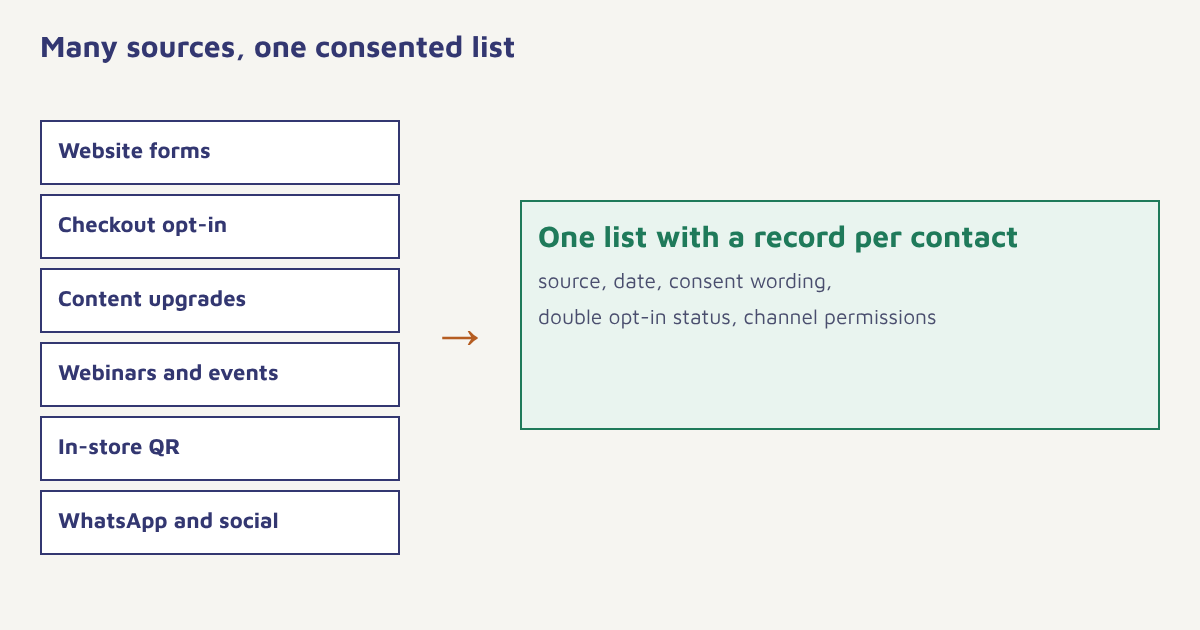
| Source | How it works | Tips |
|---|---|---|
| Website footer and header form | A simple sign-up on every page | Say what people will get and how often |
| Pop-up or slide-in | Appears on exit or after reading | Delay it, make it easy to close, show a clear benefit |
| Checkout opt-in | Unticked box offering updates | Never pre-tick it; explain the value |
| Content upgrade or guide | A checklist or template in return for an email | Match the offer to the page content |
| Webinars and events | Registration forms and attendee lists | Ask consent for follow-up at registration |
| In-store QR code | Scan to join the list or WhatsApp updates | Offer a small reason, such as first-visit perk |
| Referral | Existing subscribers invite friends | Reward both sides |
| Social and chat | Link to a form from bio, ads or WhatsApp | Use click-to-chat and ask for permission in the thread |
What to offer in return
People give an address when the exchange feels fair. A generic “Subscribe to our newsletter” wins few sign-ups. A specific, useful offer wins more: a discount on the first order, a size guide, a checklist, a template, early access to sales, a monthly report, or simply a clear promise such as “one practical tip every Friday”. The offer should relate to what your best customers want, and it should be something you can deliver instantly by email, which also confirms the address works.
How to design a sign-up form that converts
- Ask for as little as possible. An email address is often enough. Each extra field lowers completion.
- Use a benefit-led heading. “Get 10% off your first order” beats “Newsletter”.
- State the frequency. “Weekly, never spam” sets expectations.
- Make the button specific. “Send me the guide” beats “Submit”.
- Place it where attention is. After a helpful article, at checkout, on the pricing page.
- Work on a phone. Large touch targets and the right keyboard type for email fields.
- Link to your privacy notice. Say how you will use the data.
Capture the source. Store a hidden field with the form name or page on every sign-up. You will need to know which sources produce subscribers who buy, not just which produce the most, and the record also helps prove consent.
Consent and double opt-in
Consent should be clear, specific and recorded: who agreed, to what, when and through which form. Under many rules, pre-ticked boxes and bundled consent do not count. Many senders use double opt-in: after someone signs up, they get a confirmation email and must click a link to join. It slows list growth slightly, but it removes mistyped and fake addresses, lowers complaints and gives you a strong proof of consent. If you do not use double opt-in, at least validate addresses at capture and honour unsubscribes instantly.
If you also message on other channels, collect permission for each separately. A person who joined for email has not agreed to WhatsApp or SMS. Our guides to WhatsApp marketing and SMS marketing cover those rules, and in Flowfox the contact profile stores consent per channel.
The welcome email: your best chance
A new subscriber is at peak interest in the first few minutes. Send a welcome message right away that confirms what they signed up for, delivers any promised offer, introduces who you are in two sentences and gives one useful next step. Then add a short sequence over a week, as described in our drip campaign guide. Welcome emails commonly get much higher engagement than ordinary campaigns, and early engagement helps your reputation with mailbox providers.
A step-by-step plan to start
- Pick one offer. Choose a clear reason to subscribe that suits your best customers.
- Build one good form. Short, benefit-led, mobile-friendly, with consent text and a source field.
- Place it in three spots. Footer, a high-traffic article or page, and checkout.
- Turn on double opt-in or validation. Keep the list clean from day one.
- Send the welcome series. One immediate message and a short follow-up over a week.
- Segment by source and interest. Different sign-up sources deserve different early messages. See segmentation.
- Review monthly. Check sign-ups by source, complaint rate and the share of subscribers who engage.
Keeping the list healthy
| Task | How often | Why |
|---|---|---|
| Remove hard bounces | Automatically on each send | Protects sender reputation |
| Suppress unsubscribes and complaints | Instantly | Legal and reputational requirement |
| Re-engage or remove inactive contacts | Every quarter, using a 6 to 12 month window | Keeps engagement high |
| Check duplicates and typos | At import and capture | Avoids waste and mistakes |
| Review consent records | Twice a year | Ready for audits and requests |
The segment builder can find contacts who have not opened in 180 days, and a journey can run a re-permission sequence before you suppress them. Authentication also matters for new lists: see SPF, DKIM and DMARC.
Rules to keep in mind in India and abroad
Indian businesses collecting personal data now work under the Digital Personal Data Protection Act, 2023, which centres on notice, purpose-limited consent and the right to withdraw. Sending to European residents brings the GDPR into play, and sending to US recipients brings the CAN-SPAM Act. The practical overlap is simple: tell people what they will receive, ask clearly, record the answer, make leaving easy and honour it quickly. Rules and their interpretation change, so check the current text or ask your legal advisor before you launch a new collection method, especially for phone numbers and WhatsApp.
Do the sums on quality too. If your list has 10,000 addresses and 1,500 of them are active, you have a 15 percent engaged list. Removing the other 8,500 may look like losing 85 percent of your audience, but results per send usually improve, complaints fall and the next campaign lands in more primary inboxes. Judge the list by the people who read it.
Mistakes to avoid
- Buying a list. It is the fastest route to blocklists and complaints.
- Adding customers without permission. A purchase is not consent to marketing in many places.
- Hiding the unsubscribe. Complaints rise when leaving is hard.
- Long forms. Every extra field costs sign-ups.
- No welcome message. You waste the highest-interest moment.
A list is a relationship you were invited into. Treat it that way and it keeps paying you back.
Grow a list that engages. Capture consent per channel, welcome new subscribers automatically and keep your list clean.
Next, read about email subject lines and lead nurturing, and browse the blog.
Frequently asked questions
What is email list building?
Email list building is the ongoing process of collecting email addresses from people who have agreed to hear from you, with a recorded source and a recorded permission for each contact.
How do I build an email list from scratch?
Pick one clear offer, add a short benefit-led sign-up form in several places such as the footer, a popular article and checkout, use double opt-in or validation, and send an immediate welcome message.
Is it okay to buy an email list?
No. Purchased lists produce bounces, spam complaints and spam trap hits, damage your sender reputation and may breach data protection laws.
What is double opt-in?
Double opt-in means a new subscriber confirms their address by clicking a link in a confirmation email. It reduces fake and mistyped addresses and provides stronger proof of consent.
What is a lead magnet?
A lead magnet is something useful offered in exchange for an email address, such as a guide, checklist, template, discount or early access.
How often should I clean my email list?
Remove hard bounces and unsubscribes immediately, and review inactive contacts every quarter, using an inactivity window of about six to twelve months.
How many fields should a sign-up form have?
As few as possible. An email address alone is often enough, and every extra field tends to reduce the share of visitors who complete the form.