Most people who show interest in your business are not ready to buy on the day they do. They download a guide, request a price list, ask a question on WhatsApp, and then go quiet. Lead nurturing is how you stay useful to those people until they are ready, without nagging them. This guide explains what lead nurturing is, how it differs from plain follow-up, a stage-by-stage framework, a working example sequence, how to score leads, and how to measure whether it brings more sales.
What is lead nurturing?
Lead nurturing is the process of building a relationship with prospects over time by giving them relevant information and help at each step of their decision. It follows lead generation, which is the work of attracting the interest in the first place. A nurture programme answers questions, removes doubts and keeps your name in front of someone who has already shown intent, so that when they are ready, you are the obvious choice.
Why it matters
- Timing rarely matches. The moment of interest and the moment of purchase are usually weeks apart. Nurturing bridges the gap.
- Sales time is limited. Automated nurturing keeps warm leads warm so your team spends time on those who are ready.
- It lowers acquisition cost. Converting leads you already paid for is cheaper than finding new ones. See how this feeds CLV against CAC.
- It builds trust. Helpful content earns credibility before a pitch.
The lead nurturing framework
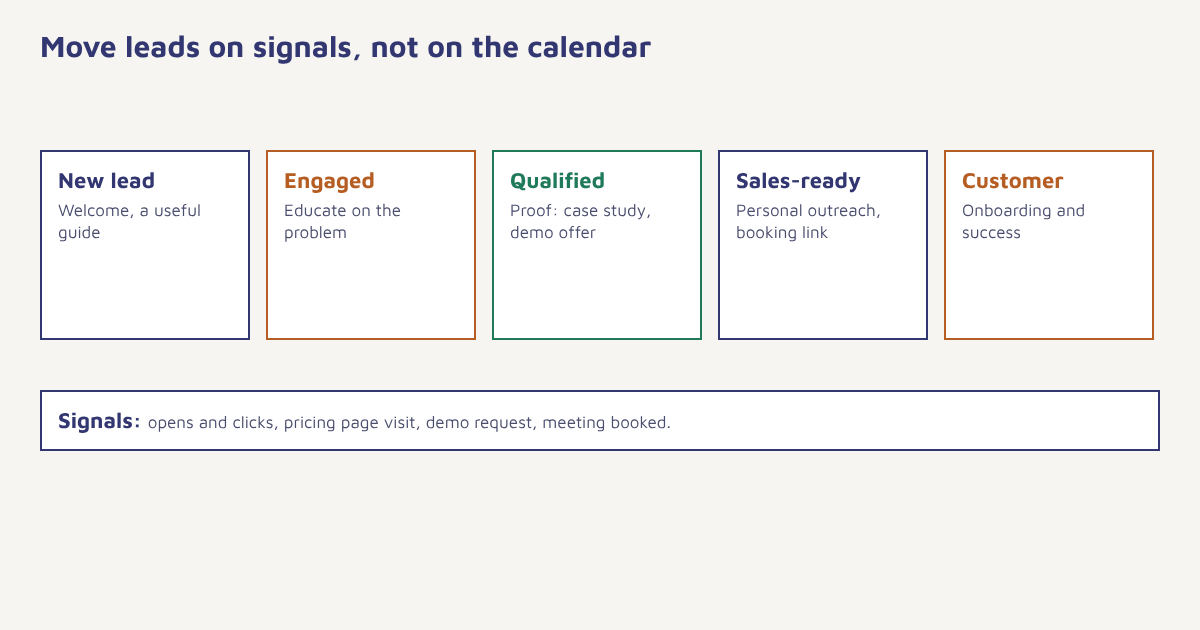
| Stage | What the lead needs | Content and channel | Signal to move on |
|---|---|---|---|
| New lead | Confirmation and a reason to trust you | Welcome email, WhatsApp hello, a useful guide | Opens, clicks or replies |
| Engaged | Education on the problem and options | Articles, short videos, comparison pages | Visits pricing or product pages |
| Qualified | Proof it works for someone like them | Case studies, demo invitation, FAQs | Asks for a demo or price |
| Sales-ready | A clear, easy next step | Personal outreach, booking link, proposal | Meeting booked |
| Customer | Onboarding and success | Onboarding journey, support, tips | Moves to retention |
Notice that each stage depends on behaviour. That is the heart of nurturing: you respond to what the person does, using the journeys and segments tools rather than a single blast.
Lead scoring in plain terms
Lead scoring assigns points to a lead based on who they are (fit) and what they have done (engagement), so you know when to hand them to sales. A simple model has two parts.
| Type | Example signal | Points |
|---|---|---|
| Fit | Company size in your target range | +10 |
| Fit | Role is a decision maker | +10 |
| Fit | Free email domain for a B2B product | -5 |
| Engagement | Opened three emails in two weeks | +5 |
| Engagement | Visited pricing page | +15 |
| Engagement | Requested a demo | +30 |
| Decay | No activity for 30 days | -10 |
Set a threshold, for example 50 points, at which the lead is flagged to sales. Review the model every quarter by checking which signals actually appeared before wins, and adjust the points. A short, honest model beats an elaborate one nobody trusts.
How to build a nurture programme, step by step
- Define the audience and goal. Pick one lead source, such as people who downloaded your pricing guide, and one goal, such as booked demos.
- Capture consent and data. Collect permission for the channels you will use and the information you need, such as company and role.
- Map the questions. List the doubts a lead has at each stage and the best answer you have for each.
- Create the content. Short, useful pieces: a guide, a comparison, a case study, a FAQ.
- Build the journey. Entry on sign-up, waits between messages, branches based on clicks and visits, and an exit when a demo is booked.
- Add scoring and sales alerts. Notify the sales team when a lead crosses the threshold, with the history attached.
- Test and refine. Test subject lines and timing with A/B tests, and check results monthly.
Example: a six-message nurture sequence
| Day | Channel | Message | Goal |
|---|---|---|---|
| 0 | Here is the guide you asked for, plus what to read next | Deliver value | |
| 2 | Three common mistakes and how to avoid them | Educate | |
| 5 | WhatsApp (if opted in) | Quick question: what are you trying to fix first? | Start a conversation |
| 9 | A customer story from a similar business | Build proof | |
| 14 | Compare your options: a simple table | Help decision | |
| 21 | Email and WhatsApp | Book a 20-minute walkthrough | Convert |
Stop when they act. Set a goal such as “demo booked” so the person leaves the sequence immediately. Few things annoy a prospect more than being nurtured after they have already said yes.
Choosing channels
Use email as the backbone because it carries detail and costs little. Add WhatsApp for personal, quick questions with people who have opted in, and SMS for time-sensitive reminders such as a demo starting soon. For website visitors, web messaging can start a conversation in the moment. Keep consent per channel, and review the rules in our guides to email marketing and WhatsApp marketing.
Metrics that show nurturing works
| Metric | What it shows |
|---|---|
| Lead-to-qualified rate | Share of leads who reach the qualified stage |
| Time to conversion | Days from first touch to purchase or demo |
| Sales-accepted leads | Leads the sales team finds worth contacting |
| Revenue from nurtured leads | Closed deals that went through the programme |
| Unsubscribe rate | Whether volume and relevance are balanced |
Compare nurtured leads against a similar group who received nothing, if you can, to see the true lift, and review the results in analytics.
Nurturing by lead source
| Lead source | What they know | First nurture move |
|---|---|---|
| Guide or ebook download | Interested in the topic, not your product | Send related content, avoid a hard pitch |
| Pricing page visit or price request | Already comparing options | Fast reply, comparison table and a booking link |
| Webinar attendee | Warm, spent time with you | Recording, key takeaways and a short follow-up question |
| WhatsApp or chat enquiry | Asked a specific question | Answer first, then ask what they are trying to do |
| Event or trade show | Met you briefly | Personal note referencing the conversation |
A single sequence rarely fits all of these. Split by source at the entry point, and merge leads into a shared sequence once they have engaged. This is where segmentation pays off.
Handing a lead to sales
A good handoff includes what the lead read, clicked and asked, so the first sales message continues the conversation rather than restarting it. In practice, send sales an alert with the lead score, the last five activities, the lead’s own words from any form or chat, and the nurture stage. Agree a response time, for example within two working hours, since interest cools fast. If a lead turns out not to be a fit, sales should mark why, so scoring can improve. The wider idea of moving prospects through a purchase funnel only works when marketing and sales share the same view of each person, which is what a good CRM integration provides.
Content ideas for each stage
- Early: checklists, glossaries, short how-to guides and explainer videos.
- Middle: comparison pages, buyer guides, calculators and webinars.
- Late: case studies, free trials, personalised demos and pricing walkthroughs.
- After purchase: onboarding guides, tips and invitations to share feedback.
Common mistakes
- Selling in every message. Mix useful content with offers.
- One sequence for everyone. Segment by interest, role and stage.
- Ignoring sales feedback. If sales say leads are poor, change the scoring.
- Too many emails too fast. Space them out and cap frequency.
- No exit rule. People who converted still receive nurturing.
Good nurturing feels like a helpful colleague who remembers your question, not a salesperson who will not go away.
Nurture leads on autopilot. Build event-driven sequences with scoring, branches and sales alerts.
For the next step after the sale see customer onboarding, and for wider context read about marketing automation and the blog.
Frequently asked questions
What is lead nurturing?
Lead nurturing is building a relationship with prospects over time by giving them relevant information and help at each stage of their decision, so they are ready to buy when the time comes.
What is the difference between lead generation and lead nurturing?
Lead generation attracts people who show interest. Lead nurturing guides those people towards a decision through relevant content and timely follow-up.
How long should a lead nurturing sequence be?
It depends on your sales cycle. Many programmes run three to four weeks with five or six messages, then move to a slower, occasional rhythm.
What is lead scoring?
Lead scoring assigns points for fit and behaviour, such as role, company size, pricing page visits and demo requests, to show when a lead is ready for sales.
Which channels work best for lead nurturing?
Email is the usual backbone. WhatsApp suits personal follow-up with opted-in leads, SMS suits time-sensitive reminders and web messaging can engage visitors in the moment.
How do I know if lead nurturing is working?
Track lead-to-qualified rate, time to conversion, sales-accepted leads and revenue from nurtured leads, ideally against a group that received no nurturing.
How many emails are too many in lead nurturing?
There is no fixed limit, but watch unsubscribes and complaints. Space messages by several days and reduce frequency for leads who stop engaging.