A drip campaign is a series of messages sent automatically, one after another, over days or weeks. The idea is simple: instead of sending everything at once, you “drip” useful information at a pace that suits the person receiving it. Drip campaigns welcome new subscribers, teach new customers how to use a product, nudge prospects towards a decision and bring lapsed customers back. This guide explains how drip campaigns work, how they differ from broadcasts, five sequences you can copy, how to set the timing, how to measure results and where they go wrong.
What is a drip campaign?
Drip marketing is the practice of sending a pre-written sequence of messages to a contact, triggered by a starting event such as signing up or buying, and spaced by waiting periods. Each person enters the sequence at their own moment and moves through it at their own pace, so the same campaign serves a thousand people who joined on a thousand different days. Modern drips are rarely a fixed timetable. They branch on what people do: if someone clicks, they move down one path, and if not, another.
Drip campaign vs broadcast
| Broadcast | Drip campaign | |
|---|---|---|
| Starts | When you press send | When a person triggers it |
| Audience | Everyone at once | Each person at their own time |
| Timing | Same moment for all | Relative to each person’s start |
| Content | One message | A planned series, often with branches |
| Effort | Repeated each time | Built once, runs continuously |
| Best for | Announcements and sales | Welcome, onboarding, nurturing, win-back |
How a drip campaign works
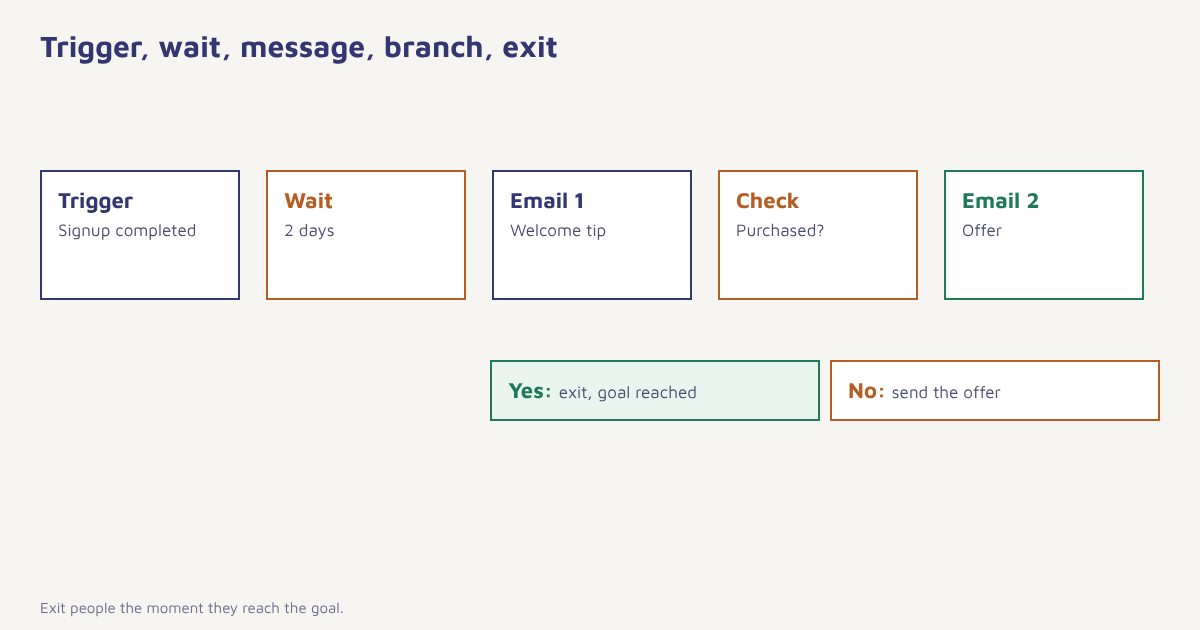
Every drip has four parts. A trigger starts it: signup, first purchase, a form fill, an abandoned cart. A sequence of messages and waits follows. Conditions branch the path based on behaviour. An exit ends it when the goal is reached, so people do not get reminded to do something they have already done.
Five drip campaigns worth building
| Drip | Trigger | Sequence | Goal |
|---|---|---|---|
| Welcome | Signup | Email now; tip on day 2; best content on day 5; offer on day 7 | Engage new subscribers |
| Onboarding | Account created | Setup task, nudge if stalled, first-value note, habit tip, check-in on day 30 | Activation |
| Lead nurture | Guide download | Educate, case study, comparison, demo invitation | Booked demo |
| Post-purchase | Order delivered | Care tips, review request, cross-sell after a week | Repeat orders and reviews |
| Win-back | No activity in 60 to 90 days | Check-in, incentive, final notice | Reactivate or clean the list |
Our guides go deeper on three of these: customer onboarding, lead nurturing and abandoned cart recovery. Ready-to-edit versions live in the use cases.
Choosing the timing
Timing depends on how fast your customer decides. Impulse purchases move in hours. Business software moves in weeks. Use these as starting points and adjust with data.
| Situation | Typical spacing |
|---|---|
| Welcome | Immediate, then day 2, day 5 and day 7 |
| Cart reminder | 1 hour, 24 hours, 72 hours |
| Lead nurture (B2B) | Every 3 to 5 days over three to four weeks |
| Post-purchase | On delivery, then day 3 and day 14 |
| Win-back | Three messages over two weeks, then stop |
Use waits with conditions. Instead of “wait 3 days”, use “wait up to 3 days for a purchase, then continue”. The journey moves on the moment the person acts, which feels far more natural than a fixed timetable.
How to set up a drip campaign, step by step
- Define the goal. One outcome: first purchase, booked demo, second order.
- Choose the trigger and audience. Which event or segment starts it, and who should be excluded.
- Map the messages. Write down what each message does. If two messages do the same thing, merge them.
- Write and design. Short, specific, one call to action each.
- Set waits and branches. Add conditions for opens, clicks and purchases, and a clear exit.
- Apply frequency rules. Cap how often a person can be in drips, and respect quiet hours.
- Test with yourself. Walk the whole sequence on a test contact and check it on a phone.
- Launch, then review. Look at each step’s conversion after a few weeks and fix the weakest.
In Flowfox you build this on the journey canvas: pick an event or segment as the entry, add waits and conditions, choose a channel for each message and set a goal. The first journey guide and the notes on goals and waits take about twenty minutes. You can mix channels, for example email first and WhatsApp for people who did not open, using email and WhatsApp together.
{
  "name": "Welcome drip",
  "trigger": { "event": "signup_completed" },
  "steps": [
    { "send": "email", "template": "welcome_1" },
    { "wait": "2 days" },
    { "send": "email", "template": "welcome_tip" },
    { "wait": "3 days", "until": "purchase_completed" },
    { "if": "not purchase_completed", "send": "email", "template": "welcome_offer" }
  ],
  "goal": "purchase_completed",
  "frequency_cap": { "per_week": 3 }
}
Metrics to track
| Metric | What to look at |
|---|---|
| Entries and completion | How many start and how many finish the sequence |
| Step conversion | Clicks and conversions at each message |
| Goal rate | Share who reach the goal, such as a purchase |
| Drop-off between steps | Where people unsubscribe or stop engaging |
| Unsubscribes and complaints | Whether the pace or content is wrong |
Use analytics to view results by step, and compare against a holdout group to see the real lift. See the A/B testing guide for how to test changes safely.
Drip, triggered and lifecycle: how the terms relate
People use these words loosely, so it helps to separate them. A triggered message is a single email sent because of one event, such as a receipt or a password reset. A drip is a planned series that starts from a trigger. A lifecycle program is the full set of drips and triggers that cover a customer from first visit to loyalty, win-back and beyond. In practice you build triggered messages first because they have the highest intent, then drips for welcome and onboarding, and finally the wider lifecycle. All of this belongs to the broader field of marketing automation, which is why our marketing automation guide pairs well with this one.
Compliance applies to every message in a series, not only the first. Each email needs a working unsubscribe, a truthful sender name and a physical or contact address where the law requires one. The CAN-SPAM Act in the United States and local rules in other countries set these basics, and an unsubscribe should stop the whole drip at once, not just the current step. Keep a record of when and how each person agreed to receive messages, as covered in our list building guide, and remember that a person who opted in for email has not necessarily agreed to WhatsApp or SMS.
One more practical point: write the whole sequence before you build it, reading all messages in order as one conversation. Repeated openings, repeated offers and a tone that shifts between messages are easy to spot on a single read and hard to spot inside a tool. Cut anything that does not move the reader towards the goal, and keep the last message honest about being the last.
Common mistakes
- Too long. Most people do not read the tenth email. Keep sequences short and focused.
- No exit. Reminding a customer who already bought is a fast way to lose them.
- Same message for everyone. Segment by source, interest or stage. See customer segmentation.
- Forgetting consent and frequency. Respect channel permission and cap total messages.
- Never reviewing. Update the content when your product or offers change.
A good drip feels like a thoughtful conversation, not a conveyor belt.
Build your first drip campaign. Start from a template, add waits and goals, and let it run.
Read more about marketing automation and email subject lines, and browse the blog.
Frequently asked questions
What is a drip campaign?
A drip campaign is an automated series of messages sent over time to a contact, triggered by an event such as signing up or buying, and spaced with waits.
How is a drip campaign different from a newsletter?
A newsletter is a broadcast sent to everyone at once. A drip campaign is a sequence that each person starts at their own time, often branching on their behaviour.
How many emails should be in a drip campaign?
Most effective drips have between four and six messages. Longer sequences can work for complex sales cycles, but watch drop-off and unsubscribes.
How long should the gaps be between drip messages?
It depends on the buying cycle: hours for impulse purchases and cart reminders, a few days for welcome and nurture sequences, and weeks for long B2B decisions. Test and adjust.
What are examples of drip campaigns?
Welcome series, onboarding sequences, lead nurture emails after a download, post-purchase care and review requests, abandoned cart reminders and win-back campaigns.
Do drip campaigns need to be email only?
No. They can use WhatsApp, SMS, push and in-app messages as well, with channels chosen by consent and by what each person responds to.
How do I measure drip campaign success?
Track goal rate, conversion at each step, drop-off between steps, unsubscribes and complaints, and compare results with a holdout group that did not receive the drip.