Customer data usually lives in a dozen places: the website, the app, the store system, the payment gateway, the helpdesk, the email tool. Each holds a slice of the same person under a different ID. A customer data platform, or CDP, is the system built to pull those slices together into one profile that other tools can use. This guide explains what a CDP is, how it differs from a CRM, a data warehouse and a DMP, what it does, when you actually need one, how to evaluate options and how to implement it without a year-long project.
What is a customer data platform?
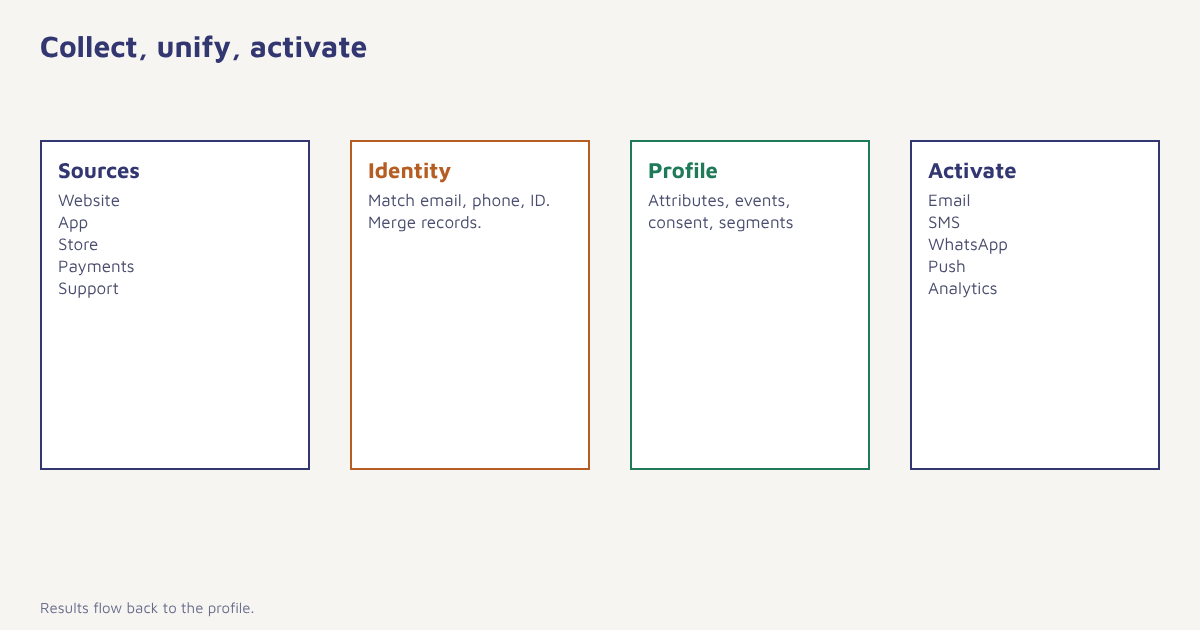
A customer data platform is software that collects customer data from many sources, links records that belong to the same person, stores them as a persistent profile and makes that profile available to marketing, product and support tools. The main idea is that marketing teams can use the data directly, without raising an engineering ticket for each new audience. A CDP does three jobs: collect, unify and activate.
How a CDP works
- Collect. Events, attributes and transactions arrive through SDKs, APIs, webhooks and file imports from your site, app, store, payment and support systems.
- Resolve identity. Records that share an identifier, such as the same email address or phone number or a logged-in user ID, are merged into one profile. Anonymous visits are attached once the person identifies themselves.
- Unify and enrich. The profile gathers attributes, event history, consent status and computed fields such as lifetime value.
- Segment. Rules create audiences that update as profiles change.
- Activate. Audiences and profile data flow to channels and tools for messaging, personalization and analysis.
- Learn. Results flow back to the profile so the next decision uses what happened.
CDP vs CRM vs data warehouse vs DMP
| CDP | CRM | Data warehouse | DMP | |
|---|---|---|---|---|
| Main purpose | Unified customer profiles for activation | Managing sales and service relationships | Storing and analysing large datasets | Anonymous audience data for ads |
| Data type | First-party, identified and anonymous | Contacts, deals, tickets | Everything, structured | Mostly third-party and cookies |
| Main users | Marketing and product | Sales and support | Data and analytics teams | Advertising teams |
| Real-time activation | Yes | Limited | Usually not | For ad buying |
| Identity resolution | Core feature | Basic | Needs to be built | Cookie-based |
A CDP does not replace a CRM or a data warehouse. It sits between your sources and your marketing tools, and often feeds the others. A data management platform is an older advertising tool built around cookies and third-party data, which is fading as privacy rules tighten.
What a CDP is used for
| Use case | Example |
|---|---|
| Unified customer view | Support sees the same orders and messages marketing sent |
| Behavioural segmentation | Customers who viewed a product twice and have not bought |
| Triggered messaging | Cart reminder, payment failure, welcome series |
| Personalization | Recommendations and dynamic content using the whole profile |
| Suppression and consent | Stop messages everywhere when a person opts out |
| Analytics and attribution | Cohorts, funnels and revenue by channel |
These are the same jobs that personalization, omnichannel marketing and segmentation depend on. Without unified data, each of them stays shallow.
Do you need a CDP?
Not every business does. Ask these questions.
- Do customers appear in three or more systems with different IDs?
- Do you need audiences based on behaviour across site, app and store, not only email activity?
- Do your channels send conflicting or duplicate messages because they cannot see each other?
- Does marketing wait weeks for engineers to build each new audience?
- Do you need one place to enforce consent and suppression?
If you answered yes to two or more, a CDP, or a platform with a built-in profile and event store, will probably pay for itself. If you have one store and one email tool, simple integrations may be enough for now.
Built-in profiles count. Many modern engagement platforms, including Flowfox, keep a unified profile with events, attributes, consent and segments as part of the product. For many teams that covers the CDP job without buying and integrating a separate system.
How to evaluate a CDP
| Question | Why it matters |
|---|---|
| How does identity resolution work, and can I see and undo merges? | Wrong merges are worse than none |
| Which sources and destinations are supported out of the box? | Integration effort drives cost |
| Can marketers build audiences without engineers? | Speed of use |
| How fast does data reach channels? | Real-time triggers need real-time data |
| How is consent stored and enforced? | Compliance and trust |
| Where is data stored and how is it secured? | Privacy and regulation, including Indian rules |
| What does it cost at your event volume? | Pricing is often per profile or per event |
How to implement a CDP without a giant project
- Define two or three use cases. For example cart recovery and a welcome series. Let them drive what data you collect first.
- Choose the identity keys. Decide how to match people, such as email, phone number and customer ID.
- Design a small tracking plan. Name the events and attributes you need and keep names consistent. See our data model guide.
- Connect the highest-value sources. Usually the website or app, the store or order system and the payment gateway.
- Send the events and test them. Check profiles for a few real customers end to end. See sending your first event.
- Add consent. Store permission per channel and apply it to every audience.
- Activate one journey. Prove value quickly, then add use cases.
{
  "event": "order_completed",
  "identity": { "email": "asha@example.com", "phone": "91XXXXXXXXXX", "customer_id": "c_8841" },
  "properties": {
    "order_id": "FX-20481",
    "total": 3498,
    "currency": "INR",
    "items": [{ "sku": "TR-07", "name": "Trail Runner", "qty": 1 }]
  },
  "consent": { "email": true, "whatsapp": true, "sms": false },
  "timestamp": "2026-11-02T10:15:00Z"
}
A single event like this carries identity, the action and the consent state. Send it consistently from every source, and the profile builds itself.
The profile layer in Flowfox
Flowfox keeps one profile per person. Contacts store identifiers, attributes and consent, the data model holds events and transactions, FlowConnect brings data in from your tools and the API, and segments turn it into live audiences for journeys and campaigns. Analytics reads from the same profile, so reporting and messaging never disagree. If you are moving from another tool, the migration guide describes how to bring your data across.
Privacy and governance
A unified profile concentrates personal data, so governance matters. Collect only what you use. Record consent and its source. Limit who can see what. Set retention periods and delete data on request. In India, the Digital Personal Data Protection Act, 2023 sets duties around notice, consent and withdrawal, and customers in the EU have rights under the GDPR. Involve your legal advisor when you design the tracking plan, not after you launch.
Common mistakes
- Starting with “collect everything”. Begin with use cases, then collect what they need.
- Skipping the tracking plan. Inconsistent event names make data unusable.
- Bad identity matching. Merging two different people damages trust. Start with strong identifiers.
- Treating it as an IT project. Marketing and product need to own the use cases.
- Ignoring consent. A unified profile must respect permission everywhere.
A CDP is not a database you admire. It is the layer that lets every message know who it is talking to.
See your customers as one person. Unify events, attributes and consent, then activate across every channel.
For next steps, see retention strategies and marketing automation, and read more on the blog.
Frequently asked questions
What is a customer data platform (CDP)?
A CDP is software that collects customer data from many sources, links records that belong to the same person into a unified profile and makes that profile available to marketing, product and support tools.
What is the difference between a CDP and a CRM?
A CRM manages sales and service relationships with contacts, deals and tickets. A CDP unifies behavioural and transactional data from many sources and feeds it to marketing and product tools in real time.
What is the difference between a CDP and a data warehouse?
A data warehouse stores and analyses large structured datasets, mainly for data teams. A CDP focuses on identity resolution, unified profiles and activating audiences in other tools, and is usable by marketers.
Do I need a CDP?
You probably do if customers appear in several systems with different IDs, you need cross-channel behavioural audiences, channels send conflicting messages or marketing waits on engineers for every audience. A simpler setup may suffice with one store and one email tool.
What is identity resolution?
Identity resolution links records that belong to the same person, using identifiers like email, phone number or user ID, so all events and attributes appear on a single profile.
How long does it take to implement a CDP?
A focused implementation with two or three use cases and a few sources can show value in weeks. Large, all-sources projects take much longer, so start small and expand.
Is a CDP compliant with data protection laws?
Compliance depends on how you use it. You need clear notice, recorded consent, access and deletion processes, security controls and retention rules, in line with laws such as India’s DPDP Act and the GDPR.