Loyalty programs are everywhere: points at the pharmacy, stamps at the coffee shop, tiers at the airline. Some are quietly profitable, and many are expensive ways to give discounts to people who would have bought anyway. The difference comes down to design. This guide explains what a loyalty program is, the main types, how to choose rewards that change behaviour rather than just cost money, how to run one with the tools you already have, how to measure whether it works and the mistakes that sink most of them.
What is a customer loyalty program?
A loyalty program is a structured scheme that rewards customers for repeat purchases or other valued behaviour. The reward can be points, discounts, free products, early access, status or experiences. The goal is not generosity. It is to increase retention and repeat purchases among customers who would otherwise drift away, and to learn more about those customers through the data they share. It belongs to the same family of tactics as retention strategies, and its value shows up in customer lifetime value.
Types of loyalty programs
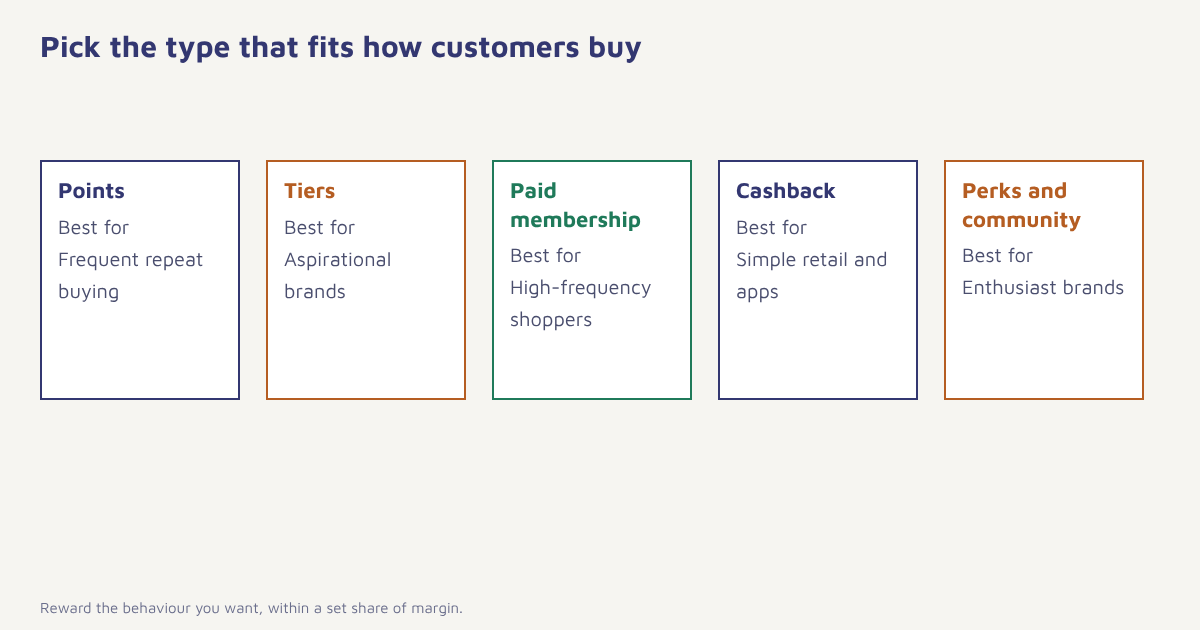
| Type | How it works | Best for | Watch out for |
|---|---|---|---|
| Points | Earn points per rupee, redeem for rewards | Frequent, repeat purchases | Liability for unredeemed points |
| Tiers | Status levels unlock better benefits | Brands with aspirational appeal | Complexity; most customers never reach the top |
| Paid membership | A fee for ongoing benefits such as free shipping | High-frequency shoppers | Must deliver visible savings |
| Cashback or store credit | Earn a share back to spend later | Simple retail and apps | Margin impact |
| Punch card or stamps | Buy N, get one free | Cafes, salons, local services | Easy to copy; low data value |
| Perks and community | Early access, events, exclusive products | Enthusiast brands | Needs real exclusivity |
How to design a program that earns its cost
- Decide the behaviour you want. More orders, higher basket, faster second purchase, referrals, reviews? Reward that.
- Make the first reward easy. If people must spend a lot before they get anything, they never start. A welcome reward builds the habit.
- Reward the margin, not just the revenue. Points on low-margin products can lose money.
- Make progress visible. “You are 120 points from a free gift” drives the next order.
- Keep the rules simple. If you cannot explain it in two sentences, customers will not use it.
- Offer non-monetary value. Early access and recognition cost little and feel personal.
- Set expiry fairly. Expiry creates urgency but can annoy. State it clearly.
A quick example of the sums. If your average margin on an order of Rs 1,500 is 30 percent, you earn Rs 450. A program that returns 5 percent in rewards costs Rs 75 per order, which is about a sixth of that margin. If it raises repeat orders by 10 percent among members, it may well pay for itself, but if members would have bought anyway, you have simply lowered your margin. This is why a holdout group matters. The numbers here are illustrative, so use your own margins.
Choosing rewards
| Reward | Cost to you | Perceived value | Notes |
|---|---|---|---|
| Percentage discount | High and direct | Medium | Easy to understand, trains customers to wait |
| Free shipping | Moderate | High | Strong in e-commerce |
| Free gift or sample | Low to moderate | High | Good for discovery and cross-sell |
| Early access | Very low | High for fans | Needs a product people want |
| Birthday or milestone offer | Low | Medium | Personal and timely |
| Exclusive experiences | Varies | Very high | Hard to scale |
Reward behaviour, not just spending. Points for a review, a referral, a profile completion or a first app login build engagement beyond the till. They also give you data and content you could not buy.
How to launch a loyalty program, step by step
- Set the goal and the budget. For example, raise repeat purchase rate by a set amount within 12 months, with rewards costing no more than a fixed share of margin.
- Pick the type and the rules. Points, tiers or membership, with simple earning and redemption.
- Define the data. You need a customer identifier on every order, so that purchases link to members. See the data model.
- Build the communication. A welcome message, balance updates, progress nudges, rewards available and expiry reminders.
- Automate with journeys. Trigger each message from events. See journeys.
- Choose the channels. Email for detail, WhatsApp or SMS for short alerts, push for app members. Check consent per channel.
- Launch to a pilot group. Test with a segment, with a comparison group.
- Review and adjust. Check cost, redemption and behaviour after a quarter.
Running loyalty communication in Flowfox
Flowfox is not a points ledger, but it is where the messaging and the segments live, and you can keep a balance or tier as an attribute on the contact profile and update it from your store through FlowConnect or the API. From there, segments can find members close to the next tier, members with expiring points, or members who have not redeemed. A journey can send the right message at the right moment, for example a nudge when a customer is a small spend away from a reward. See the e-commerce solution and the festival campaign use case for seasonal patterns.
Hi {{ contact.first_name | default: "there" }},

You have {{ contact.loyalty_points }} points.
{% if contact.points_to_next_reward <= 100 %}
You are only {{ contact.points_to_next_reward }} points away from your next reward.
{% endif %}
Your points expire on {{ contact.points_expiry_date }}.
The snippet uses Liquid, covered in the Liquid reference, to personalise a balance message. Include a default for missing fields, and avoid sending balance messages to people without consent for that channel.
Measuring whether it works
| Metric | What to compare |
|---|---|
| Repeat purchase rate | Members vs a comparison group |
| Purchase frequency and basket size | Before and after joining |
| Revenue per member | Net of reward cost |
| Enrolment and active rate | Share of customers who join and use it |
| Redemption rate | Too low means weak rewards, too high may mean over-generous |
| Retention by cohort | Members vs non-members. See cohort analysis |
Be careful with a classic trap, selection bias. Customers who join a loyalty program are often already your best customers, so their higher spend is not proof that the program caused it. A holdout group, or a before-and-after comparison on similar customers, gives a fairer answer. Pair your results with satisfaction scores from NPS, CSAT and CES to see whether the program improves how customers feel about you.
Setting a budget and checking the sums
Before launch, model the programme on paper. Take your average order value, gross margin and current repeat rate. Then estimate what share of customers will join, how much more they will buy and what the rewards will cost. If the programme needs customers to buy twice as often to break even, the design is too generous. Start with a modest reward rate, track real redemption in the first quarter and adjust. The study of customer loyalty suggests that emotional connection matters as much as incentives, so spend some of the budget on service, packaging and recognition, which often cost less than discounts. Companies that run schemes in several countries should also check local rules on expiry of points and stored value.
Common mistakes
- Copying a competitor. Your customers and margins differ.
- Too complex. Many tiers and conversion tables confuse people.
- Rewards that are too far away. If it takes a year, people forget.
- No communication. A program nobody hears about does not work.
- Not tracking cost. Unredeemed points are a liability, and over-redeemed ones are a margin leak.
Loyalty is earned by the experience. A program only makes it visible.
Keep members engaged automatically. Segment by tier and balance, trigger reminders and measure the effect.
Continue with customer engagement and win-back campaigns, and visit the blog.
Frequently asked questions
What is a customer loyalty program?
A loyalty program is a structured scheme that rewards customers for repeat purchases or valued behaviour with points, discounts, perks, status or experiences, aiming to raise retention and repeat sales.
What are the main types of loyalty programs?
The main types are points, tiers, paid membership, cashback or store credit, punch cards and perks or community programs.
How do I know if my loyalty program is working?
Compare repeat purchase rate, frequency, basket size and revenue per member net of reward cost against a holdout or comparison group, and watch redemption and retention by cohort.
How much should a loyalty program cost?
Set the reward budget as a share of margin, for example a few percent of order value, and check that the extra repeat purchases cover it.
What rewards work best?
Rewards that are easy to reach and valued, such as free shipping, early access and gifts, often work well. Percentage discounts are simple but can train customers to wait for offers.
Should loyalty points expire?
Expiry creates urgency and limits liability, but it can frustrate customers. If you use it, state the rule clearly and send reminders before points expire.
Can small businesses run a loyalty program?
Yes. A simple stamp card, a welcome reward or a tier for repeat buyers can work, provided you can identify customers and track purchases.