New channels appear every few years, and email is regularly declared dead. Yet it keeps being one of the first channels businesses invest in and one of the last they abandon. The reasons are practical: you own the audience, it is cheap to send, it can be personalised and automated and its results can be measured. This guide sets out the real benefits of email marketing, with examples, the limits you should know about, how email compares with other channels and how to start getting those benefits without hurting your sender reputation.
The main benefits of email marketing
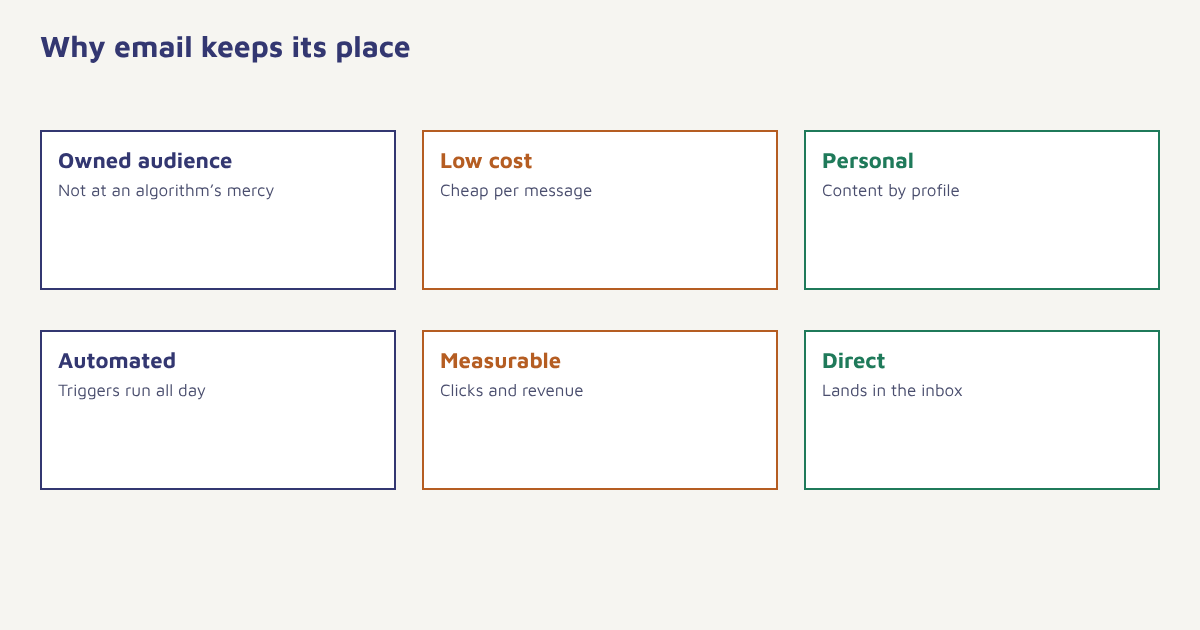
| Benefit | What it means | Example |
|---|---|---|
| Owned audience | The list is yours, not controlled by a platform algorithm | Your newsletter reaches subscribers even if social reach falls |
| Low cost | Sending costs little per message compared with ads | Thousands of messages for the price of a small ad |
| Personalization | Content can change by profile, behavior and stage | Recommendations based on past purchases |
| Automation | Trigger-based messages run without manual work | Welcome series, cart reminders, win-back |
| Measurability | Opens, clicks, conversions and revenue can be tracked | Revenue per email by campaign |
| Direct reach | Messages arrive in a personal inbox | Receipts, updates and offers |
| Flexible content | Short notes, long stories, images, links and attachments | Newsletters, announcements, invoices |
| Integration | Works with your store, CRM and app data | Order events trigger messages |
1. You own the audience
Social networks can change their rules overnight. A list of email addresses that people gave you permission to use is an asset you control. It is portable between tools, and it does not depend on any platform’s reach. That is why list building is worth the effort, provided you collect consent properly and keep the list clean.
2. Low cost and high return potential
Sending an email costs a fraction of a paid click. Industry surveys often report strong returns on email spend, although such figures vary widely by sector and are usually self-reported, so treat them as a guide and measure your own. The economics improve as your list and automation grow, because the same journey serves every new subscriber. Lower cost per conversion also helps your customer acquisition cost.
3. Personalization at scale
With profile and event data, each email can reflect what a person bought, viewed or ignored. A customer who bought running shoes can receive tips on care and a note when new models arrive, while a browser who never bought receives a different message. See marketing personalization and behavioral segmentation for methods.
4. Automation saves time
Once built, automated flows run all day. A welcome series, an abandoned-cart reminder, a post-purchase review request and a win-back sequence together cover much of the customer lifecycle. See drip campaigns, cart recovery and marketing automation.
5. Clear measurement
Email gives you data at each step: delivered, opened, clicked, converted, unsubscribed. Take the numbers with some care, since privacy features have made open rates less reliable; clicks and revenue are sturdier. Our guide to email marketing metrics explains what to track, and A/B testing shows how to improve it.
The limits to know
| Limit | What to do |
|---|---|
| Inbox competition | Make subject lines and content clearly valuable. See subject lines |
| Deliverability | Authenticate your domain and keep the list clean. See deliverability |
| Consent and law | Collect permission, include an unsubscribe and follow local rules |
| Slower than instant channels | Use SMS or WhatsApp for urgent news. See email vs SMS vs WhatsApp |
| Fatigue | Control frequency and segment by interest |
Email also works best as part of a group of channels, not alone. A reminder on WhatsApp may reach someone faster, while a long guide fits email better. Read about the history and practice of email marketing for background, and our omnichannel guide for how to coordinate.
Who benefits most?
| Business | How email helps |
|---|---|
| Ecommerce | Cart recovery, replenishment reminders, product launches |
| SaaS | Onboarding, feature education, renewals |
| Education | Course updates, deadlines, re-enrolment |
| Fintech | Statements, security alerts, product education |
| Media | Newsletters, subscriptions, reader loyalty |
| Local services | Appointment reminders, reviews, offers |
See the ecommerce, SaaS and edtech pages for sector flows.
How to start getting these benefits
- Set up your domain. Add SPF, DKIM and DMARC. See authentication setup.
- Collect consent properly. Use clear forms and record the source.
- Send a welcome message. Confirm the sign-up and set expectations.
- Launch two automated flows. Welcome and cart recovery are good first choices.
- Send a regular newsletter. Choose a rhythm you can sustain.
- Measure and improve. Review clicks and revenue monthly and test one change at a time.
Flowfox puts these pieces in one place: the email builder, campaigns, journeys and analytics, with email delivery built in.
A worked example: an online bookstore
An online bookstore has 30,000 subscribers and sends a weekly newsletter by hand. It adds three automated flows. A welcome series introduces the store and recommends popular titles by the genre the subscriber chose at sign-up. A cart reminder goes out two hours after a basket is left. A post-purchase flow suggests the next book in the series ten days after delivery. Within a few months, most email revenue comes from the three automations, not from the weekly newsletter, and the team spends its time improving content instead of copying lists. The figures are invented, but the pattern is common: the largest benefit of email is often the quiet, always-on flows.
The store also learns from the data. Subscribers who open the newsletter but never buy are shown fewer discounts and more reviews and author stories, while frequent buyers get early access to releases. Because each email links to a product page with tracking, the team knows which topics drive orders and which only drive curiosity. Over time, it builds a picture of its readers that no social platform would hand over. That is the deeper benefit of an owned channel: it lets you learn directly from customers and respond.
Email also supports the rest of the business beyond sales. Receipts and shipping updates build trust, feedback requests improve products, and service notices reduce support calls. Transactional messages typically have the highest engagement of all, which is why our guide to transactional emails is worth a read. For historical background, the article on opt-in email explains how permission became the foundation of the channel, and it is still the best principle to follow: send what people asked for, make it useful and let them leave easily.
If you are weighing a budget decision, compare email against your other channels by cost per conversion and by what each channel does for long-term relationships, not only by first-order sales. Email tends to look strongest on retention and repeat purchase, where its low cost per message and strong targeting matter most. Pair it with push, WhatsApp and SMS for time-sensitive moments, and keep a single view of every customer so that the channels support each other.
Common mistakes
- Buying lists. It damages reputation.
- Sending only promotions. Mix in useful content.
- Ignoring mobile. Most emails are opened on phones.
- No segmentation. Everyone gets everything.
- Judging by opens alone. Look at clicks and revenue.
Email is not the newest channel. It is the one you still own when the others change their rules.
Start with email you own. Build, send and automate email with the rest of your channels.
Read next: email marketing, email newsletters and the blog.
Frequently asked questions
What are the benefits of email marketing?
Key benefits include an owned audience, low cost, personalization, automation, measurable results and direct reach to the inbox.
Why is email marketing still effective?
It reaches people who gave permission, costs little per message, can be personalised and automated, and gives clear data on results.
Is email marketing better than social media?
They serve different purposes. Email gives you an owned audience and direct reach, while social media is good for discovery. Most businesses use both.
Is email marketing cheap?
Sending is inexpensive compared with paid ads, though you also spend on tools, content and list building. Measure return for your own business.
What are the disadvantages of email marketing?
Inboxes are crowded, deliverability needs care, consent rules apply, it is slower than instant messaging and over-sending causes fatigue.
How quickly can I see results from email marketing?
Automated flows like welcome series and cart recovery can show results within weeks, while list growth and reputation take longer to build.
Which businesses benefit most from email marketing?
Ecommerce, SaaS, education, fintech, media and local services all benefit, especially those with repeat customers.