Many brands say they are “everywhere”: email, SMS, WhatsApp, app, website, store. But being in many channels is not the same as working across them. A customer who gets a cart reminder on WhatsApp, the same reminder by email an hour later and a discount SMS after buying has met a multichannel brand that is not connected. Omnichannel means the channels share one view of the customer and act together. This guide explains the difference, compares the two models side by side, shows examples and gives a practical path from multichannel to omnichannel.
Multichannel and omnichannel defined
Multichannel marketing means using several channels to reach customers, each usually run as its own programme with its own data, team and goals. Omnichannel marketing connects those channels around the customer, so a message, a conversation or a purchase on one channel is known and used on the others. The related idea of omnichannel comes from retail, where it describes a seamless experience across store, web and mobile. A fuller guide to the approach is in our article on omnichannel marketing.
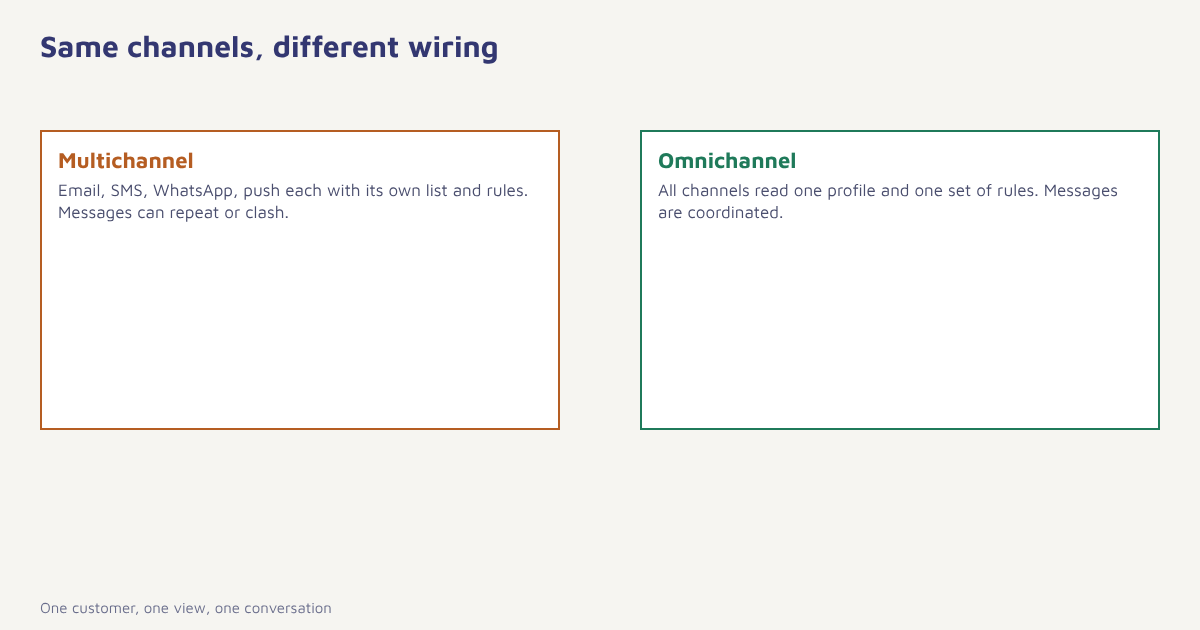
Omnichannel vs multichannel at a glance
| Multichannel | Omnichannel | |
|---|---|---|
| Focus | The channel | The customer |
| Data | Separate per channel | One shared profile |
| Messages | Planned per channel, may repeat or clash | Coordinated, aware of what was already sent |
| Consent and suppression | Handled separately | Applied everywhere at once |
| Customer experience | Fragmented | Continuous |
| Measurement | Per channel | Across the customer journey |
| Team structure | Channel owners | Shared goals, journey owners |
| Effort to start | Lower | Higher, needs integration |
A day in the life of one customer
| Moment | Multichannel brand | Omnichannel brand |
|---|---|---|
| Adds shoes to cart on the app and leaves | Email reminder after 4 hours, WhatsApp reminder after 5 | One reminder on the channel the customer prefers, timed once |
| Buys in the store the next day | Still receives cart reminders | Cart journey stops at once |
| Delivery delayed | Support and marketing both send updates | One update, support sees the same record |
| Opts out of SMS | Still gets WhatsApp promos from another tool | Opt-out applies to the right channels, with preferences honoured |
| Returns a week later | Receives generic offer | Receives something based on the purchase |
The omnichannel customer feels recognised. The multichannel customer feels like they are talking to five separate companies. The cost of the gap shows up as lower engagement, more unsubscribes and wasted spend, as the customer engagement guide explains.
Why omnichannel pays off
- Fewer duplicate and conflicting messages. Less annoyance and fewer unsubscribes.
- Better timing. Triggers react to behaviour on any channel.
- Stronger personalization. The whole history informs each message. See personalization.
- Cleaner reporting. You see how channels work together, not only separately.
- Easier compliance. One place for consent and suppression. See the DPDP Act guide.
How to move from multichannel to omnichannel
- Map the channels you use. List every tool that sends messages and who owns it.
- Pick the identity keys. Decide how to recognise a person across channels, such as email, phone number and customer ID. See the customer data platform guide.
- Unify the data. Bring events, orders and consent into one profile. See the data model.
- Centralise consent. Record permission per channel and apply it to every send.
- Set channel rules. Define which channel leads for each message type and what fallback to use. See email vs SMS vs WhatsApp.
- Build cross-channel journeys. Start with cart recovery or welcome, with conditions that stop the flow when the goal is met.
- Add frequency caps. Limit total messages per person per week across all channels.
- Measure the journey. Look at conversion and revenue per customer, not just per channel.
Flowfox was built around this model: one contact profile, channels such as email, WhatsApp, SMS and push in the same journey and analytics across them. See the FlowConnect page for connecting your other systems.
When multichannel is enough
Omnichannel is a direction, not a switch. A small business with one store and a single email tool may not need it yet, and forcing the integration could cost more than it returns. Multichannel is enough when your audience is small, your channels rarely overlap or you are still learning which channels work. Move toward omnichannel when customers appear in several systems, messages begin to clash or teams spend their time copying lists between tools. A sensible first step is shared suppression: make sure that a person who opts out or buys is removed from other channels’ campaigns promptly. Even that small change removes much of the irritation.
It also helps to define what “connected” means in practice. At the basic level, channels share a customer ID and a consent record. At the next, they share events, so a purchase on one channel changes what the others send. At the advanced level, they share decisions too, so one engine chooses the next best message and channel for each person. Most teams move through these levels over months. For background reading on the wider idea, see the overview of multichannel marketing.
How to measure omnichannel success
Channel reports alone cannot show whether the approach works, so add a few customer-level measures. Track revenue per customer across all channels, the share of customers active on two or more channels, the rate at which duplicate or conflicting messages occur (ideally close to zero), unsubscribe and complaint rates per customer and the time from first trigger to conversion. If connecting channels is working, customers who engage on more than one channel should be more valuable and more loyal than those on one, and your total message volume per person should fall or stay flat while results rise. Use a holdout group to check this: leave a small random share of customers on the old, uncoordinated setup and compare.
Attribution is the hard part. When a customer sees an email, taps a push and then buys after a WhatsApp reminder, which channel gets the credit? Simple last-click models give it all to the final touch, which undervalues the others. Look at several views, including first touch, last touch and a comparison of customers who received a channel with similar ones who did not. No model is perfect, so use them to ask better questions, not to settle arguments. The background on this problem is covered in the article on marketing attribution.
Finally, think about the people behind the system. Omnichannel often fails for organisational reasons, not technical ones: the email team and the app team have separate targets, and each fights for the customer’s attention. Agree on shared goals such as retention or revenue per customer, appoint an owner for each journey and hold a regular review of what customers actually receive. Look at the experience from the customer’s side by signing up with a test account and following the messages for a month. You will learn more from that exercise than from many dashboards. For more on the numbers that matter, see our guide to email marketing metrics and customer lifetime value.
Common mistakes
- Buying tools before fixing data. Integration without identity matching only moves the mess around.
- Sending everywhere. Omnichannel is not “every message on every channel”.
- No frequency cap. More channels means more risk of overload.
- Different tone per channel. Keep the brand voice consistent.
- Measuring only per channel. You miss how channels help each other.
Multichannel is where you show up. Omnichannel is whether you remember who you are talking to.
Run one journey across every channel. Unify the profile and coordinate email, WhatsApp, SMS and push.
Read next: marketing automation, retention strategies and the blog.
Frequently asked questions
What is the difference between omnichannel and multichannel?
Multichannel uses several channels separately. Omnichannel connects them around one customer profile so messages and experiences are coordinated.
Is omnichannel better than multichannel?
Omnichannel usually gives a better customer experience and clearer measurement, but needs more integration. Multichannel can be enough for small or early-stage businesses.
What is an example of omnichannel marketing?
A customer abandons a cart on the app, gets one reminder on their preferred channel, buys in a store the next day and the reminder journey stops automatically.
What do I need to be omnichannel?
You need identity matching across channels, one customer profile with events and consent, cross-channel journeys and shared frequency rules.
Does omnichannel mean sending on every channel?
No. It means choosing the right channel and timing for each person, and avoiding duplicates and conflicts.
How does omnichannel help with compliance?
A single consent and suppression record lets you apply opt-outs and permissions to every channel consistently.
How do I start moving to omnichannel?
Map your channels, pick identity keys, unify data and consent, then build one cross-channel journey such as cart recovery.