Should you send that message by email, SMS or WhatsApp? Teams often choose by habit or by whichever tool is nearest. A better way is to choose by what the message needs to do: how fast it must arrive, how much it needs to say, whether the person agreed to hear from you on that channel, and what it costs. This guide compares the three channels honestly, with strengths, weaknesses, costs, rules and typical uses, and gives a simple way to decide for each message. It also shows how to combine them so that one customer does not get the same message three times.
The three channels side by side
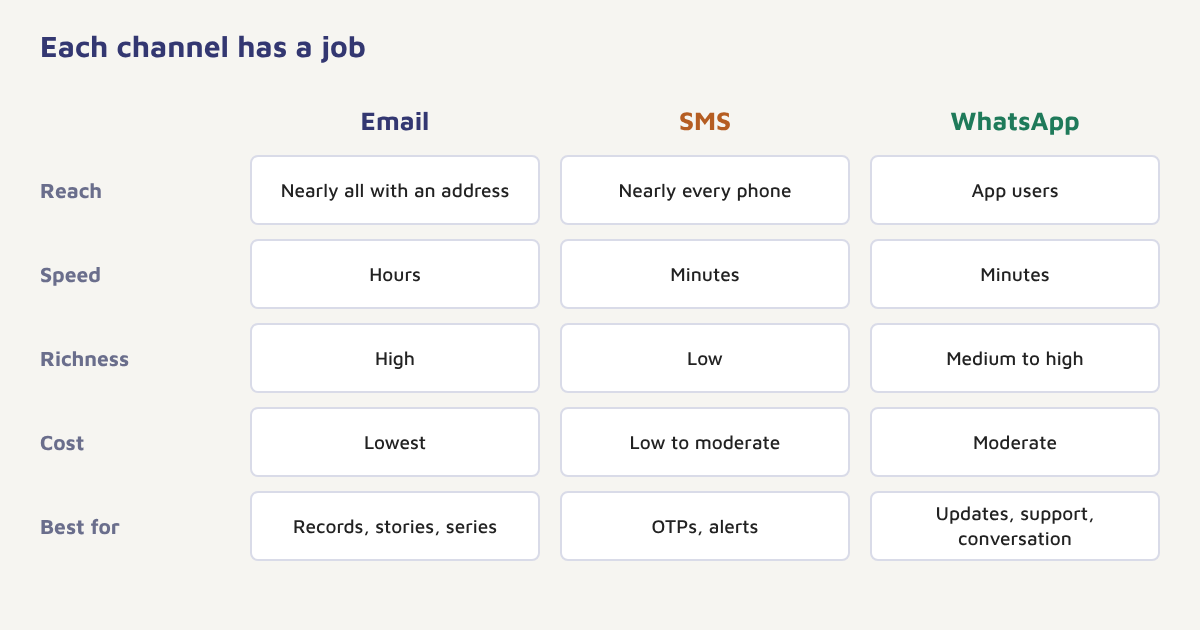
| SMS | |||
|---|---|---|---|
| Reach | Nearly everyone with an address | Nearly every phone, no data needed | Most smartphone users in many markets, need the app |
| Speed of attention | Hours | Minutes | Minutes |
| Richness | High: long text, images, design | Low: plain text and a link | Medium to high: images, documents, buttons, conversation |
| Cost per message | Lowest | Low to moderate, per segment | Moderate, varies by category and country |
| Two-way conversation | Slow | Limited | Natural |
| Rules to follow | Consent, unsubscribe, authentication | Registered headers and templates, timing rules | Opt-in, approved templates, 24-hour window |
| Best for | Newsletters, receipts, stories, lifecycle series | OTPs, alerts, short time-sensitive offers | Order updates, support, personal offers, conversation |
| Main risk | Spam folder, low attention | Intrusive, character limits | Blocks and quality rating if you over-send |
Where email wins
Email is the best channel for anything that needs space or a record. Receipts, invoices, long guides, newsletters and multi-step lifecycle series all suit it, and it is the cheapest to send at scale. It also reaches people who are not on a particular app. Its weakness is attention: inboxes are crowded and messages may wait hours to be read. Deliverability work such as authentication and list hygiene is essential. See our guides to email marketing, deliverability and transactional emails.
Where SMS wins
SMS needs no app and no internet connection, and nearly every phone can receive it. That makes it the channel of choice for one-time passwords, delivery alerts, payment reminders and urgent updates. Messages are read quickly, but they are short and plain, and in India they must follow registration and template rules. See SMS marketing and SMS templates. SMS can feel intrusive if overused, so reserve promotions for moments that justify the interruption.
Where WhatsApp wins
WhatsApp combines high attention with a conversational format. Customers can reply with a question, tap a button or send a photo. That makes it strong for order updates, appointment reminders, customer support and personal offers to people who have opted in. The trade-offs are platform rules (approved templates, the 24-hour window, quality ratings), a per-message cost and the need for the recipient to use the app. See WhatsApp marketing, WhatsApp broadcasts and WhatsApp chatbots.
How to choose for each message
| Question | If yes, lean towards |
|---|---|
| Must it arrive in seconds, like a code? | SMS, with email or WhatsApp as a fallback |
| Does it need a lot of content or a document? | Email, or WhatsApp with a document |
| Do you want a reply or a conversation? | |
| Is it a record the customer will search for later? | |
| Is the customer on the move and the message time-sensitive? | SMS or WhatsApp |
| Is it a low-priority update for many people? | Email, the cheapest channel |
| Does the customer have consent on this channel? | Only then can you use it |
Consent decides first. Before any other question, check that the customer has agreed to hear from you on that channel. Permission for email is not permission for SMS or WhatsApp. Our DPDP Act guide explains how to record consent per channel.
The same event on three channels
| Event | SMS | ||
|---|---|---|---|
| Order shipped | Full details and tracking in a designed email | Short alert with a tracking link | Update with a tracking button and a reply option |
| Cart abandoned | Reminder with product image | Short nudge, only to opted-in customers | Personal reminder with a button to resume |
| Payment due | Invoice and pay link | Brief due date and link | Reminder with a pay button |
| Festival offer | Gift guide | Short time-limited code | Personal offer with buttons. See festival campaigns |
| Feedback request | Survey link | Rating by reply | One-tap rating buttons. See NPS, CSAT and CES |
Combine channels without spamming
The best results come from sequences where channels support each other. A common pattern: send an email first, wait a day, and send a WhatsApp or SMS message only to those who did not open or click and who have consented to that channel. For high-importance messages, such as a payment failure, you may use two channels at once. Set frequency caps across all channels so that one person does not receive the same offer three times in an hour, and give each person a preferred channel based on what they respond to. This is the idea behind omnichannel marketing, and a journey is the tool that makes it work. Use segments to split audiences by channel consent and by engagement, and analytics to compare channel results.
- List your messages. Group them: transactional, lifecycle, promotional and conversational.
- Check consent by channel. Record permission for email, SMS and WhatsApp separately.
- Assign a primary channel. The one that suits each message type best.
- Add a fallback. What to try if the first channel is not opened or not available.
- Set shared limits. Maximum messages per day and week across all channels, plus quiet hours.
- Test channel mixes. Compare email only against email plus WhatsApp, with a holdout.
- Review costs and results. Look at revenue and cost per channel, not just clicks.
{
  "journey": "Cart reminder",
  "entry": { "event": "cart_abandoned" },
  "steps": [
    { "wait": "1 hour", "until": "order_completed" },
    { "send": "email", "template": "cart_1" },
    { "wait": "1 day", "until": "order_completed" },
    { "if": "consent.whatsapp and not email_clicked", "send": "whatsapp", "template": "cart_reminder_wa" },
    { "wait": "2 days", "until": "order_completed" },
    { "if": "consent.sms and not any_clicked", "send": "sms", "template": "cart_last_sms" }
  ],
  "frequency_cap": { "per_day": 1, "per_week": 4 }
}
Thinking about cost
Channel costs differ and change over time, so look at current price lists, but the pattern is stable: email is cheapest per message, SMS costs more per segment and WhatsApp varies by message category and destination. A cheaper channel is not always better. A WhatsApp message that converts at three times the rate of email may be well worth its price for a high-value order and not worth it for a low-value one. Compare cost per conversion, not cost per message. Our pricing page explains how channel costs work on Flowfox. For general background on how messaging channels developed, see instant messaging and omnichannel.
Notes for India
In India, all three channels are widely used, but their roles differ by audience. WhatsApp is the dominant messaging app, which makes it a natural channel for service and conversation, while SMS remains important for one-time passwords, bank and payment alerts and for customers who do not use data all the time. Email is strongest for B2B, e-commerce receipts and content. Regulation also differs: SMS follows the telecom registration system, WhatsApp follows Meta’s business policies and all three fall under data protection rules for personal data. Language matters as well. Many customers prefer messages in Hindi or a regional language, and short, clear messages in the customer’s own language usually outperform English translations. Check how the script renders: Unicode text uses fewer characters per SMS segment, and some fonts display poorly in older email clients. Test on real devices in the languages you plan to use, and let customer replies show you which language and channel each person prefers.
Finally, review the mix every quarter. Customer habits change, platform rules change and prices change. A comparison like this one is a starting point, and your own results are the evidence that should decide how you spend.
Common mistakes
- Using one channel for everything. Each has a strength.
- Messaging without channel-specific consent. It is a legal and trust risk.
- Duplicating messages. Coordinate with shared limits.
- Choosing by cost per message. Compare cost per result.
- Ignoring preferences. Some people ignore email and answer WhatsApp. Let their behaviour decide.
The right channel is the one your customer actually reads, with permission, at the moment it matters.
Use every channel on purpose. Send by email, SMS or WhatsApp from one journey, with shared limits and per-channel consent.
Read next: RCS messaging and push notifications, and visit the blog.
Frequently asked questions
Which is better, email, SMS or WhatsApp?
None is better for everything. Email suits detail and records at low cost, SMS suits urgent short alerts, and WhatsApp suits conversation and rich, personal updates. Choose by what each message needs.
Is WhatsApp more effective than email?
WhatsApp often gets faster attention and enables conversation, but it costs more per message, needs opt-in and approved templates, and suits shorter content. Email is better for long content and records.
When should I use SMS instead of WhatsApp?
Use SMS for one-time passwords and urgent alerts to people who may not use WhatsApp or have no data connection, and WhatsApp when you want rich content or a reply.
Can I use all three channels together?
Yes, with consent on each channel, shared frequency limits and rules that avoid duplicates, for example sending WhatsApp only to people who did not open the email.
Do I need separate consent for each channel?
Yes. Permission to email does not cover SMS or WhatsApp, so record consent per channel and per purpose.
Which channel is cheapest?
Email is usually the cheapest per message. SMS and WhatsApp cost more, and the best comparison is cost per conversion, not cost per message.
How do I decide which channel to use for each message?
Check consent first, then consider speed, content length, need for a reply, cost and the customer’s own response history.