How much does it cost to win one new customer? It sounds like a simple question, and it is the one that decides whether a growing business is healthy or quietly losing money on every sale. Customer acquisition cost, or CAC, is the number that answers it. This guide explains how to calculate CAC with a worked example, how to compare it with customer lifetime value, what a good ratio looks like, how to handle blended versus paid CAC and payback period, and the practical ways marketers bring it down without cutting quality.
What is customer acquisition cost?
Customer acquisition cost is the total sales and marketing spend needed to acquire a new customer over a period, divided by the number of new customers won in that period. It tells you what you pay for growth. Unlike a campaign metric such as cost per click, CAC measures the cost of an actual customer, not a visit or a lead, which makes it the bridge between marketing activity and business outcomes.
The formula, with an example
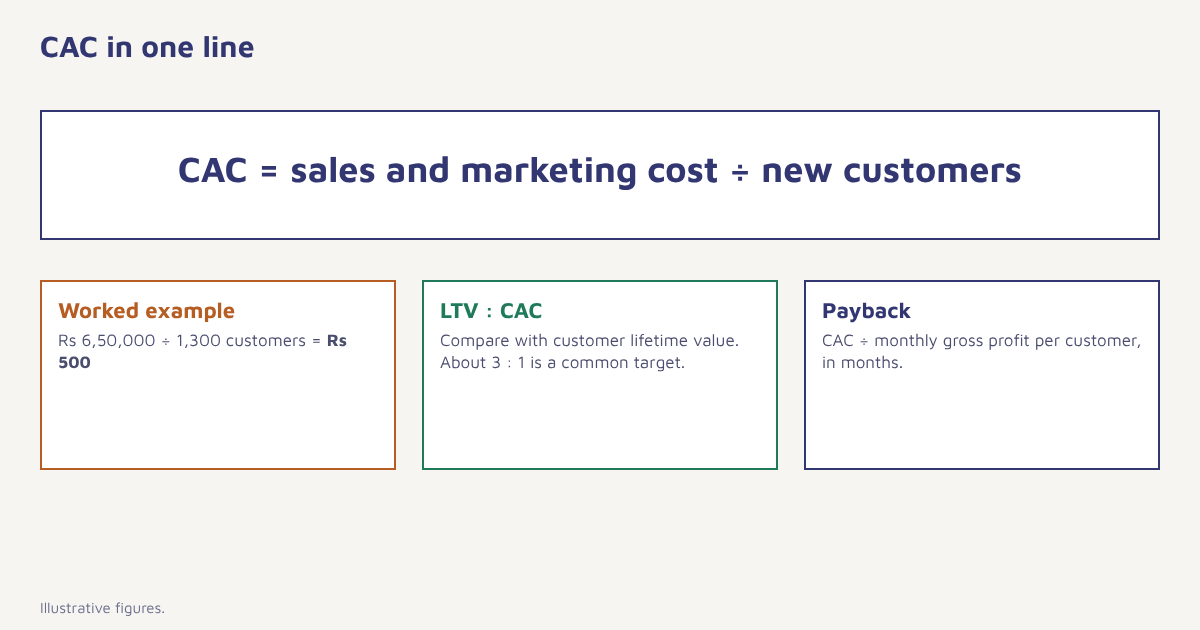
Formula. CAC = total sales and marketing costs in the period ÷ number of new customers acquired in the period
Suppose in one quarter an online store spends Rs 4,00,000 on ads, Rs 80,000 on tools and agency fees, Rs 1,20,000 on salaries for the marketing team and Rs 50,000 on content and creative. The total is Rs 6,50,000. In the same quarter, it wins 1,300 new customers. The CAC is 6,50,000 ÷ 1,300 = Rs 500.
| Cost item | Amount (Rs) |
|---|---|
| Ad spend | 4,00,000 |
| Tools and agency fees | 80,000 |
| Marketing salaries | 1,20,000 |
| Content and creative | 50,000 |
| Total | 6,50,000 |
| New customers | 1,300 |
| CAC | 500 |
These numbers are an illustration of the arithmetic. What you include in the cost matters. A fully loaded CAC counts salaries and tools, while a simpler paid CAC counts only advertising. Both are useful, but do not compare one with the other, and be consistent over time.
Blended CAC, paid CAC and channel CAC
| Type | What it includes | Use it for |
|---|---|---|
| Blended CAC | All new customers, from every source, over all costs | The overall health of the business |
| Paid CAC | Customers attributed to paid channels over paid spend | Judging advertising efficiency |
| Channel CAC | Cost and customers for one channel, such as search or social | Reallocating budget |
| Fully loaded CAC | Includes salaries, tools, overheads | Profitability planning |
Blended CAC is stable, because it includes organic and referral customers, but it can hide a rising paid cost. Paid CAC shows the marginal price of growth. As a business scales, paid CAC usually rises because the cheapest audiences are used first. Track both. Attribution is imperfect, so treat channel CAC as a guide and check it with experiments such as turning a channel off in one region.
CAC and customer lifetime value
A CAC of Rs 500 is cheap if a customer is worth Rs 5,000 and terrible if they are worth Rs 400. The standard comparison is the ratio of customer lifetime value to CAC. See our guide to customer lifetime value for how to estimate it.
| LTV : CAC | What it often suggests |
|---|---|
| Below 1 : 1 | You lose money on every customer |
| 1 : 1 to 3 : 1 | Thin or uncertain; check margins and retention |
| About 3 : 1 | A commonly quoted healthy level for many businesses |
| Above 5 : 1 | Strong, or you may be under-investing in growth |
The 3 to 1 figure is a popular rule of thumb, not a law. The right ratio depends on margin, cash needs and how reliable your lifetime value estimate is. Use gross margin, not revenue, when you calculate lifetime value, otherwise the ratio flatters you.
Payback period
Payback period is the time it takes for a customer’s gross profit to repay their acquisition cost. If CAC is Rs 500 and the average customer generates Rs 150 of gross profit per month, payback is about 3.3 months. Short payback lets you reinvest quickly. Long payback needs patient cash. Many subscription businesses aim for payback within a year, but your tolerance depends on your funding and retention. This is where retention matters: a customer who leaves before payback is a loss. See customer churn rate and cohort analysis to check whether customers stay long enough.
How to reduce customer acquisition cost
- Fix conversion before buying traffic. A better landing page, faster checkout and clearer offer lower CAC without touching ad spend.
- Target better. Use your best customers to define who to reach. Lookalike audiences and sharper segments cut waste.
- Recover the leaks. Win back carts and leads you already paid for. See abandoned cart recovery and lead nurturing.
- Use owned channels. Email, WhatsApp and SMS convert existing visitors at low marginal cost. See list building.
- Encourage referrals. Reward customers who bring friends. A referral often costs less than an ad.
- Improve onboarding. Activated customers stay and recommend you. See customer onboarding.
- Invest in content and SEO. Organic traffic has a slower start but a low marginal cost.
- Test continuously. Run experiments and keep the winners. See A/B testing.
Notice that most of these steps do not involve spending less. They involve getting more from what you already spend. Cutting the budget blindly often lowers CAC for a month and then starves growth. The better lever is retention: if customers stay longer and buy more, you can afford a higher CAC and still win. See our guides to retention strategies and loyalty programs.
Tracking CAC with Flowfox data
CAC needs two inputs: spend and new customers. Flowfox holds the customer side. The data model records the first order and the source on each contact profile, so you can count new customers by channel and campaign. Analytics shows new customers and revenue by source, and you can export the counts to combine with your ad spend in a spreadsheet. Use FlowConnect to bring in order data from your store. The measurement is only as good as your source tracking, so capture UTM parameters or the referring channel at sign-up and first purchase.
-- New customers and blended CAC by month (spend table assumed)
SELECT m.month,
       s.total_spend,
       COUNT(*)                         AS new_customers,
       ROUND(s.total_spend / COUNT(*), 2) AS cac
FROM (SELECT customer_id, DATE_FORMAT(MIN(created_at), '%Y-%m-01') AS month
      FROM orders GROUP BY customer_id) m
JOIN marketing_spend s ON s.month = m.month
GROUP BY m.month, s.total_spend
ORDER BY m.month;
Pitfalls in measuring CAC
- Counting leads as customers. A lead is not a customer, and cost per lead is a different measure.
- Ignoring salaries and tools. Fully loaded cost is what the business really pays.
- Mixing periods. Customers won this month were often influenced by spend from earlier months, so for long sales cycles, lag the spend.
- Overcrediting last click. Branded search often gets credit for customers that email or social created.
- Not separating new from returning customers. CAC applies to new customers only.
For definitions that finance teams and investors use, see the overview of marketing mix modeling for how attribution is estimated at the channel level, and the idea of unit economics for how CAC fits into the profitability of one customer. Both are useful background even if you never build a model.
Common mistakes
- Chasing the lowest CAC. The cheapest customers may leave first.
- Comparing with the wrong benchmark. Industries and models differ widely.
- Forgetting margin. Revenue-based ratios overstate health.
- Ignoring payback. A good ratio can still strain cash.
- Reporting once a year. Track monthly, and watch the trend.
CAC alone tells you what growth costs. Pair it with lifetime value and you learn whether it is worth it.
See new customers and sources in one place. Track first orders, sources and retention to understand what growth really costs.
Continue with customer lifetime value and email marketing metrics, and visit the blog.
Frequently asked questions
What is customer acquisition cost (CAC)?
CAC is the total sales and marketing cost needed to win a new customer, calculated as total costs in a period divided by the number of new customers acquired in that period.
How do you calculate CAC?
Add all sales and marketing costs for a period, including ads, tools, salaries and content, and divide by the number of new customers won in the same period.
What is a good LTV to CAC ratio?
A ratio of about 3 to 1 is a commonly quoted healthy level, but the right figure depends on margins, cash needs and the reliability of your lifetime value estimate.
What is CAC payback period?
It is the time it takes for a customer’s gross profit to repay their acquisition cost, calculated as CAC divided by monthly gross profit per customer.
What is the difference between blended and paid CAC?
Blended CAC includes all new customers and all costs, while paid CAC counts only paid channels, showing the marginal cost of growth through advertising.
How can I reduce customer acquisition cost?
Improve conversion rates, target better audiences, recover abandoned carts and leads, use owned channels like email, encourage referrals, improve onboarding and test continuously.
Should CAC include salaries?
A fully loaded CAC includes salaries and tools and shows the true cost of growth. A paid CAC may count ad spend only. Use one definition consistently.