Nobody goes from stranger to loyal customer in one step. They notice you, learn a little, compare you with others, decide, buy and, if all goes well, return. The marketing funnel is a simple picture of that path, and it is one of the most useful tools for deciding what to say to whom, and where your effort is leaking. This guide explains the stages of the marketing funnel, the models people use, what to measure and which content and channels fit each stage, how to find your biggest leak, and the limits of the funnel as a picture of real behaviour.
What is a marketing funnel?
A marketing funnel describes the stages a person passes through on the way to buying, and the fact that fewer people reach each next stage. It is wide at the top, where many people first hear of you, and narrow at the bottom, where a few become customers. The idea is old; the best-known form, AIDA (attention, interest, desire, action), is covered in the article on the AIDA model, and the related purchase funnel has been adapted many times since. The funnel does not describe every journey, but it is a handy way to organise questions.
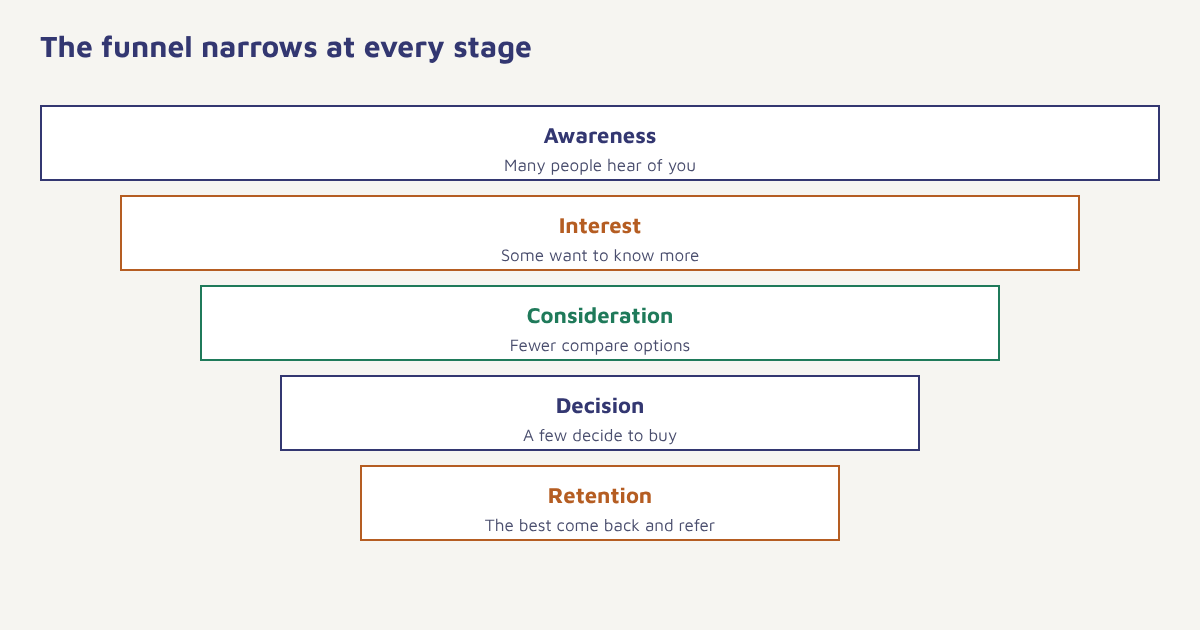
The stages of the marketing funnel
| Stage | What the customer thinks | What you want | Example metric |
|---|---|---|---|
| Awareness | “I have a problem, or I have heard of this” | To be found and remembered | Reach, visits, search impressions |
| Interest | “This might help me” | To earn attention and a way to stay in touch | Sign-ups, content engagement |
| Consideration | “How does it compare with others?” | To show fit, proof and differences | Product page views, demo requests |
| Decision | “Should I buy, and is it safe?” | To remove doubt and friction | Add-to-cart rate, checkout completion |
| Retention and advocacy | “Was it worth it? Will I buy again?” | Repeat purchase and recommendation | Repeat rate, referrals, retention |
Some models stop at purchase. Many modern ones add the stage after the sale, since keeping and growing existing customers is usually cheaper than finding new ones. See our guide to retention strategies and the retention rate formula.
Top of the funnel: awareness
Here people do not yet know you or may not know they have a need. The aim is to be found and to be useful. Typical tools are search content, social posts, ads, partnerships and educational guides. Avoid asking for a purchase. Instead, offer something worth giving an email address for, then follow up. Our guide to email list building covers how to do that with consent. Measure visits by source and the share who take a first step, not just raw traffic.
Middle of the funnel: interest and consideration
People now know you exist and are comparing options. They want proof and clarity: comparison pages, case stories, reviews, demos, pricing information and answers to questions. This is the stage where lead nurturing and drip campaigns help most, with a sequence of emails or WhatsApp messages that answer the questions buyers actually ask. In B2B, lead scoring helps decide when a contact is ready for sales.
Bottom of the funnel: decision
At this stage the person is close. Barriers are practical: price surprises, doubts about delivery or returns, a slow checkout, a missing payment option. Remove them. Offer guarantees, clear policies and fast support. Recover those who leave with an abandoned cart reminder and fix the leaks with the methods in our guide to conversion rate optimization.
After the sale: retention and advocacy
The funnel does not end at purchase. Onboarding helps new customers succeed (customer onboarding), follow-ups encourage repeat purchases (cross-selling and upselling), loyalty programmes recognise good customers (loyalty programs) and win-back messages re-engage those who drift (win-back campaigns). Satisfied customers also bring new ones through reviews and referrals, which feeds the top of the funnel again.
Matching channels and content to each stage
| Stage | Content | Channels |
|---|---|---|
| Awareness | Guides, videos, search content, ads | Search, social, partnerships |
| Interest | Checklists, newsletters, webinars | Email sign-up, email, web messaging |
| Consideration | Comparisons, demos, reviews, case stories | Email, WhatsApp, retargeting |
| Decision | Offers, guarantees, delivery information | Email, SMS, push |
| Retention | Onboarding, tips, rewards | Email, WhatsApp, in-app |
How to find your biggest leak
- Define each stage with an event. For example: visit, sign-up, product view, add to cart, purchase, repeat purchase. Use the data model to name them consistently.
- Count people at each stage. Over a fixed period, such as the last 30 days.
- Work out the step conversion. Divide the number at each stage by the number at the one before.
- Compare by segment. Device, source, country and new versus returning. Averages hide problems.
- Find the weakest step with the most volume. Fixing a big leak beats polishing a small one.
- Form a hypothesis and test it. See A/B testing.
In Flowfox, the funnel report counts people moving through the events you define, and the segment builder lets you build an audience of those who stopped at a stage, for example everyone who viewed a product but did not add it to a cart. A journey can then send the right follow-up. The help article on funnels explains how to set them up.
A worked example
The numbers here are invented, but the method is real. An online store has 50,000 visits in a month. Of these, 6,000 view a product (12 percent), 1,500 add to a cart (25 percent of viewers), 900 start checkout (60 percent) and 600 buy (67 percent). Overall, 1.2 percent of visitors buy. Looking only at the headline rate, the team might try to get more traffic. But the funnel shows a different picture: the step with the largest relative loss in absolute terms is from visit to product view, while the step that is cheapest to fix may be checkout, where a third of people who start do not finish. A survey finds that surprise delivery charges are the main reason. After showing delivery cost earlier, checkout completion rises to 74 percent, which adds about 60 orders a month without more traffic.
| Stage | People | Step conversion |
|---|---|---|
| Visits | 50,000 | – |
| Product views | 6,000 | 12% |
| Add to cart | 1,500 | 25% |
| Checkout started | 900 | 60% |
| Purchases | 600 | 67% |
The limits of the funnel
Real journeys are not tidy. People loop back, skip stages, switch devices and see you in many places before buying. The funnel is a simplification, so use it to organise thinking, not as a law of nature. Newer pictures such as the loop or flywheel stress that customers feed growth again after they buy. For a closer look at actual paths, read our guide to customer journey mapping. Attribution is also hard: when several channels touch one customer, simple last-click credit gives a misleading picture. See the overview of marketing attribution for the main approaches.
Common mistakes
- Pushing sales too early. Someone in awareness is not ready for a hard offer.
- Ignoring the stage after purchase. Retention is the cheapest growth.
- Looking at averages. Segment the funnel.
- One message for all stages. Content should match intent.
- Measuring only the top. Traffic is not revenue.
A funnel is a map of where people give up. The most useful marketing is finding out why.
See where customers drop off. Track every stage and follow up automatically with the right message.
Read next: customer engagement, STP marketing, the customer feedback loop and the blog.
Frequently asked questions
What are the stages of the marketing funnel?
A common version has awareness, interest, consideration, decision and retention or advocacy, though models differ in names and number of stages.
What is the difference between top, middle and bottom of the funnel?
The top is awareness, where people first learn of you. The middle is interest and consideration, where they compare. The bottom is decision, where they decide whether to buy.
How do I measure a marketing funnel?
Define an event for each stage, count unique people at each in a fixed period, and calculate the conversion from one stage to the next.
What content works at each funnel stage?
Awareness suits guides and search content, interest suits newsletters and webinars, consideration suits comparisons and case stories, decision suits offers and guarantees, retention suits onboarding and rewards.
Is the marketing funnel outdated?
It is a simplification, because real journeys loop and skip stages. It remains useful for organising content and finding where people drop off, as long as you do not treat it as exact.
How is a marketing funnel different from a sales funnel?
A marketing funnel covers how people become aware of and interested in you. A sales funnel usually covers the later steps handled by sales, from qualified lead to closed deal.
How do I fix a leaky funnel?
Find the stage with the biggest loss in volume, learn why people leave using data and feedback, then test a fix. Fix the biggest leak first.