Selling to an existing customer costs far less than finding a new one, and the customer already trusts you. That is the case for cross-selling and upselling: two simple ways to raise the value of each order and each relationship without a bigger advertising budget. They are easy to explain and easy to get wrong. Push too hard and you annoy people. Suggest the wrong thing and you look like you were not paying attention. This guide explains the difference, shows the moments where each works best, gives examples by industry, explains how to automate it and how to measure whether it helps.
Cross-selling vs upselling
Cross-selling means offering a related or complementary product to go with what the customer is buying or has bought, such as a phone case with a phone. Upselling means offering a better, larger or more expensive version of what they are considering, such as the 256 GB model instead of 128 GB. A third idea, the downsell, offers a cheaper alternative to keep a hesitant customer from leaving. All three belong to the broader aim of increasing customer lifetime value.
| Cross-sell | Upsell | |
|---|---|---|
| Offer | Related add-on or complement | Premium or larger version |
| Example | Charger with a laptop | Pro plan instead of Basic |
| Customer question | What else goes with this? | Is the better one worth it? |
| Best moment | Cart, order confirmation, after delivery | Product page, plan selection, renewal |
| Main risk | Irrelevant suggestions | Pushing a price the customer will not pay |
| Key metric | Attach rate | Upgrade rate and average order value |
The moments that work
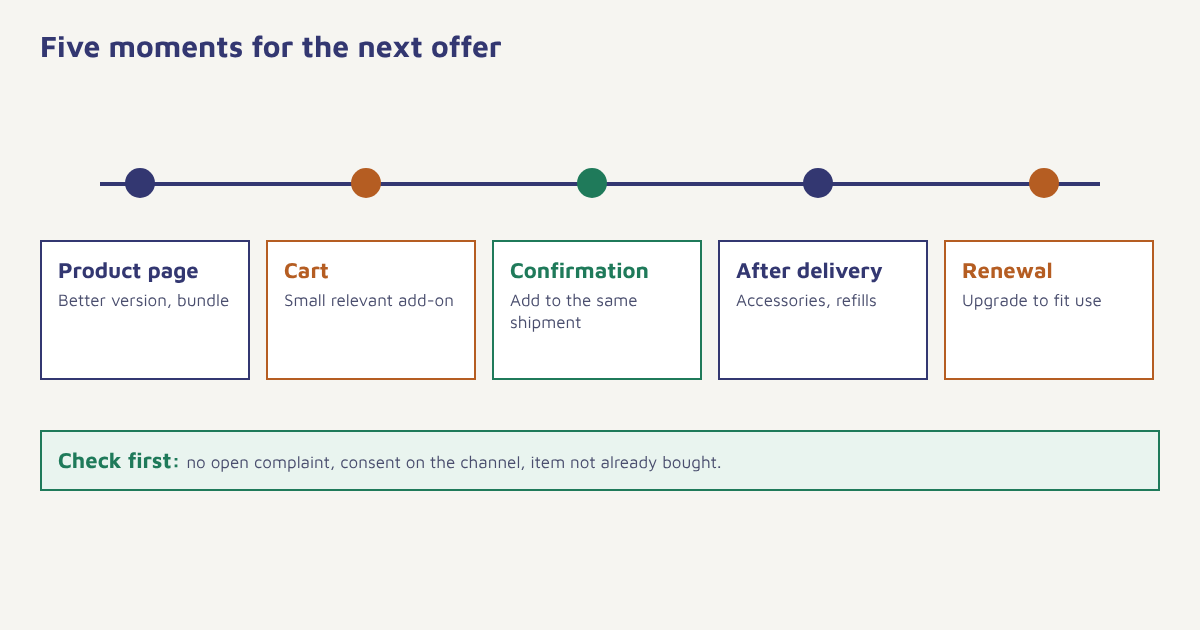
| Moment | What to offer | Channel |
|---|---|---|
| Product page | Better version, bundle, compatible items | Website and recommendations |
| Cart | Small, relevant add-ons that complete the purchase | Website, in-app |
| Order confirmation | Add-on to the same shipment before it is packed | Email, WhatsApp |
| After delivery | Accessories, refills, care products, tips | Email, WhatsApp, push |
| Repeat purchase window | Replenishment and a larger pack | Email, SMS, WhatsApp |
| Renewal or plan review | Upgrade to a plan that matches use | Email, in-app |
The best offers use what you already know. If someone bought running shoes three weeks ago, a message about insoles or socks makes sense. If someone has used 90 percent of their plan limit, an upgrade message is timely. If they bought a printer last month, ink is a natural follow-up when the cartridge should be running low. This is the same behavioural logic behind marketing personalization and segmentation.
Examples by industry
| Industry | Cross-sell | Upsell |
|---|---|---|
| E-commerce fashion | Matching accessories, care products | Premium line, larger bundle |
| Electronics | Cases, chargers, warranty | Higher storage or newer model |
| Grocery and consumables | Complementary items, recipes | Larger pack, subscription |
| SaaS | Add-ons, integrations, extra seats | Higher tier plan, annual billing |
| Travel | Insurance, transfers, activities | Better room or fare class |
| Financial services | Insurance with a loan, savings with a card | Higher limit card, premium account |
| EdTech | Related courses, practice tests | Full programme instead of one course |
Some sectors need extra care. In financial services and healthcare, offers must be suitable for the customer and comply with regulation. See our pages for e-commerce, SaaS and fintech for patterns that suit each.
Rules for offers customers welcome
- Be relevant. An unrelated suggestion is noise. Use purchase history and browsing to decide.
- Keep add-ons small. A cross-sell that costs a fraction of the main item feels like a convenience. A cross-sell that costs more than the main item feels like a trap.
- Show the benefit. “Keeps your shoes clean longer” beats “You may also like”.
- Do not hide costs. No pre-ticked add-ons, which can break consumer protection rules and erode trust.
- Make it easy to say no. The path to checkout should stay clear.
- Limit the number. One or two well-chosen offers beat a wall of products.
- Respect timing. Do not pitch during a complaint or just after a delivery problem.
Service first, selling second. If a customer has an open support issue or a late delivery, hold marketing offers until it is resolved. The best upsell programmes check the customer’s recent experience before they send anything.
How to build a cross-sell and upsell programme
- Find the natural pairs. Look at orders to see which products are often bought together, and which upgrades customers choose.
- Define the trigger moments. Choose events, such as order confirmed, delivered, plan limit reached or renewal due.
- Segment by value and history. Different offers for new, loyal and lapsed customers. See RFM analysis.
- Write the offers. Short, specific and benefit-led, with one button.
- Choose the channel. Email for detail, WhatsApp or SMS for short timely nudges, in-app for users who are present. Check consent.
- Set limits. Frequency caps and exclusions for open complaints and recent returns.
- Test and compare. Use a control group. See A/B testing.
- Review monthly. Keep the offers that lift value, retire the rest.
In Flowfox, order and delivery events from your store arrive through FlowConnect or the API and land on the contact profile. A journey can wait for delivery, check that no complaint is open, and then send a relevant offer, with product details pulled from the order using Liquid. The retention use case includes a post-purchase pattern, and the cart recovery guide covers the moment before purchase.
Hi {{ contact.first_name | default: "there" }},

Your {{ event.items[0].name }} was delivered on {{ event.delivered_on }}.
Customers who bought it also picked {{ recommended.name }}.
{% if contact.open_support_tickets == 0 %}
Add it to your next order and get free delivery.
{% endif %}
The condition at the end shows the principle: check the customer’s situation before the offer is shown. It is a small piece of logic that prevents some of the most irritating marketing mistakes.
How to measure it
| Metric | Formula or meaning |
|---|---|
| Attach rate | Orders with an add-on ÷ total orders |
| Average order value | Revenue ÷ orders, before and after |
| Upgrade rate | Customers who upgraded ÷ customers offered |
| Revenue per customer | Total revenue ÷ customers, by cohort |
| Opt-out and complaint rate | A warning if offers become too pushy |
| Return rate | Add-ons that are returned cost more than they earn |
Compare with a control group that did not receive the offer, since some customers would have bought the add-on anyway. Watch the long-term effect too: a pushy upsell may raise this month’s revenue and lower next year’s retention. The cohort view shows whether customers exposed to offers stay and keep buying. For the economic background, the articles on average revenue per user and on product bundling offer useful context.
Cross-selling and upselling in B2B and subscription products
In business and subscription products, the same ideas apply with a different rhythm. Upsell moments are tied to usage: a team nearing its seat limit, an account that has used most of its monthly quota or a customer who keeps asking for a feature that a higher plan includes. Cross-sell moments are tied to outcomes: a customer who has mastered one module is ready for the next, and an integration that saves them time is easier to sell than a new product. Account managers and automated messages should work together. Let the product and the message flag the opportunity, and let a person handle the conversation where the account is large. Always check satisfaction first, because a customer who is struggling needs help before an offer, and the sale that follows a good support experience tends to stick. Track expansion revenue separately from new revenue so that you can see how much of your growth comes from the customers you already have, which also feeds into lifetime value and churn reporting.
Finally, test the price framing. Showing the annual plan as the saving relative to twelve monthly payments, or the larger pack as the lower price per unit, helps customers see why the upgrade is sensible. Be accurate, and show the real numbers, because customers compare. Done honestly, framing is a service: it lets people see value they might have missed.
Common mistakes
- Generic recommendations. The same three products to everyone is not personalisation.
- Offering what they just bought. Exclude purchased items.
- Too many offers. Choice overload lowers conversion.
- Ignoring consent and frequency. Marketing messages need permission on each channel.
- Measuring only revenue. Check returns, complaints and retention.
A good cross-sell feels like service. A bad one feels like a sales pitch.
Offer the right next product at the right moment. Trigger from orders and delivery, check the customer’s situation and measure the lift.
Read next: customer engagement and loyalty programs, and visit the blog.
Frequently asked questions
What is the difference between cross-selling and upselling?
Cross-selling offers a related or complementary product alongside a purchase, while upselling offers a better or more expensive version of the item the customer is considering.
When is the best time to cross-sell?
Common moments are the cart, the order confirmation, after delivery and when a replenishment is due, always based on what the customer bought and their recent experience.
How do I upsell without being pushy?
Show a clear benefit, keep the offer relevant to usage, make it easy to decline, avoid pre-ticked add-ons and do not pitch during an open complaint.
What is attach rate?
Attach rate is the share of orders that include an add-on or complementary product, calculated as orders with an add-on divided by total orders.
Which channels work for cross-sell and upsell?
Email suits detail, WhatsApp and SMS suit short timely nudges to consented customers, and in-app messages suit users who are present in the product.
How do I measure whether cross-selling works?
Track attach rate, average order value, upgrade rate and revenue per customer against a control group, and watch returns, complaints and retention.
Can cross-selling hurt customer relationships?
Yes, if offers are irrelevant, too frequent or badly timed. Relevance, limits and checks for open complaints protect the relationship.