Getting more visitors is expensive. Getting more of the visitors you already have to buy, sign up or book is usually cheaper and faster. That is conversion rate optimization, or CRO: the habit of finding why people do not take the action you want and fixing it, one tested change at a time. This guide explains what conversion rate is, how to calculate it, a research-first process you can follow, the changes that most often make a difference, how to run tests properly and how email, WhatsApp and SMS fit in. It is written for teams without a dedicated optimization department.
What is conversion rate optimization?
Conversion rate optimization is the systematic process of increasing the share of visitors or recipients who complete a desired action. A conversion can be a purchase, a sign-up, a demo request, a download or a reply. The word “systematic” matters: CRO is not a list of tricks or button colours. It is a cycle of research, hypothesis, test and learning, and its goal is to understand people better, not just to change a page.
Formula. Conversion rate (%) = conversions ÷ visitors (or recipients) × 100
If 20,000 people visit a product page and 500 buy, the conversion rate is 2.5 percent. Raise it to 3 percent, and the same traffic produces 600 orders, which is 100 extra orders at no extra advertising cost. That is why CRO is often described as the cheapest form of growth, and why it lowers your customer acquisition cost.
Decide what counts as a conversion
| Funnel step | Conversion event | Rate to watch |
|---|---|---|
| Landing page | Click to product or form | Click-through rate |
| Product page | Add to cart | Add-to-cart rate |
| Cart | Start checkout | Checkout start rate |
| Checkout | Payment completed | Checkout completion rate |
| Sign-up page | Account created | Sign-up conversion rate |
| Click and purchase | Click-through and conversion rate. See email metrics |
Pick one main conversion per page, plus the step just before it. A page with five goals has none. Then measure the whole path as a funnel, because the biggest losses usually sit in one or two steps, and fixing those moves the final number more than polishing the steps that already work.
The CRO cycle
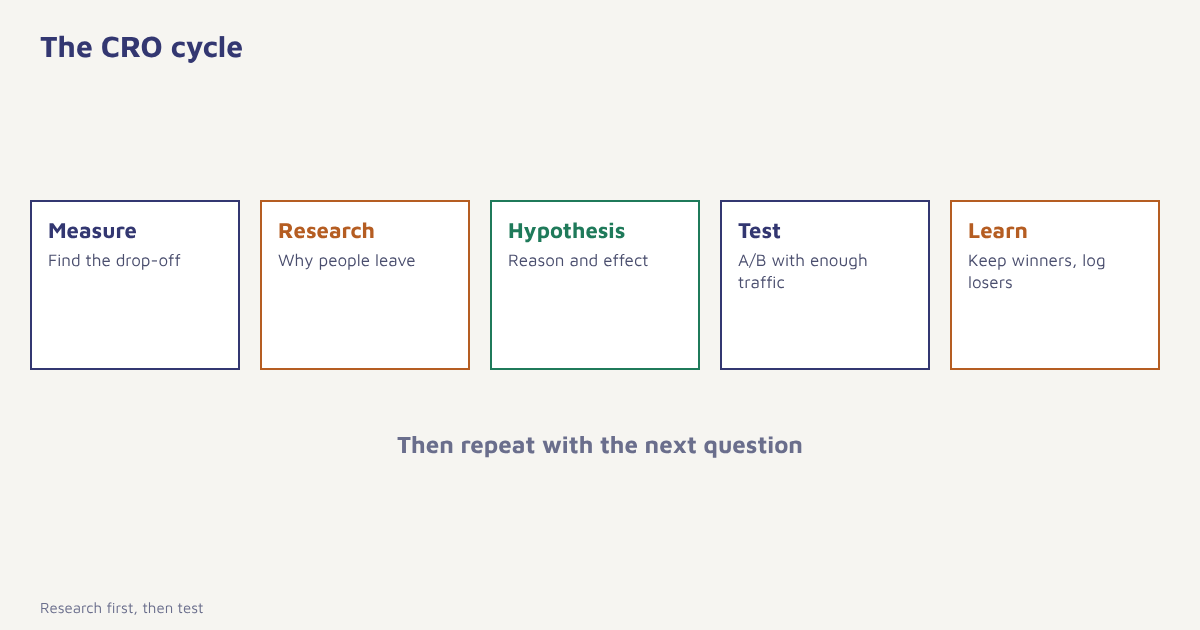
- Measure the funnel. Find where visitors drop off, by device, source and page. Use your analytics and the funnel report in analytics.
- Research the reasons. Combine numbers with human evidence: session recordings, heatmaps, on-page surveys, support tickets and customer interviews.
- Write a hypothesis. “Because customers say they are unsure about delivery time, showing the delivery date near the button will raise add-to-cart.”
- Prioritise. Score ideas by likely impact, confidence and effort, and start with the high-impact, low-effort ones.
- Test. Run an A/B test with enough traffic. See A/B testing.
- Learn and roll out. Keep winners, record losers and ask why, then choose the next question.
Research beats guessing
The strongest CRO ideas come from watching real behaviour and hearing real words. Look at web analytics to see where drop-offs happen, then add qualitative evidence to find out why. A simple exit survey on a checkout page, with a single question such as “What stopped you from completing your order?”, often produces more useful answers in a week than a month of guessing. Read support chats for repeated questions, and look at search terms used on your site, which tell you what people expect to find. Our guides to NPS, CSAT and CES and customer engagement cover ways to collect feedback.
The changes that usually matter
| Area | What to check | Example fix |
|---|---|---|
| Value proposition | Can a new visitor tell in five seconds what you offer and why it is good? | Clear headline, one supporting line, relevant image |
| Page speed | Does the page load in a couple of seconds on mobile data? | Compress images, remove heavy scripts |
| Mobile experience | Are buttons large and forms easy to fill on a phone? | Larger tap targets, right keyboard type, fewer fields |
| Calls to action | Is there one clear next step with a specific label? | “Get my quote” instead of “Submit” |
| Trust and proof | Do reviews, guarantees and clear policies appear where doubt arises? | Ratings near the button, return policy summary |
| Price and shipping clarity | Are total costs and delivery time visible early? | Show delivery estimate on the product page |
| Forms | Do you ask for more than you need? | Remove optional fields, add inline help, save progress |
| Checkout | Are there surprise costs, forced sign-up or too few payment options? | Guest checkout, UPI and wallet options, clear totals |
| Friction and errors | Do errors explain how to fix them? | Inline validation with plain messages |
Notice that most of these are about removing doubt and effort, not adding persuasion. People rarely fail to buy because the page was not exciting enough. They fail because something was unclear, slow, risky or tiring.
CRO beyond the website
Conversion is not only a web page problem. The messages that bring people to your site are conversion points as well, and the people you already know are your best opportunity.
- Email. Test subject lines, a single call to action and landing page match. See subject lines and email design.
- Abandoned carts. A timely reminder recovers some of the lost conversions. See abandoned cart recovery.
- WhatsApp and SMS. Short, timely messages to consented customers can lift completion. See which channel to use.
- On-site and in-app messages. Contextual nudges at the point of hesitation. See in-app messaging.
- Onboarding. The first-use experience is a conversion funnel too. See customer onboarding.
In Flowfox, you can find visitors who viewed a product but did not buy using the segment builder, and follow up through a journey across email, WhatsApp, SMS or push. The event data behind those segments is the same data you use for funnel analysis, so research and action work together.
How to test without fooling yourself
An A/B test compares two versions by showing each to a random half of the audience. A few rules protect you from false wins. Decide the metric and the sample size before you start. Do not stop the test the moment one version looks ahead, because early results swing wildly. Run it for at least one or two full business cycles, usually whole weeks, so weekday and weekend behaviour both count. Change one thing at a time if you want to know what worked. And accept that most tests do not win: a flat result is also information. If your traffic is too low for a reliable test, use before-and-after comparison cautiously, or spend your effort on fixes that are obviously right, such as speeding up a slow page.
| Mistake | Why it hurts |
|---|---|
| Stopping early | Random noise looks like a win |
| Testing tiny changes on low traffic | You will never reach a clear result |
| Changing several things at once | You cannot tell which one worked |
| Ignoring segments | A change may help mobile and hurt desktop |
| Measuring clicks, not sales | A button can win clicks and lose revenue |
Common mistakes
- Copying competitors. What works for them may not suit your customers.
- Starting with colours. Fix clarity, speed and trust first.
- Ignoring mobile. Most traffic in many markets is on phones.
- Optimizing the wrong people. Better targeting can raise conversion more than a better page.
- Not recording what you learn. Keep a log of tests and results so the team does not repeat them.
CRO is not about tricking visitors. It is about removing every reason they had to leave.
Turn more of your visitors into customers. Find the drop-offs, follow up across channels and measure what worked.
Continue with customer lifetime value, personalization and the blog.
Frequently asked questions
What is conversion rate optimization?
Conversion rate optimization is the systematic process of increasing the share of visitors or recipients who complete a desired action, through research, hypotheses, testing and learning.
How do you calculate conversion rate?
Divide the number of conversions by the number of visitors or recipients and multiply by 100. For example, 500 orders from 20,000 visitors is a 2.5 percent conversion rate.
What is a good conversion rate?
It varies widely by industry, traffic source, device and price. Compare against your own history and similar pages, not a single published average.
How do I start CRO with a small team?
Measure your funnel, find the biggest drop-off, collect a little qualitative feedback, fix obvious problems such as speed and clarity, then run simple tests on high-traffic pages.
How long should an A/B test run?
Decide the sample size in advance and run for at least one or two full weeks so weekday and weekend behaviour are included. Avoid stopping early when one version looks ahead.
Does CRO apply to email and WhatsApp?
Yes. Subject lines, content, timing and landing page match all affect conversion, and follow-ups such as cart reminders recover conversions that would be lost.
What is the difference between CRO and SEO?
SEO aims to bring more visitors from search engines. CRO aims to make more of the visitors you have take action. They work best together.