If you try to sell to everyone, you end up speaking to no one. STP marketing, short for segmentation, targeting and positioning, is the classic framework for avoiding that trap. It asks three questions in order: which groups of customers exist, which of them should we serve, and how do we want them to see us? Answer them well and many other decisions, from the message to the channel to the price, become easier. This guide explains each step with practical examples, shows how to write a positioning statement, and connects the framework to the data you already hold.
What is STP marketing?
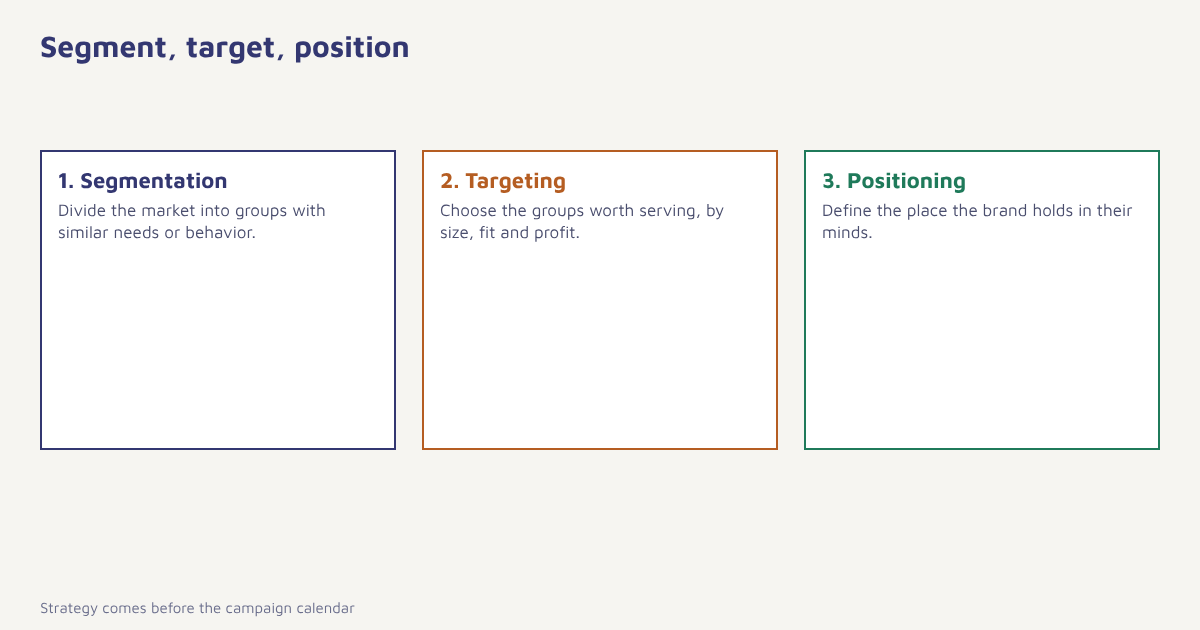
STP is a three-step process attributed to marketing thinkers such as Philip Kotler. First you divide a market into groups with similar needs (segmentation), then you choose the groups worth pursuing (targeting), and finally you shape how your product is perceived by them compared with alternatives (positioning). It is a strategy tool, not a tactic. It sits before the campaign calendar and decides what the campaigns are for.
Step one: segmentation
Segmentation groups customers who share needs, behaviours or characteristics so that each group can be served differently. The usual bases are shown below. Most businesses combine two or three.
| Basis | Examples | Strength |
|---|---|---|
| Demographic | Age, gender, income, occupation, family size | Easy to find and buy media for |
| Geographic | Country, city tier, climate, language | Useful for logistics, language and local offers |
| Psychographic | Values, lifestyle, attitudes, interests | Explains why people choose |
| Behavioural | Purchase history, usage, loyalty, benefits sought | Closest to real action |
| Firmographic (B2B) | Industry, company size, revenue, tech stack | Basis for account targeting |
For most digital businesses, behavioural data is the most reliable and the most available, because you collect it every day. Segments based on what people did, for example buyers who purchase every month, browsers who never buy and customers who have not returned in 90 days, can be acted on at once. Our guides to customer segmentation, RFM analysis and cohort analysis show ways to build them.
A good segment passes five tests. It is measurable, so you can size it. It is substantial, large enough to be worth the effort. It is accessible, so you can reach it through a channel. It is differentiable, so it responds differently from other groups. And it is actionable, because you can do something different for it.
Step two: targeting
Not every segment deserves your attention. Targeting is the decision about where to focus. Evaluate each segment on size and growth, how well your product fits its needs, competition, profitability and the cost of reaching it. Then choose a targeting approach.
| Approach | What it means | Best when |
|---|---|---|
| Undifferentiated | One offer for the whole market | Needs are very similar, such as basic commodities |
| Differentiated | Different offers for several segments | You have the resources to serve several groups |
| Concentrated (niche) | Focus on one segment deeply | Limited resources or a clear specialist advantage |
| Micromarketing | Tailoring to individuals or very small groups | Rich data and automation are available |
Modern engagement platforms make micromarketing realistic. If you hold profile and event data, you can send different messages to dozens of segments without tripling the workload, as discussed in our guide to marketing personalization. The limit is no longer production cost but your ability to explain why each segment gets what it gets, and to measure whether it works.
Step three: positioning
Positioning is the place your product holds in the customer’s mind relative to alternatives. It is not what you say on one banner, but what people come to believe after meeting your brand repeatedly. A simple template for a positioning statement helps to focus the team.
Positioning statement template. For [target customer] who [need or problem], [brand] is the [category] that [key benefit], because [reason to believe]. Unlike [main alternative], we [point of difference].
| Brand idea | Target | Positioning example |
|---|---|---|
| Running shoes for beginners | First-time runners aged 22 to 35 in cities | The comfortable, affordable shoe that makes the first month of running easier, with free coaching tips, unlike performance brands built for athletes |
| Subscription groceries | Busy urban families | Fresh essentials delivered before 7 am, so mornings start without a shop run, unlike apps with variable delivery windows |
| B2B email platform | Small ecommerce teams | The easiest way to run email, SMS and WhatsApp from one profile, unlike enterprise suites that need a developer |
Strong positioning rests on a real point of difference: price, quality, speed, service, convenience, specialisation or values. It has to be true, relevant to the target and hard for competitors to copy. A common tool for thinking about it is the perceptual map, where you plot brands on two axes that matter to customers, such as price and quality, and look for the open space. Treat the map as a thinking aid and check it with real customer research.
How to run an STP exercise
- Gather your data. Customer records, orders, survey answers, search and browsing behaviour, and support themes.
- Find the natural groups. Look for clusters that behave differently: frequent versus occasional buyers, bargain seekers versus quality seekers, new versus loyal.
- Describe each segment. Size, needs, behaviour, value and how to reach them.
- Score and choose targets. Rate each on size, fit, growth, competition and profitability.
- Write the positioning. One statement per target, plus the proof points.
- Turn it into messages. Headline, offer, tone and channel for each segment.
- Run, measure and refine. Compare segment results and adjust the choices.
In Flowfox, segments are rules over profile and event data, so an STP segment becomes a live audience in the segment builder, and the messages that express your positioning run as campaigns and journeys. Analytics shows how each segment responds. See the solutions pages for sector examples.
A short worked example
Consider an online store selling running shoes. Its data shows three groups. Beginners buy one pair a year and ask many questions. Regular runners buy two or three pairs and care about performance. Gift buyers appear around festivals and want quick advice. The store decides to concentrate on beginners and regular runners, since gift buying is seasonal and hard to predict. Its positioning for beginners is friendly, affordable and supportive, so it sends a welcome series with beginner training tips, offers a size guide and a fit promise and avoids jargon. For regular runners it highlights technical detail, restocks of favourite models and early access to new releases. The numbers and brand here are invented to show the logic. Real work begins with your own data.
Common mistakes
- Too many segments. If you cannot treat them differently, merge them.
- Demographics only. Two people of the same age can behave very differently.
- Targeting everyone. It is the same as targeting no one.
- Positioning that cannot be proved. Claims need evidence.
- Doing it once. Markets and customers change, so revisit STP yearly.
Strategy is choosing who you will not serve, so that you can serve someone well.
Turn your segments into live audiences. Build behavioural segments and run a tailored journey for each target.
Read next: consumer behavior in marketing, omnichannel marketing and the blog.
Frequently asked questions
What does STP stand for in marketing?
STP stands for segmentation, targeting and positioning: dividing a market into groups, choosing which groups to serve and shaping how the brand is perceived by them.
What is an example of STP marketing?
A shoe retailer segments customers into beginners, regular runners and gift buyers, targets the first two and positions itself as friendly and supportive for beginners and technical for regulars.
What are the bases of market segmentation?
The main bases are demographic, geographic, psychographic and behavioural, with firmographic segmentation used in B2B. Most businesses combine two or three.
What makes a good market segment?
A good segment is measurable, substantial, accessible, differentiable and actionable, so you can size it, reach it and treat it differently.
What is a positioning statement?
A positioning statement summarises the target customer, their need, the brand, its main benefit, the reason to believe it and what makes it different from alternatives.
What is the difference between targeting and segmentation?
Segmentation divides the market into groups. Targeting is the decision about which of those groups to serve.
How often should I revisit my STP strategy?
At least once a year, and whenever your product, competitors or customer behaviour change significantly.