Why did a customer pick one brand over another, abandon a full cart or come back for the fifth time? Consumer behavior is the study of how people decide what to buy, use and recommend. Marketers who understand it write better messages, time them better and choose better channels. This guide explains what consumer behavior is, the factors that shape it, the stages of the buying decision, the main types of buying behavior and how to turn all of that into practical segments and campaigns using the data you already have.
What is consumer behavior in marketing?
Consumer behavior is the study of the actions people take, and the reasons behind them, when they search for, choose, buy, use and talk about products and services. For a marketer, it answers practical questions. What triggers a purchase? What holds people back? Who influences the decision? Why do some customers stay for years while others leave after one order? The aim is not to manipulate people but to meet real needs at the right moment, with honest information.
Factors that influence buying behavior
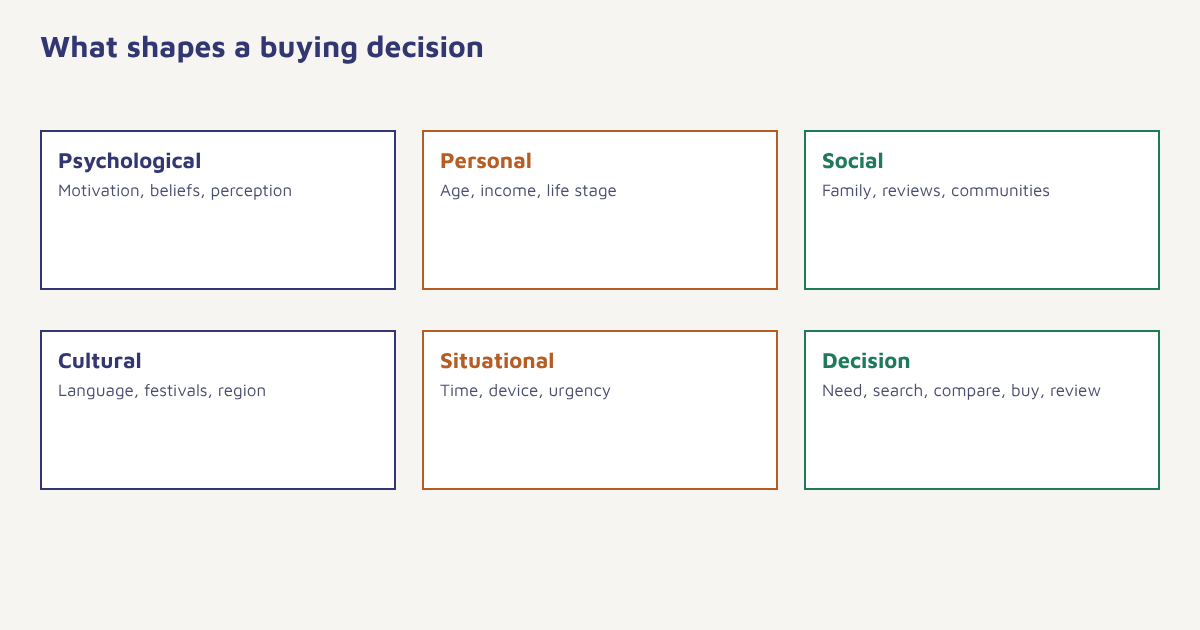
| Group | Examples | What it means for marketing |
|---|---|---|
| Psychological | Motivation, perception, beliefs, attitudes, learning, memory | Messages must match what people already believe and want |
| Personal | Age, occupation, income, lifestyle, life stage, personality | Different life stages need different offers |
| Social | Family, friends, reviews, communities, social media, reference groups | Proof from other people carries weight |
| Cultural | Culture, language, religion, festivals, region, social class | Local language and festivals change what resonates |
| Situational | Time, urgency, mood, device, location, weather | The same person behaves differently in different moments |
In India, culture and occasion carry unusual weight. Festivals, weddings and seasonal sales create sharp peaks in demand, language preference changes by region and trust in a brand often grows through family and community recommendations. See how to plan around these peaks in our guide to festival marketing campaigns.
The buying decision process
A widely used model, found in most marketing textbooks, splits a purchase into five stages. Not every purchase passes through all of them, and people can move back and forth, but the model is a handy way to think about where your message fits.
- Need recognition. Something triggers a want: a broken phone, an advert, a friend’s recommendation, a festival coming up.
- Information search. The person looks at search results, reviews, social posts and your site, and asks people they trust.
- Evaluation of alternatives. They compare price, features, reviews, delivery and return terms.
- Purchase decision. They choose, subject to last-minute doubts such as delivery cost, payment options and trust.
- Post-purchase behavior. They judge whether the product met expectations, and decide whether to return, complain or recommend.
Each stage suggests different content. Early on, helpful guides and search visibility matter. During comparison, reviews, comparison tables and clear pricing help. At purchase, remove friction, as discussed in our guide to conversion rate optimization. After purchase, onboarding, support and follow-ups decide whether the customer comes back, which links to retention strategies and customer lifetime value.
Four types of buying behavior
A classic framework from Henry Assael, summarised on Wikipedia, groups purchases by how involved the buyer is and how different the brands appear.
| Type | Situation | Example | What helps |
|---|---|---|---|
| Complex buying | High involvement, big differences between brands | Laptop, car, home loan | Detailed guides, comparisons, demos, expert help |
| Dissonance-reducing | High involvement, few visible differences | Mattress, kitchen appliance | Reassurance after purchase, warranties, clear support |
| Habitual buying | Low involvement, few differences | Salt, tea, detergent | Availability, repeat reminders, convenient reorder |
| Variety seeking | Low involvement, big differences | Snacks, beverages, fashion basics | Offers, new launches, sampling, fresh recommendations |
Knowing which type applies to your product tells you where to put effort. A habitual product wins by being easy to repurchase. A complex purchase wins by being easy to understand.
Reading behavior from your own data
You do not need a research lab to observe behavior. Your customers leave a trail: what they search for, which pages they view, what they add to a cart, when they buy, how often they return, which messages they open and what they ignore. Turn that trail into questions.
| Behavior signal | What it may indicate | Possible action |
|---|---|---|
| Repeated product views, no purchase | Interest with a doubt | Send reviews, size guides or a reminder |
| Cart abandoned at shipping | Cost or delivery surprise | Show delivery cost earlier, test free-shipping threshold |
| Opens email but never clicks | Subject works, content or offer does not | Test content and call to action |
| Buys only during sales | Price-sensitive | Use early access in place of deeper discounts |
| Buys on a regular cycle | Habitual | Remind just before the usual reorder date |
| Stops visiting | Fading interest | Run a win-back sequence |
Methods such as RFM analysis, cohort analysis and behavioural segmentation turn these signals into groups you can act on. In Flowfox, events and attributes sit on one profile in the data model, so a segment such as “viewed twice, did not buy, opted in to WhatsApp” is a few clicks in the segment builder, and a journey can respond automatically. This is the practical side of the STP framework.
Use behavioral insight responsibly
Insight carries responsibility. Collect data with clear notice and consent, use it for the purposes you stated and let people opt out. Avoid pressure tactics such as fake countdowns or false scarcity, which may work briefly and damage trust. Behavioral research also shows that choices are influenced by framing, defaults and mental shortcuts, a field often discussed as behavioral economics. Use that knowledge to make good choices easy, not to trap people. For India-specific rules, read our guide to the DPDP Act for marketers.
Putting it to work: a short plan
- Pick one decision to understand. For example, why first-time visitors do not buy.
- Collect evidence. Look at funnel data, ask five customers, read support chats and reviews.
- Name the barrier. Price, trust, information, convenience or timing.
- Design a response. Content, offer or message to remove that barrier, sent through the right channel.
- Test and measure. Compare with a holdout group and see what changed. See A/B testing.
- Share what you learn. Product, support and marketing all benefit.
Behavior in the Indian market
Several patterns shape digital buying in India. Many shoppers browse on a phone and compare on more than one app, so a slow page loses them quickly. Payment preference varies: UPI is widely used, cash on delivery still matters in many areas and trust in a first-time seller is built through reviews, return terms and visible contact details. Language matters too, as people often respond better to messages in their own language, and WhatsApp is a natural place for conversation about orders. Read about Digital India for the wider context of rising online adoption, and treat all of these as hypotheses to test with your own customers rather than rules. A short survey or a handful of calls often reveals what no dashboard shows.
Common mistakes
- Assuming customers think like you. Ask them.
- Relying on averages. Behavior differs sharply between groups.
- Studying only buyers. Non-buyers explain what is wrong.
- Ignoring post-purchase behavior. Repeat and referral depend on it.
- Copying foreign playbooks. Local culture and payment habits matter.
Customers do not buy products. They buy relief from a problem, in a moment, from someone they trust.
Act on what your customers do. Segment by behavior and respond across email, WhatsApp, SMS and push.
Read next: customer engagement, customer acquisition cost and the blog.
Frequently asked questions
What is consumer behavior in marketing?
Consumer behavior is the study of how people search for, choose, buy, use and recommend products, and the psychological, personal, social, cultural and situational factors behind those actions.
What are the factors affecting consumer behavior?
The main groups are psychological, personal, social and cultural influences, plus the situation, such as urgency, device and location.
What are the stages of the consumer buying process?
The common model has five stages: need recognition, information search, evaluation of alternatives, purchase decision and post-purchase behavior.
What are the four types of buying behavior?
Complex buying, dissonance-reducing buying, habitual buying and variety-seeking buying, based on how involved the buyer is and how different the brands appear.
How can I study consumer behavior with limited resources?
Use your own data on views, carts, orders and message engagement, add short surveys and customer conversations, and read reviews and support chats.
Why is consumer behavior important for digital marketing?
It helps you choose the right message, timing and channel, reduce drop-offs and build segments that respond differently, which improves results and lowers cost.
How is consumer behavior different from customer segmentation?
Consumer behavior explains why people act as they do. Segmentation groups people with similar needs or behavior so that each group can be treated differently.