Why should a customer choose you over the alternatives, including doing nothing? A value proposition is your clear, honest answer. It is not a slogan. It is a promise about the outcome you deliver, for a specific kind of customer, that is better or different from what else is on offer. This guide explains what a customer value proposition is, what makes a good one, a simple canvas for building it, a statement template, examples, how to test it and how to carry it into your emails, pages and messages so that it shows in every customer interaction.
What is a customer value proposition?
A customer value proposition describes the benefits a customer gets from your product or service, why those benefits matter to them and why they are better than the alternatives. It sits between your strategy and your messages: strategy decides who you serve (see our guide to the STP framework), the value proposition says what you offer them, and campaigns express it. If it is unclear, every message that follows will be generic.
What a strong value proposition contains
| Element | Question it answers |
|---|---|
| Target customer | Who exactly is this for? |
| Problem or need | What job are they trying to get done, and what gets in the way? |
| Benefit | What outcome do they get? |
| Difference | Why is this better than the alternatives? |
| Proof | What evidence shows it is true? |
A strong one is specific (names the customer and the outcome), relevant (solves a real problem), distinct (not something every competitor says) and believable (backed by proof). Words like “best”, “innovative” and “world-class” do none of these.
The value proposition canvas
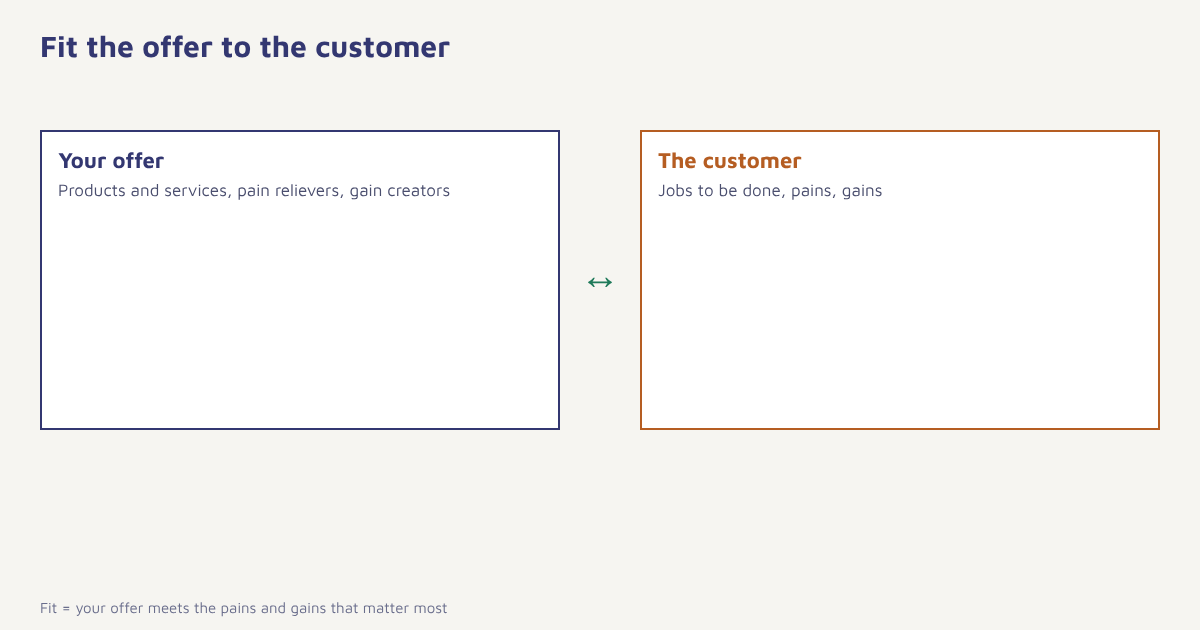
A popular tool, developed by Alexander Osterwalder and colleagues, is the value proposition canvas, which pairs a customer profile with a value map. It is described in the literature around the business model canvas. It has two sides.
| Customer side | Your side |
|---|---|
| Jobs: tasks the customer wants done | Products and services: what you offer |
| Pains: frustrations, risks and costs | Pain relievers: how you reduce those pains |
| Gains: outcomes and benefits they want | Gain creators: how you deliver those gains |
- Choose one customer segment. Be specific. A proposition for “everyone” fits no one.
- List their jobs, pains and gains. Use interviews, support tickets, reviews and survey answers, not guesses.
- Rank them. Which pains are most severe, and which gains matter most?
- Map your offer. Show how your product relieves the top pains and creates the top gains.
- Find the fit. Keep what meets important needs. Drop features that address nothing.
- Write the statement. Use the template below.
- Test it. Check wording with real customers, and compare variants in a campaign.
A value proposition template
Template. For [target customer] who [need or problem], [product] provides [main benefit] by [how it works]. Unlike [alternative], we [key difference], proven by [evidence].
| Business | Weak version | Stronger version |
|---|---|---|
| Engagement platform | The best customer engagement solution | For growing ecommerce teams who juggle five messaging tools, Flowfox puts email, WhatsApp, SMS and push in one journey builder, so every message knows what the customer already received |
| Grocery delivery | Fresh groceries delivered | Fresh essentials at your door before 7 am, so mornings start without a shop run |
| Online course | Learn new skills | Learn data skills in 8 weeks with weekly mentor feedback, built for working professionals |
| Accounting app | Smart accounting | Send GST-ready invoices in two taps, so small shops spend evenings with family, not spreadsheets |
The first example is an illustration of the style, not a claim about any measured result. Notice that stronger versions name a customer, a pain and a concrete difference. They can be checked.
Where the insight comes from
The best value propositions use the customer’s own words. Read reviews of your product and your competitors’. Listen to sales calls and support chats. Ask recent buyers why they chose you and what nearly stopped them. Look at what people search for before they find you. Our guides to consumer behavior and NPS, CSAT and CES show ways to gather this evidence, and user-generated content often contains the phrases that customers naturally use.
Carry it into every message
A value proposition only works when customers meet it consistently. Use it as the filter for headlines, subject lines, onboarding messages and ads. Each message should reinforce one promise and prove it. For example, if your promise is speed, your welcome email should show how to get the first result in five minutes, and your cart reminder should mention fast delivery. If your promise is trust, lead with guarantees and clear policies.
Different segments may care about different parts of the promise, so adjust the emphasis, not the truth. With the segment builder you can send the speed message to impatient buyers and the savings message to price-sensitive ones, and use journeys to deliver the proof over time. See personalization and onboarding for how this works in practice.
How to test your value proposition
| Method | What it shows |
|---|---|
| Five-second test | Can a new visitor say what you offer after five seconds on the page? |
| Customer interviews | Do they recognise their own problem in your words? |
| A/B test headlines | Which version drives sign-ups or clicks? See A/B testing |
| Win and loss reviews | Why do people choose you or leave? |
| Competitor swap | Could a competitor claim the same line? If so, it is not distinct |
Revisit it at least yearly. Markets move, competitors copy and customer needs change. A statement that was distinct two years ago may now be common. Your proposition also underpins how you grow: sharper messages improve conversion, help retention and lower acquisition cost.
A worked example: a small ecommerce brand
A brand selling handmade leather bags believes its proposition is “quality leather bags”. After interviewing ten recent buyers, it hears different words. Customers mention that the bags last for years, that they feel confident gifting them and that they appreciate being able to speak to the maker about repairs. The real promise is closer to “a bag you will still be using in ten years, with the maker behind it”. The team rewrites its homepage headline, adds a repair guarantee and a short story about each craftsperson, and changes its emails to talk about longevity and care rather than discounts. Gift buyers get a separate message about packaging and returns. The interviews and results here are illustrative, but the lesson is real: the proposition customers recognise is often not the one the company wrote.
Once the proposition is clear, it guides smaller choices. It tells you which features to build, which offers to avoid and which channels suit your story. A brand that promises craft and care may prefer fewer, richer emails and personal WhatsApp replies over constant flash sales. A brand that promises speed will invest in delivery tracking messages and instant support. For more on turning positioning into practice, see the discussion of positioning, and combine it with the segments you built using the behavioral segmentation guide. Write the proposition down on one page, share it with the whole team and check new campaigns against it before they go out.
Common mistakes
- Listing features instead of benefits. Customers buy outcomes.
- Vague claims. “Best” and “leading” prove nothing.
- Copying competitors. If it fits everyone, it distinguishes no one.
- Writing it in a meeting room. Use customer language.
- Making it and forgetting it. Check it against messages and results.
A value proposition is a promise. Every email, page and call either keeps it or breaks it.
Say it in every channel. Deliver your promise through segmented journeys across email, WhatsApp, SMS and push.
Read next: customer engagement, customer lifetime value and the blog.
Frequently asked questions
What is a customer value proposition?
A customer value proposition is a clear statement of the benefits a specific customer gets from your offer, why they matter and why they are better than the alternatives.
What makes a good value proposition?
It is specific, relevant to a real problem, distinct from competitors, believable with proof and written in the customer’s language.
What is the value proposition canvas?
It is a tool that matches the customer’s jobs, pains and gains with your products, pain relievers and gain creators to find fit.
How is a value proposition different from a slogan?
A slogan is a short, memorable phrase for branding. A value proposition is a fuller promise of outcome, audience and difference that guides all messaging.
How do I write a value proposition?
Choose one segment, research their jobs, pains and gains, map your offer to them, and use the template: for a target customer who has a need, our product provides a benefit, unlike alternatives, proven by evidence.
How do I test a value proposition?
Use a five-second test, customer interviews, A/B tests of headlines, and win and loss reviews, and check that a competitor could not claim the same line.
How often should I review it?
At least once a year, and whenever your market, competitors or customers change significantly.