A newsletter is the friendliest form of email marketing. Done well, it is the one message people look forward to. Done badly, it is a weekly pile of promotions that trains people to ignore you. Most of the difference comes from a few decisions made once: who it is for, what it promises, how it is laid out and how often it arrives. This guide explains how to plan a newsletter, a structure that works, how to choose content, how often to send, how to grow the list, what to measure and how to keep going without burning out.
What is an email newsletter?
An email newsletter is a recurring email, usually sent on a fixed schedule, that shares news, useful content or updates with people who chose to receive it. It differs from a one-off promotional campaign because it builds a habit. The idea has a long history, going back to printed newsletters sent by clubs and companies. For businesses, a newsletter keeps you present between purchases, shares expertise and drives traffic to your site or store. It is one part of wider email marketing, and it works best when the list is built with care, as described in email list building.
Plan the newsletter before you write it
- Define the reader. Who is it for and what do they want? A newsletter for first-time buyers differs from one for professionals.
- Write the promise. One sentence: “Every Friday, one practical tip for cutting delivery costs.” Put it on the sign-up form.
- Pick the goal. Traffic, sales, education or loyalty. You can have a main goal and a secondary one.
- Choose a rhythm. Weekly, fortnightly or monthly. A smaller promise you can keep beats a large one you cannot.
- Name it and design it. A recognisable name and a consistent layout help people spot it.
- Create a content bank. A running list of topics and a rough calendar.
- Set up measurement. Decide which numbers you will watch before the first issue goes out.
A structure that works
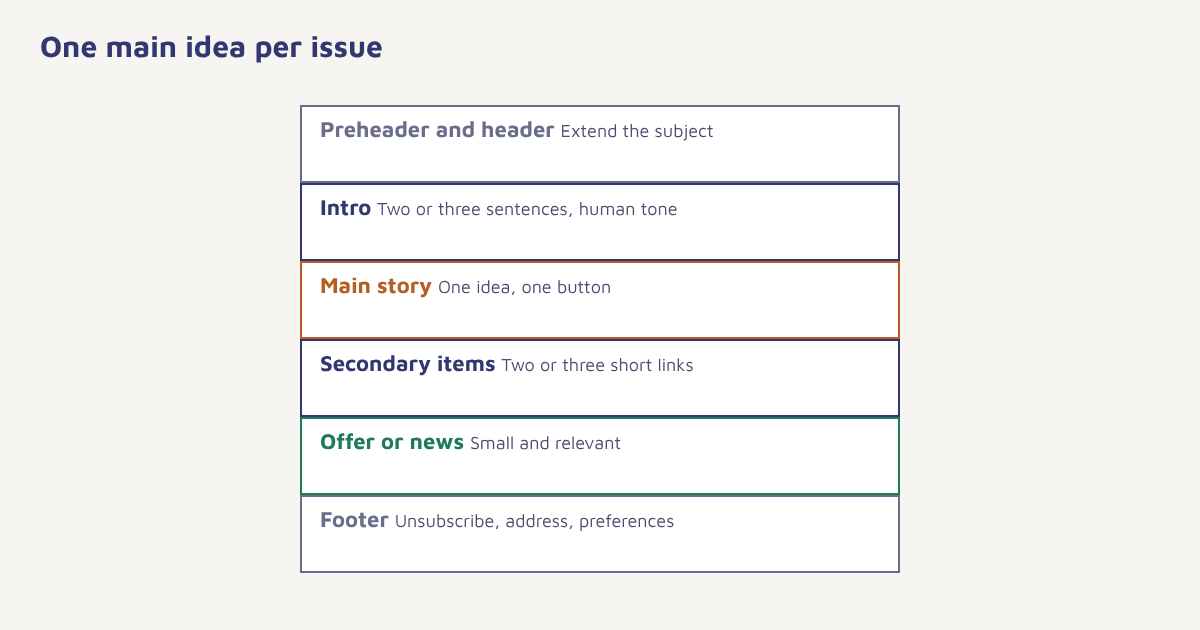
| Section | Job | Tips |
|---|---|---|
| Sender and subject | Get opened | A recognisable sender name; specific subject. See subject lines |
| Preheader | Extend the subject | Write it deliberately, do not leave it blank |
| Intro | Set the tone | Two or three sentences, written like a person |
| Main story | Deliver the value | One idea, one button |
| Secondary items | Reward scanning | Two or three short items with links |
| Offer or news | Commercial goal | Small and relevant, not the whole issue |
| Footer | Trust and compliance | Unsubscribe, address, preferences, contact |
Use the email builder to turn this into a reusable template, so every issue takes minutes to assemble rather than hours. Keep the design simple, with a single column, readable fonts and enough contrast. Test on a phone first, because most newsletters are read there.
What to put in it
The most common reason a newsletter fails is that it is about the sender and not the reader. A useful rule is to split content roughly into three: about two parts that help (tips, how-tos, stories, answers to questions), one part that informs (news, product updates, behind the scenes) and a small part that sells. Adjust to your audience, and watch what they click.
| Content type | Examples | Why it works |
|---|---|---|
| How-to and tips | Short guides, checklists, templates | Practical value |
| Stories | Customer stories, case studies | Social proof and interest |
| Curated links | Good reads, tools and news from your field | Positions you as a guide |
| Behind the scenes | How a product is made, team notes | Human connection |
| Product news | New arrivals, features, restocks | Commercial relevance |
| Questions and replies | Answers to reader questions, polls | Interaction and ideas |
Write like a person. Use first person, short paragraphs and plain words. Read it aloud. If it sounds like a brochure, rewrite it. Invite replies, because replies are the best sign of a healthy relationship and help your deliverability.
How often to send
There is no universal answer. Weekly suits content-rich brands, fortnightly or monthly suits most small businesses, and daily is for publishers whose product is the news itself. Consistency matters more than frequency: pick a day and time and keep to it. Ask subscribers about preferences at sign-up, and offer a choice between the weekly and the monthly version. If unsubscribes jump after a change in frequency, you have found the limit. Watch your engagement as well as your unsubscribes, since people who stop opening are quietly leaving. See win-back campaigns for what to do with them.
How to grow the list
- Make the promise visible. A short line and an example issue on the sign-up form.
- Offer a welcome gift. A guide or discount that arrives instantly.
- Place forms where interest is high. After a useful article, at checkout, on the thank-you page.
- Use content upgrades. A relevant checklist in exchange for an address.
- Ask for referrals. A “forward to a friend” link and a sign-up link in each issue.
- Welcome new subscribers. A short drip, as described in drip campaigns, reinforces the habit.
- Respect consent. Only add people who asked. See the DPDP Act guide.
Running a newsletter in Flowfox
Build a template once in the email builder, duplicate it for each issue and send it as a campaign to a segment of subscribers. You can send different versions to different interests, for example a version for customers and another for prospects, and use FoxAI to draft subject line variants and summaries, which you then edit. New subscribers can enter a welcome journey automatically, and each issue’s results appear in analytics. See the email channel page for sending and authentication.
What to measure
| Metric | What it shows | Note |
|---|---|---|
| Click rate | Interest in content | Your main engagement measure |
| Unsubscribe rate | Fit and frequency | Spikes show a problem |
| Replies | Relationship strength | Hard to fake |
| List growth | Net new subscribers | Sign-ups minus unsubscribes and bounces |
| Traffic and conversions | Business value | Use tracked links |
| Open rate | Rough interest | Inflated by privacy features. See email marketing metrics |
Test one thing at a time: subject line, send time, length or layout. Our A/B testing guide explains how to do it fairly. Keep a log of what you learn. The email marketing field has a lot of folklore about the best day to send, and most of it depends on your audience, so trust your own data after a few months.
How to keep it going
Most newsletters die because the author runs out of time. Make it easy to continue. Keep a content bank, write two issues ahead, reuse good material in different forms, ask colleagues and customers to contribute, and cut sections that nobody clicks. A shorter, steadier newsletter beats a grand one that disappears after four issues.
If you are curious about the craft, the history of email newsletters and of content marketing shows how the best ones grew: a clear voice, a regular rhythm and content that stands on its own even without a sales message. Read two or three newsletters you admire, note what they do in the first three lines and what they leave out, and borrow the discipline rather than the style.
Common mistakes
- All promotion. People unsubscribe from a weekly advert.
- No clear promise. Readers do not know what to expect.
- Too much in one issue. Five stories with five buttons get no clicks.
- Inconsistent schedule. Random timing lowers habit and trust.
- Ignoring replies. A reply is a conversation. Answer it.
A good newsletter is a small, regular gift. People keep opening gifts they like.
Publish your newsletter without the busywork. Reuse templates, segment readers and track clicks in one place.
Continue with email subject lines and customer engagement, and browse the blog.
Frequently asked questions
What is an email newsletter?
An email newsletter is a recurring email sent to subscribers who chose to receive it, sharing useful content, news or updates on a regular schedule.
How often should I send a newsletter?
Weekly suits content-rich brands, and fortnightly or monthly suits most small businesses. Choose a rhythm you can keep and send at a consistent time.
What should I include in a business newsletter?
A mix of helpful content such as tips and stories, some news or product updates and a small commercial section, with one main idea and a clear button per issue.
How do I grow my newsletter subscribers?
Make the promise visible on a sign-up form, offer a welcome gift, place forms where interest is high, use content upgrades, ask for referrals and only add people who opted in.
What is a good newsletter open rate?
It varies by industry and list, and open rates are inflated by privacy features. Judge your newsletter mainly by clicks, replies and conversions against your own history.
How long should a newsletter be?
Long enough to deliver one clear idea and a few short secondary items. Many successful newsletters can be read in two to five minutes.
What is the best day to send a newsletter?
It depends on your audience. Test different days and times, and keep the one that gives the best clicks, then stay consistent.