Every sales team and every online business needs a steady flow of people who have shown interest. Lead generation is the work of creating that flow, and it is also easy to do badly: buying lists, chasing sign-ups that never convert, or collecting names without permission. This guide explains what a lead is, the main lead generation strategies and when each works, how to build a capture-to-conversation process, how to qualify leads, how to measure cost and quality and the privacy rules to respect, with a worked example you can adapt for your own business.
What is lead generation?
Lead generation is the process of attracting people who might become customers and capturing their contact details with their permission so that you can continue the conversation. A lead is a person or organisation that has shown some interest or fits your target profile. Not every lead is ready to buy. Some are researching, some are comparing and some are ready now, which is why capture must be followed by lead nurturing and lead scoring.
Types of lead
| Type | What it means | Next step |
|---|---|---|
| Subscriber | Gave an email for updates | Welcome series, education |
| Marketing qualified lead (MQL) | Fits the profile and has engaged enough to merit attention | Nurture, score, invite to talk |
| Sales qualified lead (SQL) | Has shown buying intent and fits the criteria | Sales conversation |
| Product qualified lead (PQL) | Has used a free trial or free plan in a way that suggests fit | Offer help and a path to paid |
| Customer referral | Introduced by an existing customer | Personal follow-up |
Lead generation strategies that work
| Strategy | How it works | Best for | Watch out for |
|---|---|---|---|
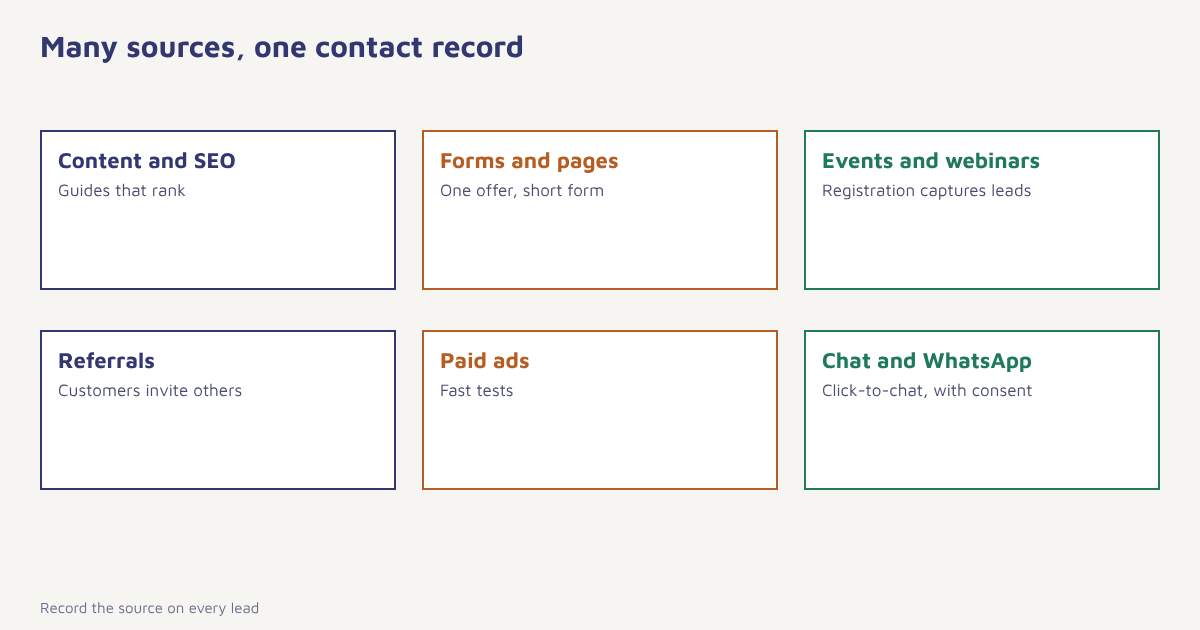
| Content and SEO | Useful guides and tools that rank in search, with a sign-up offer | Almost every business | Slow to start, needs consistency |
| Landing pages and forms | A focused page with one offer and a short form | Campaigns, ads, events | Too many fields |
| Lead magnets | Checklist, template, calculator or report in return for an email | B2B and education | Offer not matched to the buyer |
| Webinars and events | Live or recorded sessions with registration | Complex products | Low show-up rates |
| Free trials or free tools | Let people try, then follow up | Software | Support load |
| Referrals | Customers invite others with a reward for both | Products with happy users | Weak if the product is not loved |
| Paid ads | Search and social ads to landing pages | Fast tests, launches | Costs rise, quality varies |
| Chat and WhatsApp | Click-to-chat conversations that capture details | Local and consumer businesses | Needs quick replies and consent |
| Partnerships | Joint webinars, co-marketing, directories | Niche markets | Misaligned audiences |
| Outbound outreach | Personal emails or calls to a defined profile | Higher-priced B2B | Compliance and deliverability |
Pick two or three strategies and do them well rather than trying ten. Match them to how your customers buy. A fast consumer purchase rarely needs a webinar; an expensive B2B system rarely sells from a pop-up.
Capture: forms and offers that convert
Ask for as little as you need. A name and email is often enough for a first offer; add phone number when you plan to follow up by WhatsApp or SMS, and ask for consent for each channel separately. Make the offer specific: “Get the 2026 festival calendar” beats “Subscribe”. Show what happens next, and send what you promised at once. Our guide to email list building covers forms, consent and double opt-in in detail, and conversion rate optimization shows how to improve the page itself.
Build a process, not just a form
- Define your ideal customer. Industry, size, role, problem and the trigger that makes them look for a solution. See the STP framework.
- Choose two or three sources. Start with what your customers already use.
- Create the offer and the page. One promise, one form, one next step.
- Record the source. Store where each lead came from, so you can judge quality later.
- Respond quickly. Send a confirmation at once and follow up the same day for high-intent leads.
- Nurture the rest. A short series that educates and invites. See drip campaigns.
- Score and hand over. Pass leads to sales when they meet clear criteria.
- Review monthly. Compare sources by cost, conversion and revenue.
In Flowfox, forms and imports create a contact with its source recorded, the segment builder separates new leads from warm ones and journeys run the follow-up across email and WhatsApp. See the SaaS and edtech pages for sector examples.
Qualify before you chase
A long list of weak leads wastes time. Qualify using a few simple criteria: fit (does the person match your ideal customer?), need (do they have the problem?), authority (can they decide or influence?), timing (when might they act?) and budget (can they afford it?). You can capture some of this in the form and infer more from behaviour such as pricing page visits and email replies. A points-based approach is described in our lead scoring guide. Keep human judgement in the loop: a short call often reveals more than a score.
Measure cost and quality
| Metric | Formula or meaning |
|---|---|
| Leads | Number captured in the period |
| Cost per lead | Spend on the source ÷ leads from it |
| Lead-to-customer rate | Customers ÷ leads × 100 |
| Cost per acquisition | Spend ÷ customers won. See customer acquisition cost |
| Speed to lead | Time from sign-up to first response |
| Revenue per lead | Revenue ÷ leads, by source |
Cost per lead alone misleads. A source that delivers cheap leads who never buy is worse than a dearer source that delivers customers. Always trace sources through to revenue.
A worked example: a B2B accounting software company
The following example is invented. A small company sells accounting software to retailers. It chooses three strategies: a GST filing checklist (lead magnet) promoted through search content, a monthly webinar for shop owners and a referral reward for existing users. Each source has its own landing page and hidden source field. New leads get a confirmation and a three-email series: the checklist, a customer story and an invitation to a 15-minute call. Leads who open two emails or visit the pricing page get flagged to sales within the hour.
| Source | Leads | Cost per lead | Call booked | Customers |
|---|---|---|---|---|
| Checklist and content | 320 | ₹150 | 9% | 11 |
| Webinar | 90 | ₹400 | 22% | 8 |
| Referral | 40 | ₹250 | 35% | 9 |
The numbers are made up. The lesson is that the checklist produces most leads and the lowest cost per lead, while referrals produce the best quality. The company keeps all three, puts more effort into referrals and improves the follow-up on the checklist leads, rather than cutting the source with the highest cost per lead.
Do it with permission
Buying or scraping lists may be tempting but damages your sender reputation and may break data protection law. Collect leads with clear notice and consent, record the source and honour opt-outs. The DPDP Act guide explains the main obligations in India, and the GDPR applies if you target people in Europe. Check current rules with your legal advisor before you launch a new collection method, particularly for phone numbers and WhatsApp.
B2B and B2C differences
Business buyers usually take longer, involve several people and want proof such as case studies, so lead generation leans on content, events, partnerships and personal outreach. Consumer buyers decide faster and respond to offers, reviews and convenience, so landing pages, ads and chat convert more directly. In both cases, the idea of a sales funnel helps to see where leads drop away, and our guide to marketing funnel stages shows how to measure each step.
Common mistakes
- Chasing volume. A thousand poor leads cost more than fifty good ones.
- Slow follow-up. Interest fades quickly.
- No source tracking. You cannot tell what works.
- Gating everything. Keep some content open to build trust.
- No handover rules. Sales and marketing blame each other.
A lead is not a name on a list. It is someone who asked you to continue the conversation.
Capture leads and follow up automatically. Record the source, nurture by interest and hand over when they are ready.
Read next: marketing funnel stages, customer acquisition cost and the blog.
Frequently asked questions
What is lead generation?
Lead generation is the process of attracting people who may become customers and capturing their contact details, with permission, so that you can follow up.
What are the best lead generation strategies?
Content and SEO, landing pages with lead magnets, webinars, free trials, referrals, paid ads, chat and partnerships all work. The best mix depends on how your customers buy.
What is the difference between an MQL and an SQL?
A marketing qualified lead fits your profile and has engaged enough to warrant nurturing. A sales qualified lead has shown buying intent and is ready for a sales conversation.
How do I measure lead generation success?
Track leads, cost per lead, lead-to-customer rate, speed to respond and revenue per lead by source, and judge sources by customers won, not leads alone.
Is it okay to buy leads?
Buying lists is risky. It tends to produce poor engagement, harms sender reputation and may breach data protection laws. Collect leads with consent instead.
How fast should I follow up with a new lead?
As fast as you reasonably can. Send an automatic confirmation at once and respond personally the same day to high-intent leads.
How many form fields should a lead form have?
As few as you need to qualify and follow up. Name and email is often enough to begin, and extra fields usually lower completion.