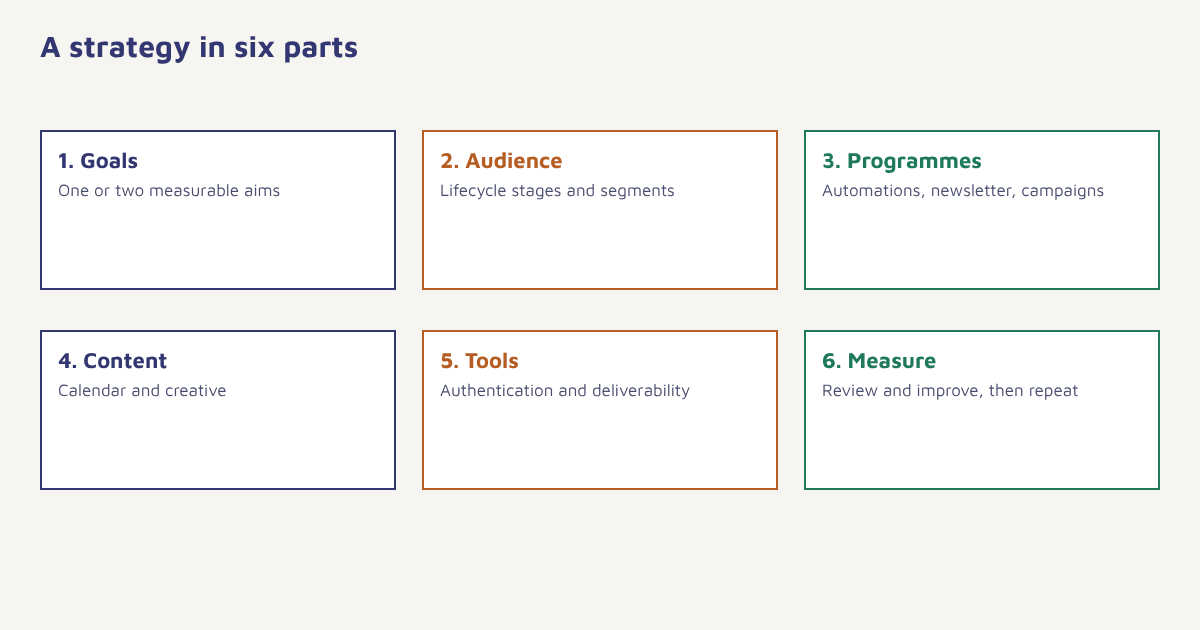
Sending emails is not the same as having an email strategy. Many teams send a weekly newsletter and a few promotions, then wonder why results flatten. A strategy answers bigger questions: what is email for, who is it for, what do we send, in what order, how often, and how do we know it works? This guide lays out a practical email marketing strategy you can build in a few sessions: goals, audience, programme design, content, calendar, tools, measurement and improvement. It uses examples from ecommerce and SaaS, and works for teams of one to twenty.
What is an email marketing strategy?
An email marketing strategy is a plan for how email supports business goals over the next six to twelve months. It defines the audience and their lifecycle stages, the programmes you will run, the content and offers in each, the schedule and the measures of success. It is different from a campaign calendar, which lists sends, and from a tactic such as a subject-line test. If you are new to the channel, read our overview of email marketing first, and for background on the medium see email marketing on Wikipedia.
Step 1: Set goals you can measure
| Business goal | Email goal | Metric |
|---|---|---|
| Grow revenue | Drive repeat purchases | Revenue per recipient, repeat purchase rate |
| Acquire customers | Convert subscribers and leads | Subscriber to customer rate |
| Retain customers | Keep customers active | Retention rate, churn |
| Reduce support cost | Proactive updates and education | Tickets per customer |
| Build brand and trust | Useful content and community | Engagement, replies, referrals |
Choose one or two main goals. A strategy that tries to do everything produces emails that do nothing in particular. Link goals to lagging and leading measures, as described in leading vs lagging indicators.
Step 2: Know your audience and lifecycle
List the groups on your list and where they are in their relationship with you. Typical lifecycle stages are subscriber, first-time customer, repeat customer, loyal customer, at-risk and lapsed. Add interests and behaviour. Use the methods in our guides to customer segmentation, behavioral segmentation and RFM analysis to turn this into segments you can act on. The STP framework can help you decide which groups matter most.
Step 3: Design your programmes
Most email strategies combine three kinds of sending, each with its own role.
| Type | Purpose | Examples |
|---|---|---|
| Automated lifecycle emails | Respond to behaviour at the right moment | Welcome series, cart recovery, post-purchase, win-back. See drip campaigns |
| Recurring content | Keep a regular relationship | Newsletter, product digest. See email newsletters |
| Campaigns | Promote a specific offer or event | Sales, launches, festivals. See festival campaigns |
| Transactional emails | Confirm and inform | Receipts, shipping, password resets. See transactional emails |
Start by building the automated programmes, since they run all year and usually earn more per email than campaigns. A sensible order is: welcome series, cart or browse recovery, post-purchase follow-up and win-back. Then add campaigns and content.
Step 4: Plan content and the calendar
A useful calendar covers three horizons. The year view shows major moments such as festivals, sales and launches. The month view sets the themes and sends. The week view assigns tasks and approvals. Balance the mix of content: educational, inspirational, promotional and relational. A common rule of thumb is that most emails should give something before they ask for something, but test what suits your list. Keep a swipe file of subject lines and layouts that perform well, and use consistent design as covered in email design best practices.
Step 5: Choose tools and get the foundations right
Whatever tool you use, the basics matter. Authenticate your domain with SPF, DKIM and DMARC, build your list through consented sign-up forms (list building), watch deliverability and keep a clean list. Choose a platform that connects email to your customer data so segments and triggers use real behaviour; our customer data platform guide explains why. In Flowfox, the email builder, campaigns, journeys and analytics are in one workspace with email delivery.
Step 6: Measure and improve
| Level | Metrics | How often |
|---|---|---|
| Health | Delivery rate, bounce rate, complaint rate, unsubscribe rate | Every send |
| Engagement | Click rate, click-to-open rate, replies | Weekly |
| Outcomes | Conversion rate, revenue per recipient, repeat purchase | Weekly to monthly |
| Programme | Revenue by automation, list growth, retention | Monthly |
| Strategy | Goals vs targets, learnings | Quarterly |
Opens are less reliable than before because some mail apps load images automatically, so give more weight to clicks and revenue. See email marketing metrics. Improve with a steady rhythm of A/B tests: one change at a time, with enough sample, and a log of results.
A 90-day plan to put it into action
- Weeks 1 to 2: audit. Review list quality, authentication, past results, current templates and the tools in use.
- Weeks 3 to 4: set the goals and segments. Agree targets and build the main segments.
- Weeks 5 to 6: build the welcome and cart journeys. These two usually return value fastest.
- Weeks 7 to 8: add post-purchase and win-back. Close the gaps in the lifecycle.
- Weeks 9 to 10: set the content calendar. Plan the newsletter and the next two campaigns.
- Weeks 11 to 12: test and report. Run two tests, report results and plan the next quarter.
A worked example
A mid-sized online pet store sends one promotional email a week to all 50,000 contacts and sees falling clicks. Its new strategy sets one goal, raising repeat purchases by a quarter within a year. It splits the list into new subscribers, first-time buyers, repeat buyers and lapsed customers. It builds a four-email welcome series, a cart reminder, a post-purchase care series timed to when pet food runs out and a win-back flow at 90 days. The weekly blast becomes a fortnightly newsletter with real content, and promotions go only to segments likely to care. After a quarter, the store compares revenue per recipient and repeat purchase rate with the previous quarter and with a small holdout. The store and figures are invented to show the shape of the plan.
Governance, consent and risk
A strategy needs rules. Decide who approves content, how often any one person can be emailed across programmes, how consent is recorded and how unsubscribes are honoured. The principles in our guide to the DPDP Act apply to Indian audiences, and other regions have their own rules, so ask your legal advisor to review your consent wording and data use. Keep a short document describing the strategy and update it every quarter; it will help new team members and keep campaigns consistent. For wider thinking on planning, the idea of a marketing plan may help you connect email to other channels.
Roles, process and the tools around the strategy
Even a small team benefits from named roles. Someone owns strategy and goals, someone writes and designs, someone watches data and deliverability, and someone approves content for compliance. In a team of one, these are hats worn in turn, which is a good reason to keep the plan simple. A lightweight process helps: brief, draft, review, test, send, report. A one-page brief for each campaign, with the goal, the audience, the offer, the call to action and the success measure, prevents most confusion. Keep a shared document with your naming rules for campaigns and segments, so that reports stay readable months later.
Review the strategy every quarter with three questions. What did we learn that surprised us? Which programmes earn the most per email, and which earn the least? What will we stop doing? Dropping weak programmes is as valuable as starting new ones. Over a year, a team that learns steadily and records what it learns usually beats a team that simply sends more. For more on measuring programmes over time, see our guides to customer retention rate and growth rate.
Using benchmarks without being misled
Industry reports publish average open, click and revenue figures, and it is tempting to judge your own numbers against them. Use them cautiously. Averages mix very different lists, and measurement methods differ between tools. A better yardstick is your own history, by programme and segment. If you still want an outside view, look at several sources, such as the research hubs run by Litmus, and note the date, the sample and the definition used. Treat them as a rough range, not a target.
Common mistakes
- No goal. Sending becomes the goal.
- One message for everyone. Relevance falls.
- Campaigns before automations. The steady earners get neglected.
- Ignoring deliverability. Great content in the spam folder is wasted.
- Never reviewing. The market and your list change.
A strategy is the reason behind every email you send, written down where the whole team can see it.
Turn the plan into programmes. Build segments, journeys and campaigns in one workspace.
Read next: welcome email series, marketing automation and the blog.
Frequently asked questions
What is an email marketing strategy?
An email marketing strategy is a plan for how email supports business goals, covering the audience, programmes, content, schedule, tools and measures of success.
How do I create an email marketing strategy?
Set measurable goals, understand your audience and lifecycle, design automated and recurring programmes, plan content, get tools and deliverability right, then measure and improve.
Which emails should I automate first?
A welcome series, cart or browse recovery, post-purchase follow-up and a win-back flow are the usual first four.
How often should I send marketing emails?
It depends on your audience and content. Test frequency by segment, and watch unsubscribe and complaint rates alongside revenue.
What metrics matter most in an email strategy?
Delivery and complaint rates for health, clicks and conversions for engagement and outcomes, and revenue per recipient and retention for programme value.
How long does it take to build an email strategy?
A working strategy can be drafted in a few sessions and implemented over about 90 days, then refined each quarter.
Do small businesses need an email strategy?
Yes, a simple one. Even a single goal, two segments and three automated emails gives direction and better results than ad hoc sending.