A renewal is the moment a customer decides, again, whether you are worth paying for. Some renew happily on autopilot. Others are surprised by a charge, cancel in irritation and tell their friends. Renewal reminders sit in the gap between those outcomes: they keep people informed, reduce disputes, catch failed payments and give you a chance to show value before the money moves. This guide covers the reminder schedule for different kinds of subscriptions, what each message should say, how to handle failed payments, how rules on auto-renewal affect what you must send, which channels to use and how to measure whether the programme protects revenue without driving people away.
Why renewal reminders matter
For subscription businesses, revenue depends on the share of customers who stay. A good reminder programme supports that in three ways. It prevents surprise charges, which are a common cause of complaints and chargebacks. It recovers payments that fail for ordinary reasons such as an expired card. And it gives you a structured chance to remind people what they got. This is the practical side of retention and churn reduction. The broader idea of recurring revenue is described under subscription business model.
What the rules may require
Many countries and industries have rules about automatic renewals, free-trial conversions, notices before charges and the ease of cancelling. Some require a reminder a set number of days before renewal, clear disclosure of price and period, or a cancellation route as simple as the sign-up. Payment networks and app stores add their own requirements. These rules differ by place, product type and payment method, and they change, so treat this guide as general information, not legal advice. Check current rules for each market you serve and keep a record of what you sent and when. Our email compliance checklist and consent management guide cover related ground, and in India it is worth reading about recurring-payment rules from your payment provider and regulator.
Practical rule. Even where no rule applies, remind people before a charge, state the amount and date plainly, and make cancelling easy. It reduces disputes and builds trust.
A reminder schedule
| Subscription type | Suggested reminders | Notes |
|---|---|---|
| Monthly plan | 3 to 5 days before, confirmation on charge | Short cycles need little advance notice |
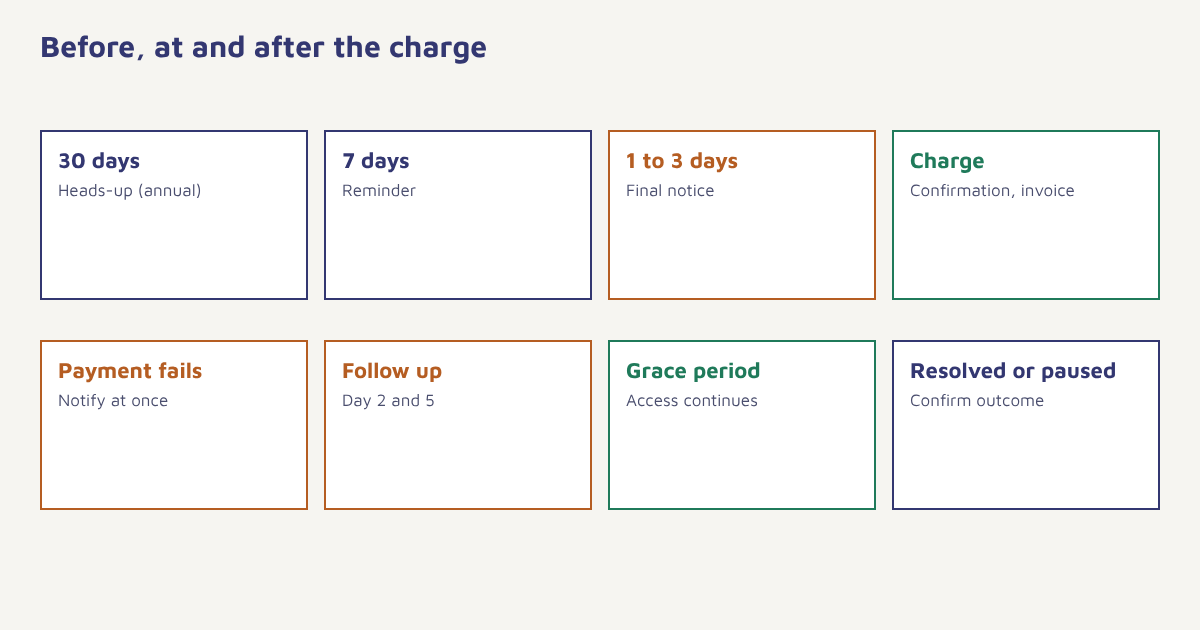
| Annual plan | 30 days, 7 days and 1 to 3 days before | Large charge, so earlier warning |
| Free trial to paid | 3 days before and on the last day | Make the price and date clear |
| Usage-based or credit plan | When balance is low, and before renewal | Tie to consumption events |
| Physical subscription box | Before the next shipment with a skip option | Skipping can save the subscription |
| Membership or licence expiry | 60, 30 and 7 days before | Longer lead time for business buyers |
These timings are starting points to test, not standards. Business buyers who need approvals usually need more notice than consumers. Adjust the schedule to the size of the charge and the customer’s decision process.
What each message should say
| Message | Must include | Nice to have |
|---|---|---|
| Heads-up before renewal | Plan name, amount, renewal date, payment method, how to change or cancel | A recap of what they used or achieved |
| Final notice | Same details, plainly stated | A link to update the card |
| Charge confirmation | Amount, date, invoice link | Thank-you and what is coming |
| Failed payment | What happened, how to fix, deadline | Reassurance that access continues for now |
| Grace-period warning | Date access will pause | Alternative: pause or downgrade |
| Cancellation confirmation | What ends and when, how to return | Short, no-pressure feedback request |
Lead with the facts. People should not have to scroll to learn what they will be charged. After the facts, a short summary of the value received, such as “This year your team sent 48 campaigns”, helps the decision, provided the numbers are accurate. Keep the tone calm. For copy tips, see email copywriting; for layout, email design best practices. The renewal notice is a service message first and a marketing message second, so avoid cluttering it with unrelated promotions; see transactional emails.
Handling failed payments
Many cancellations are involuntary: the card expired, the bank declined or the funds were short. The practice of retrying and notifying is often called dunning, and handled well it can save a meaningful share of revenue that would otherwise be lost. A simple approach follows.
- Retry smartly. Retry the charge on a sensible schedule, since many failures are temporary. Follow your payment provider’s guidance.
- Notify at once. Send an email, and an SMS or WhatsApp message where the customer has opted in, with a direct link to update payment details.
- Follow up. Send a second reminder after a day or two and a third before access changes.
- Offer a grace period. Keep access for a short, stated period.
- Offer alternatives. Another payment method, a pause or a cheaper plan.
- Close the loop. Confirm when payment succeeds, or explain exactly what has been suspended and how to restart.
This is a classic event-triggered journey: the failed-payment event starts it and a successful payment ends it. Build it in the journey builder with a goal exit, as described in goals and waits.
Channels
| Message | Best channel | Reason |
|---|---|---|
| Early heads-up | Room for detail and a record | |
| Final notice | Email plus push or in-app | Visible when it matters |
| Failed payment | Email plus SMS or WhatsApp (with opt-in) | Urgent, needs quick action |
| Large annual renewal | Email plus a human contact for key accounts | High value, relationship matters |
Check consent for each channel and use approved templates for business messaging, as explained in our guides to WhatsApp templates and SMS opt-in and opt-out. In-app banners are useful for users who are logged in; see in-app messaging.
Using the reminder to retain
A reminder is a good time to check whether the customer is getting value. If usage has been low, a gentle offer of help, a training session or a smaller plan may keep them. If they have been very active, a recap and maybe an upgrade suggestion fits. Use health signals from your data, as covered in customer health score, to choose the version. A short exit survey on the cancellation page also feeds your feedback loop. Avoid dark patterns such as hiding the cancel button or making customers phone to quit; they may be unlawful in some places and they damage trust.
A worked example
A made-up design-tool company sells annual plans. Thirty days before renewal, an email shows the plan, price, date and a summary of projects created. Seven days before, a second reminder repeats the facts and links to the billing page; for accounts with very low use, it offers a call to find a better plan. Two days before, a final notice goes out and in-app users see a banner. On renewal day, an invoice arrives. For one customer, the card has expired: an email and a WhatsApp message (the customer opted in) explain what happened with a link to update the card, a reminder follows two days later, and access continues for seven days. The payment succeeds on day three, and the journey ends with a confirmation. The company, schedule and customer are invented; adapt the timings to your product and to the rules in your markets.
Measuring the programme
| Measure | Reading it |
|---|---|
| Renewal rate | Share of due subscriptions that renew |
| Involuntary churn rate | Cancellations caused by failed payments |
| Payment recovery rate | Share of failed payments later collected |
| Refund and chargeback requests | Should fall with clearer notices |
| Cancellations after reminders | Watch for spikes, which may signal poor value or poor timing |
| Support contacts about billing | Should fall |
Test the timing and wording against a control group where rules allow, and read results alongside customer churn rate, customer lifetime value and cohort analysis. Do not hold back legally required notices for testing; test the optional content instead.
Common mistakes
- Silent renewals. Surprise charges produce disputes.
- Hiding the price. State amount and date in the first lines.
- One-size timing. Annual and monthly plans differ.
- Hard cancellation. It breeds anger and may break rules.
- No failed-payment flow. Involuntary churn is often the cheapest to fix.
A renewal reminder is a handshake before the charge, not a trap before the exit.
Protect revenue, respect customers. Build renewal and failed-payment journeys across email, WhatsApp and SMS.
Read next: customer health score, win-back campaigns and the blog.
Frequently asked questions
What are subscription renewal reminders?
They are messages sent before and after a subscription renews, telling the customer the plan, amount and date, confirming the charge and handling failed payments.
When should I send a renewal reminder?
It depends on the plan. Monthly plans often need a reminder a few days before, annual plans earlier such as 30 and 7 days, and business buyers may need more. Check rules for your markets.
Are renewal reminders required by law?
Some places and sectors require notice before automatic renewals or trial conversions. Rules vary and change, so check current requirements with your legal adviser.
What should a renewal reminder include?
Plan name, amount, renewal date, payment method, and how to change, pause or cancel, plus a link to billing details.
How do I reduce failed-payment churn?
Retry on a sensible schedule, notify the customer quickly with a link to update details, follow up, offer a grace period and alternatives such as pause or downgrade.
Should I include offers in a renewal reminder?
Keep the notice mainly factual. A relevant offer or plan suggestion can be added carefully, and never at the cost of making the price or cancellation unclear.
Which channel is best for renewal reminders?
Email is the main channel for detail and records. Add SMS, WhatsApp or push for urgent failed-payment alerts where the customer has opted in.