Collecting a tick in a box is the easy part. The hard part is remembering, a year later, exactly what that person agreed to, through which form and for which channel, and making sure every campaign, journey and export respects it. That discipline is consent management. This guide explains what a consent management system actually has to do, the data you should store for each consent, how to handle channels and purposes separately, how withdrawal and preference centres work, how consent shows up in segments and journeys and how to design the whole flow so that it survives an audit. It is operational guidance, not legal advice; confirm requirements for your markets with counsel.
What is consent management?
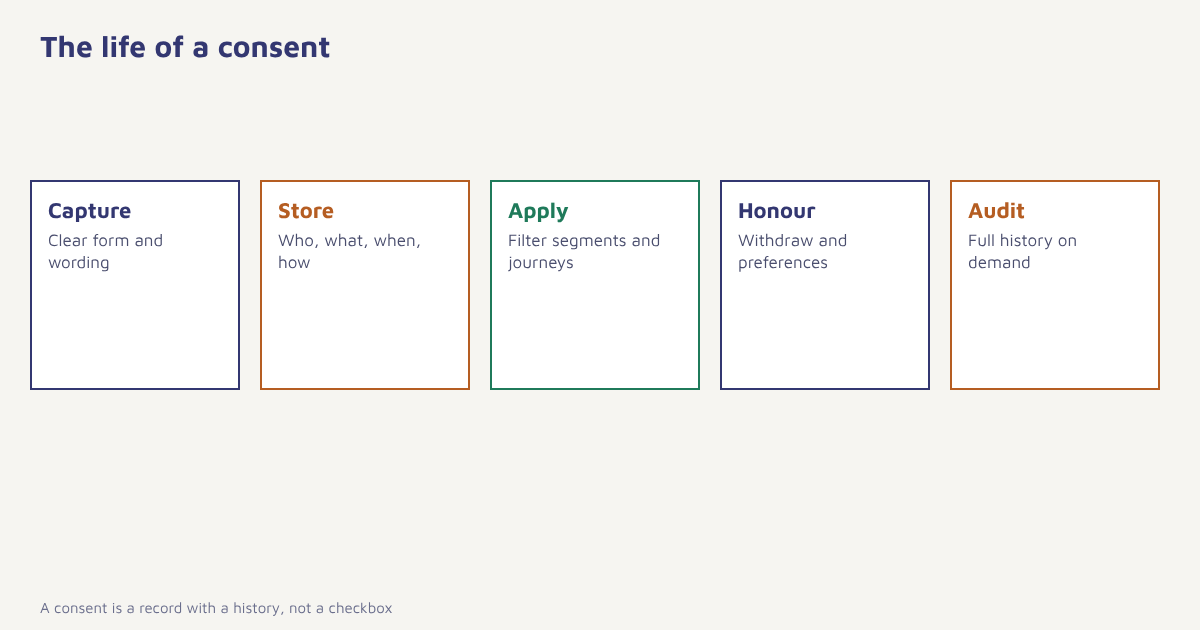
Consent management is the set of processes and tools that capture, store, apply and honour people’s permissions for how you use their data and contact them. In email and messaging, it answers four questions on demand: who agreed, to what, when and how, and has it changed since. The idea comes from privacy law, such as the GDPR and India’s DPDP Act, but it is also plain good practice, because respected consent keeps complaints low and sender reputation high.
What to store for every consent
| Field | Example | Why it matters |
|---|---|---|
| Person identifier | Email, phone or customer ID | Links the consent to a profile |
| Channel | Email, SMS, WhatsApp, push | Permissions are not interchangeable |
| Purpose | Promotions, newsletters, product updates | Consent should be specific |
| Status | Granted, withdrawn, pending, expired | Drives targeting |
| Timestamp | 2026-03-14 10:22 IST | Shows when it was given or changed |
| Source | Footer form v3, checkout, in-store QR | Shows how it was collected |
| Wording shown | The exact text and the privacy notice version | Proof of what was agreed |
| Evidence | IP or device data, confirmation click | Strengthens the record |
| History | Every change, in order | Needed for audits and disputes |
Notice that this is a table of events, not a single column on the contact. If you only keep the latest status, you lose the history that makes it defensible. In Flowfox, consent lives on the contact profile per channel, with the source recorded, which is the foundation for everything below.
Design principles
- Separate by channel and purpose. Do not let email consent stand in for WhatsApp or SMS consent. See SMS opt-in and opt-out and WhatsApp marketing for channel specifics.
- Make the opt-in clear. Plain language, unticked boxes, a visible privacy link.
- Store the full record. Use the fields in the table above, not just a yes or no.
- Apply it automatically. Segments and journeys should filter on consent without manual list work.
- Make withdrawal easy. One click from every message, honoured immediately across systems.
- Offer preferences. Let people reduce frequency or choose topics. See unsubscribe best practices.
- Review regularly. Check for stale consents, old forms and unexplained contacts.
Applying consent in segments and journeys
A consent record is only useful if it controls sending. Every audience should include a consent condition, so that a segment such as “viewed but did not buy” automatically excludes anyone who has not agreed to promotional messages on the chosen channel. In Flowfox, you can build that condition into the segment builder and into journey entry rules, so the same person can receive a transactional order update but not a promotion. When a journey spans channels, check consent at each step, not only at entry, since a person may withdraw halfway through. This is a core part of omnichannel work, where a single profile is the safeguard that keeps channels from contradicting each other.
-- Illustrative audience rule (pseudo-SQL, not Flowfox syntax)
SELECT c.id
FROM contacts c
JOIN consents k ON k.contact_id = c.id
WHERE k.channel = 'email'
  AND k.purpose = 'promotions'
  AND k.status = 'granted'
  AND NOT EXISTS (SELECT 1 FROM suppressions s WHERE s.contact_id = c.id)
  AND c.last_order_at < NOW() - INTERVAL 60 DAY;
Withdrawal and preference centres
Withdrawing consent must be at least as easy as giving it. A good preference centre does more than say goodbye: it offers a pause, a frequency choice and topic toggles, and it confirms the outcome. Treat a full unsubscribe as a hard stop, update the profile everywhere and keep a suppression record so that a later import cannot revive the address. Do not ask for a login or a reason as a precondition. Where you also run list cleaning, keep unsubscribed and bounced addresses in the suppression list rather than deleting them, or you risk emailing them again.
Dealing with legacy lists and missing records
| Situation | Sensible approach |
|---|---|
| Contacts with no recorded source | Do not assume consent. Send a re-permission request or suppress them |
| Imported lists from a merger or agency | Ask for evidence of consent; if none exists, treat as unconsented until confirmed |
| Old forms without clear wording | Retire the form; segment contacts collected through it for review |
| Customers who bought but never opted in | Follow the rules in your market on existing-customer marketing; otherwise ask |
| Shared devices or family emails | Use confirmation steps to verify the person’s identity |
A worked example (invented)
A learning platform has 120,000 contacts, of which 35,000 have no recorded consent source because they came from a webinar partner three years ago. The marketing lead builds a consent audit in four steps. First, tag all contacts by source and by whether a consent record exists. Second, send the 35,000 an honest re-permission email explaining who the platform is, why they are hearing from it and what they would receive, with a single confirm button. Third, suppress anyone who does not confirm after 30 days and two reminders. Fourth, adjust the sign-up forms so that every new contact carries a source and a consent record. Engagement among the confirmed group is later compared with the older, unconfirmed segment. The numbers are invented; the lesson is that fixing the pipeline matters more than cleaning the past once.
Who owns consent in your organisation?
Consent management fails most often for organisational reasons. Marketing collects consent, engineering stores it, support receives complaints and legal answers regulators, and nobody owns the whole chain. Name one owner, usually in marketing operations or data governance, who maintains the list of purposes, approves new forms and reviews the logs. Agree a short change process: before any new sign-up form, import or integration goes live, the owner checks the wording, the consent fields and the channel. Hold a quarterly review in which you sample twenty contacts at random and try to reconstruct, from your records alone, why each one is receiving your messages. If you cannot, you have found a gap before a regulator does.
Also decide how long consent lasts. Some teams treat consent as valid until withdrawn; others set a refresh period and re-ask contacts who have been inactive for a long time. There is no single correct rule, so choose a period you can explain and apply it consistently. The idea of explicit permission is described under opt-in email. Pair this with win-back campaigns that ask lapsed contacts whether they still want to hear from you, and with the customer 360 view that brings consent, orders and activity together.
Common mistakes
- Keeping only a yes/no flag. You cannot prove anything with it.
- One consent for all channels. It rarely holds up.
- Forgetting withdrawal across tools. The person still hears from you elsewhere.
- Hiding the preference centre. People unsubscribe instead.
- No review cycle. Old forms and imports quietly create risk.
A consent you cannot explain is a consent you do not really have.
Make consent part of every audience. Store permission per channel and filter every segment and journey on it.
Read next: email compliance checklist, GDPR and email marketing, first-party data and the blog. For wider context on the concept, see the overview of informed consent.
Frequently asked questions
What is consent management?
Consent management is the process and tooling used to capture, store, apply and honour people’s permissions for how you use their data and contact them.
What should a consent record include?
It should include the person, channel, purpose, status, timestamp, source, the wording shown, evidence such as a confirmation click, and the full history of changes.
Is email consent valid for WhatsApp or SMS?
Generally no. Consent should be specific to the channel and purpose, so collect and record it separately for each.
How should I handle contacts with no consent record?
Do not assume consent. Send a re-permission request or suppress them, and check the rules for your market.
How should unsubscribes be handled?
Honour them immediately across all systems, keep a suppression record and make the process easy, without requiring a login or reason.
Does consent management apply to transactional messages?
Transactional messages, such as receipts and security notices, are generally treated differently from marketing, but rules vary, so keep promotions out of them.
Is this legal advice?
No. It is operational guidance. Confirm the consent standards for your markets with qualified counsel and official regulator text.