Consent is the foundation of SMS marketing. Without it, even a well-written message becomes a complaint, a carrier problem or a legal risk. With it, texts are welcomed, read and answered. This guide explains how SMS opt-in and opt-out work in practice: what counts as consent, how to collect it on a checkout, a form, a keyword or a QR code, how to word the request, how to handle STOP and other opt-out words, what records to keep and how the picture differs between India and other regions. It is a practical guide, not legal advice, and rules vary by country and change, so confirm details with your legal adviser and telecom provider.
What are SMS opt-in and opt-out?
Opt-in is the act by which a person agrees to receive text messages from you. Opt-out is the act by which they withdraw that agreement. Together they define who you may message, about what and for how long. The general principle appears in laws and industry codes around the world, for example the Telephone Consumer Protection Act in the United States, the GDPR and ePrivacy rules in Europe, and telecom regulation and the Digital Personal Data Protection Act in India. The details differ, but the common core is simple: ask clearly, record the answer, respect it and make leaving easy.
The position in India, in general terms
In India, commercial messages are regulated by the telecom regulator, and operators enforce rules on registered sender IDs, registered content templates and recipient preferences. Promotional messages generally need the recipient’s consent or must respect the national preference system, while transactional and service messages have different treatment. Our guides to DLT registration and the DPDP Act for marketers explain the concepts. The rules and their interpretation change, so read the current texts from the regulator and your operator, and ask your legal adviser before launching a new collection method.
Types of opt-in
| Type | How it works | Strength | Weakness |
|---|---|---|---|
| Checkbox on a form or checkout | An unticked box with clear text | Easy to record, widely accepted | Boxes pre-ticked by default are not valid consent in many places |
| Keyword by text | Customer texts a word to a number | Strong proof, comes from the phone itself | Needs a keyword and number promoted |
| QR code | Scan opens a pre-written message or form | Good in stores and print | Needs clear wording on the sign |
| Verbal | Staff ask and enter the number | Convenient at counters | Hard to prove without a record |
| Double opt-in | Customer confirms by replying to a confirmation text | Strongest proof, cleans fake numbers | Small drop in sign-ups |
Consent is specific. Agreeing to receive order updates does not automatically mean agreeing to marketing. Keep the purposes separate, and do not carry consent from one channel, such as email, to another.
How to word the opt-in
People should know what they are agreeing to before they agree. A good opt-in names the brand, says what kind of messages to expect, gives a rough frequency, mentions that standard message charges may apply where relevant, and links to your privacy notice and terms. Avoid burying it in small print or bundling it with other terms.
| Weak | Better |
|---|---|
| I agree to the terms | Text me offers and updates from Nilgiri Tea (about 2 a month). Reply STOP to opt out. See our privacy notice. |
| (pre-ticked box) Send me promotions | [ ] Send me offers by SMS. You can unsubscribe any time. |
Confirm the sign-up
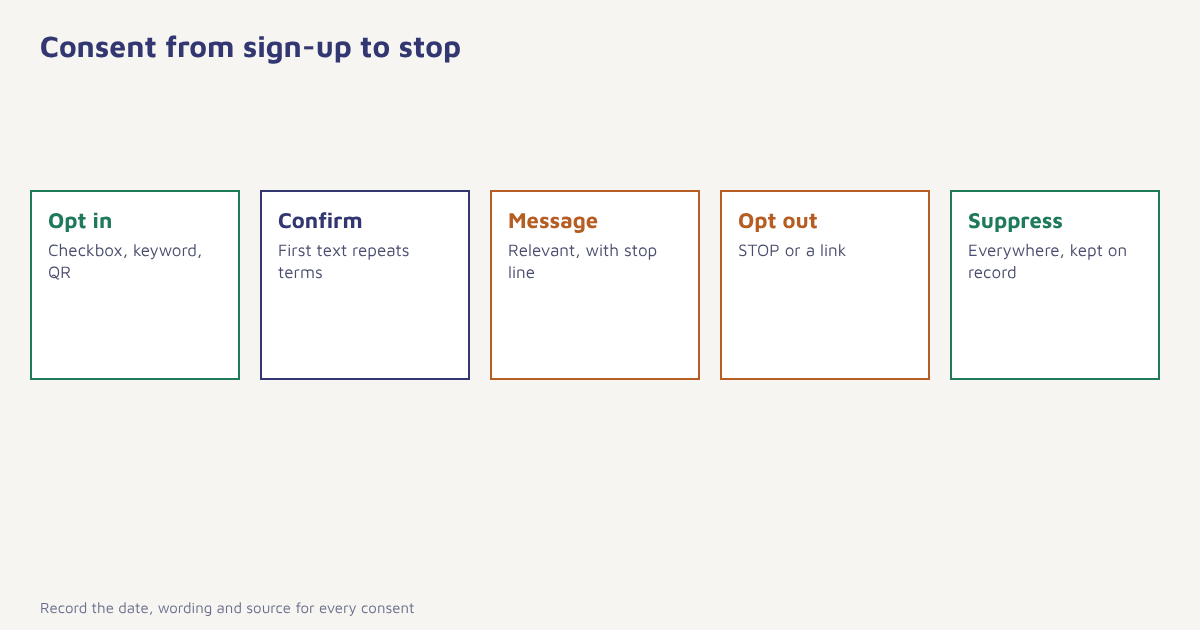
Send a confirmation text straight away. It acts as the first message, repeats what the person signed up for and shows how to stop. If you use double opt-in, ask them to reply with a word such as YES before sending anything else. Record the date and time, the exact wording shown, the source (for example “checkout” or “QR poster”) and the phone number. These records are your evidence if a complaint arises.
Sample confirmation (illustrative). Nilgiri Tea: you are subscribed to offers by SMS, about 2 a month. Reply STOP to opt out, HELP for help.
Handling opt-outs
Opt-out must be easy and quick. Give people at least one simple method: replying with a clear word, clicking a link or using a number to call. Many senders recognise several words, such as STOP, UNSUBSCRIBE, CANCEL, END and QUIT, so that people are not forced to guess a single magic word. Process the request immediately, send one final confirmation if allowed by the rules, and make sure no further promotional message goes out.
- Recognise the request. Match common words in any case, with or without punctuation, and handle local-language equivalents where your audience uses them.
- Update the profile at once. Set SMS marketing consent to false and record the time and method.
- Suppress across systems. Make sure every campaign tool and automated flow checks the same suppression list.
- Confirm once. A single message such as “You are unsubscribed and will not receive more messages” is usual.
- Keep the record. Do not delete the opt-out. You need it to avoid texting the person again.
- Review reasons. If many people opt out after one campaign, examine the targeting and frequency.
In Flowfox, consent is stored per channel on the contact profile. When someone replies with an opt-out word, the SMS channel updates the profile, and segments and journeys that check consent stop including that person right away. The segment builder can also find people who have not engaged for a long time so that you can send a re-permission message or retire them. Our guide to consent management covers the system side in more depth.
Transactional vs promotional messages
| Aspect | Transactional / service | Promotional |
|---|---|---|
| Purpose | Respond to something the customer did | Sell, announce or re-engage |
| Examples | OTP, order status, appointment reminder | Sale, new arrival, coupon |
| Consent | Usually implied by the transaction, but check local rules | Explicit opt-in expected in many places |
| Opt-out | Often not required for essential messages | Must be offered |
| Content rule | Must not slip in promotions | Must identify the sender and the offer |
Never disguise a promotion as a transactional message to avoid consent rules. It can lead to blocked sender IDs and penalties, and it damages trust. See transactional messaging for the same principle in email.
A worked example (invented)
An online sports store, invented for this example, wants to start texting customers about restocks. It adds an unticked checkbox at checkout that reads: “Text me when items I want are back in stock, plus occasional offers. About 2 messages a month. Reply STOP to opt out.” A customer ticks the box and enters a number. The store immediately sends a confirmation text with the same wording, logs the time, the checkout page version and the phone number, and tags the contact as SMS marketing consented. Three weeks later, the customer replies “Stop please” to an offer. The system recognises the word, updates the profile, adds the number to the suppression list and sends a final confirmation. No later campaign includes the number. The scenario is made up, but each step maps to a habit that protects both customer and business.
Double opt-in has a long history in email, where it is described as opt-in email practice, and the same logic carries over to texts: a confirmation step costs a few sign-ups but leaves you with cleaner numbers and stronger evidence. Whichever method you choose, apply it consistently across forms, stores and campaigns, so that your records look the same wherever consent came from.
Common mistakes
- Pre-ticked boxes. They do not show a real choice.
- Using purchase data as consent. A sale is not permission to market.
- Slow opt-out. Waiting days invites complaints.
- One suppression list per tool. People then get texted by the tool that did not hear the request.
- No records. Without proof of consent, you cannot defend a complaint.
Consent is not a hurdle before marketing. It is the thing that makes the marketing worth reading.
Keep consent and suppression in one place. Store permission per channel and apply it to every campaign and journey.
Read next: SMS marketing best practices, email unsubscribe best practices and the blog.
Frequently asked questions
What is SMS opt-in?
SMS opt-in is a person’s clear agreement to receive text messages from a business, ideally recorded with the date, time, wording and source.
What is SMS opt-out?
SMS opt-out is when a person withdraws consent, usually by replying with a word such as STOP. The business must then stop sending marketing messages to that number.
What is double opt-in for SMS?
Double opt-in asks the customer to confirm their sign-up by replying to a confirmation text before any marketing starts. It gives stronger proof and removes fake numbers.
Do I need consent to send promotional SMS in India?
Promotional messages are regulated by the telecom regulator and operators, and consent and preference rules apply. Check the current rules and your provider’s requirements, and ask a legal adviser.
Which words should count as an SMS opt-out?
Commonly STOP, UNSUBSCRIBE, CANCEL, END and QUIT, plus reasonable variations in case and punctuation. Consider local-language equivalents for your audience.
Can I text customers who bought from me without a separate opt-in?
Order and service messages are generally treated differently from marketing. For promotions, you should usually have separate consent, so check the local rules.
How long should I keep consent records?
Keep them for as long as you message the person and for a reasonable period afterwards, as advised by your legal adviser, and keep opt-outs so that you do not text them again.