SMS has the highest reach of almost any channel: nearly every phone can receive a text, and people tend to read it within minutes. That same immediacy makes it unforgiving. A badly timed or irrelevant text feels intrusive, gets reported and, in India, can land your sender ID in regulatory trouble. This guide sets out SMS marketing best practices that hold up in practice: consent, timing, content, frequency, personalization, compliance, measurement and testing. It complements our broader guide to SMS marketing by focusing on how to run campaigns well day to day.
Why SMS needs its own rules
SMS messages are short, plain and delivered straight to a phone’s default messaging app, with no image loading, no algorithm and few ways to hide. Delivery is fast, open rates are commonly described as high, and replies are easy. But the channel has tight limits. A single message is limited to a small number of characters, long texts are split into parts, there is no rich layout, and many countries regulate commercial texts closely. In India, promotional and transactional messages follow telecom rules on sender IDs, registered templates and consent, which we cover in the DLT guide. Treat all regulatory points here as general, and confirm current requirements with your telecom provider or the regulator.
1. Start with consent and a clean list
Send only to people who agreed to receive texts from you, and record when and how they agreed. Buying lists or texting every customer who ever gave a number for delivery purposes is the fastest way to complaints. Separate transactional and promotional audiences, because different rules apply to each. See our guide to SMS opt-in and opt-out for how to collect and honour consent, and keep numbers clean by removing invalid and long-inactive ones.
2. One message, one purpose, one action
A text works when the reader understands it in a glance. State who you are, what the message is about and what to do next. Avoid stacking offers or asking for several actions. Put the most important words first, because previews cut off the rest.
| Weak | Better |
|---|---|
| Big sale!!! Don’t miss out, visit now for amazing offers across categories | Nilgiri Tea: 20% off all blends till Sunday. Shop: [short link] |
| Dear customer your order update is available | Your order FX-20481 ships today. Track: [short link] |
| Hi, reminder | Reminder: your appointment is tomorrow at 11:30. Reply 1 to confirm. |
3. Make it obvious who is texting
A recognisable sender ID and your brand name in the first words build trust. People ignore messages from unknown senders, and fraud awareness is high, so avoid anything that resembles phishing: urgent threats, unfamiliar links or requests for sensitive details. Never ask for passwords, card numbers or one-time codes by text in a marketing message.
4. Use links carefully
Links make SMS actionable but raise concerns. Use a short, branded domain instead of a generic shortener, because generic shorteners are often blocked or treated with suspicion by operators. Make sure the page is mobile-friendly and loads fast, and that it matches the message. Track clicks with unique parameters so you can attribute results. If you also use email, keep landing pages consistent with those described in our conversion rate optimization guide.
5. Choose timing with care
Texts arrive on a personal device, so send during sensible hours in the recipient’s time zone, avoid late evenings and early mornings and respect any regulatory quiet hours that apply. Time-sensitive messages such as delivery updates and flash sales can go immediately, but promotions usually work better when planned. Test a few windows, as described in the best time to send, and see flash sale marketing for urgency done honestly.
6. Set a frequency cap
SMS fatigue shows up as opt-outs, complaints and ignored messages. Agree a cap across all campaigns, for example a limited number of promotional texts per customer per week or month, and count automated flows within it. Transactional messages are separate but should still be relevant. When engagement drops, send less before you send differently.
7. Personalise where it helps
A first name is the weakest form of personalization. Better signals are what the customer bought, viewed or left behind. A text about the exact item in a cart, or about the store nearest to the customer, is more relevant than a generic offer. Build these audiences from behaviour, as in behavioral segmentation and marketing personalization. In Flowfox, the segment builder and event data let you target on actions, and templates insert the right variables.
8. Make opting out easy
Include a clear way to stop messages in promotional texts and process requests quickly. Hiding the opt-out only converts a polite unsubscribe into a spam complaint. Keep suppression lists shared across channels where the person has withdrawn consent broadly, and check that automated flows respect them.
9. Measure what matters
| Metric | What it tells you | Note |
|---|---|---|
| Delivery rate | Whether messages reach phones | Low rates point to bad numbers or filtering |
| Click-through rate | Interest in the offer | Needs trackable links |
| Conversion rate | Whether clicks become actions | The metric that links to revenue |
| Opt-out rate | Fatigue or poor targeting | Watch it by campaign |
| Revenue per message | Value of each send | Compare to cost per message |
| Reply rate | Two-way engagement | Useful for service flows |
Use a holdout group, a random slice that does not get the message, to find out what the campaign truly caused. See A/B testing and marketing ROI.
A pre-send checklist
- Confirm the audience has opted in. Check the consent flag and suppression list.
- Check the template and sender ID. They must match what is registered, where registration applies.
- Read the message on a phone. Does the first line make sense on its own?
- Test the link. Open it on mobile data, not only on office wifi.
- Check the time. Is it a sensible hour in the recipient’s time zone?
- Check the frequency. Has this person already received too much this week?
- Send a small test first. Send to your team before the full list.
Compare channels before you commit budget: see email vs SMS vs WhatsApp, push vs SMS and RCS vs SMS. For the product side, see the SMS channel and campaigns. Background reading on mobile marketing and the regulator TRAI may help, although rules change and you should read the official sources.
A worked example (invented)
A regional pharmacy chain, invented for this example, wants to remind customers to refill chronic-care prescriptions without being intrusive. It texts only customers who ticked the SMS consent box, uses its registered sender ID and keeps the message to one line: the store name, the medicine category (not the medicine), a short link to reorder and an opt-out word. It sends at 10 am, no more than once a month per customer, and holds back 10 percent of customers as a comparison group. After two months, the team compares refill rates and opt-outs. The test shows a small lift in refills with a low opt-out rate, so the team extends the flow. The scenario is made up, and for health-related messages the chain would still need to check privacy and telecom rules with its advisers.
Common mistakes
- Texting without recorded consent. It risks complaints and penalties.
- Generic shortened links. They may be blocked or distrusted.
- Overlong messages. Costs rise and readers drop off.
- Ignoring time zones. A text at 2 am is a quick way to lose a customer.
- Treating SMS like email. Brevity and relevance are the whole game.
A text message earns one glance. Spend it on something the reader would thank you for.
Run SMS campaigns with consent and control. Segment by behaviour, cap frequency and measure against a holdout.
Read next: SMS templates, the DPDP Act for marketers and the blog.
Frequently asked questions
What are the best practices for SMS marketing?
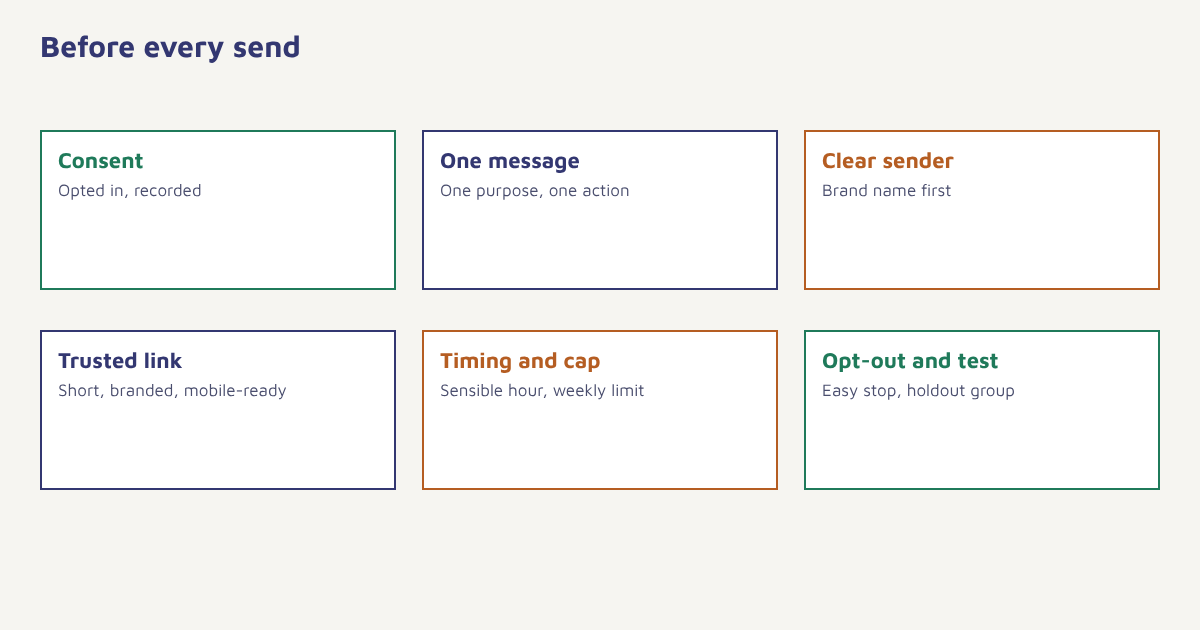
Get consent, send one clear message with one action, identify your brand, use trusted links, choose sensible times, cap frequency, personalise by behaviour, make opting out easy and measure against a holdout group.
How often should I send marketing SMS?
There is no universal number. Many businesses limit promotional texts to a few per month per customer and reduce frequency when opt-outs rise.
What is the best time to send marketing SMS?
Daytime and early evening in the recipient’s time zone are common starting points. Avoid late nights and test windows with your own audience.
How long should an SMS marketing message be?
As short as possible. One message has a limited character count, and longer texts are split and cost more, so aim for one clear line.
Do I need DLT registration for SMS in India?
Commercial SMS in India generally requires registered sender IDs and templates under telecom rules. Check current requirements with your provider and the regulator.
Are link shorteners safe in SMS?
Generic public shorteners are often blocked or distrusted. A short branded domain is usually safer, but check your operator and regulatory rules.
How do I measure SMS campaign success?
Track delivery, clicks, conversions, revenue per message, opt-outs and, where possible, results against a holdout group.