A flash sale is a promise with a deadline: this price, for this short time, for these products. Done well, it clears stock, wakes up dormant customers and gives the whole store a burst of energy. Done badly, it teaches shoppers to wait for the next discount and leaves you with a pile of returns and a dent in margin. This guide explains how flash sales work, how to decide whether one suits your business, how to plan the countdown from teaser to last call, which channels to use at each step and how to keep urgency honest so that you do not damage trust or break consumer rules.
What is a flash sale?
A flash sale is a discount or special offer available for a very short period, often a few hours to a couple of days, sometimes limited to specific products or a fixed quantity. The short window creates urgency, which draws on the psychology of scarcity: people value what they might lose. For stores, the appeal is simple: concentrated demand, easy-to-explain offers and a reason to message customers who have been quiet. The risk is equally simple: if every week brings a "flash" sale, none of them feels urgent and the discount becomes the price.
When a flash sale makes sense
| Good reason | Poor reason |
|---|---|
| Clearing seasonal or overstocked items you would discount anyway | Boosting a bad month with margin you cannot spare |
| Rewarding loyal customers with early access | Training everyone to expect weekly discounts |
| Launching a new channel or app and bringing people in | Covering up weak product or service problems |
| Celebrating a real event such as an anniversary or festival | Inventing a deadline that is not real |
| Reactivating a lapsed segment with a time-limited offer | Sending the same offer to all, including recent full-price buyers |
Before committing, check the numbers: margin after discount, shipping and payment fees, expected return rate and whether your fulfilment can cope with a spike. The discount should still leave a contribution you can live with. The maths of free shipping and basket size is covered in free shipping threshold and average order value.
The countdown: teaser to last call
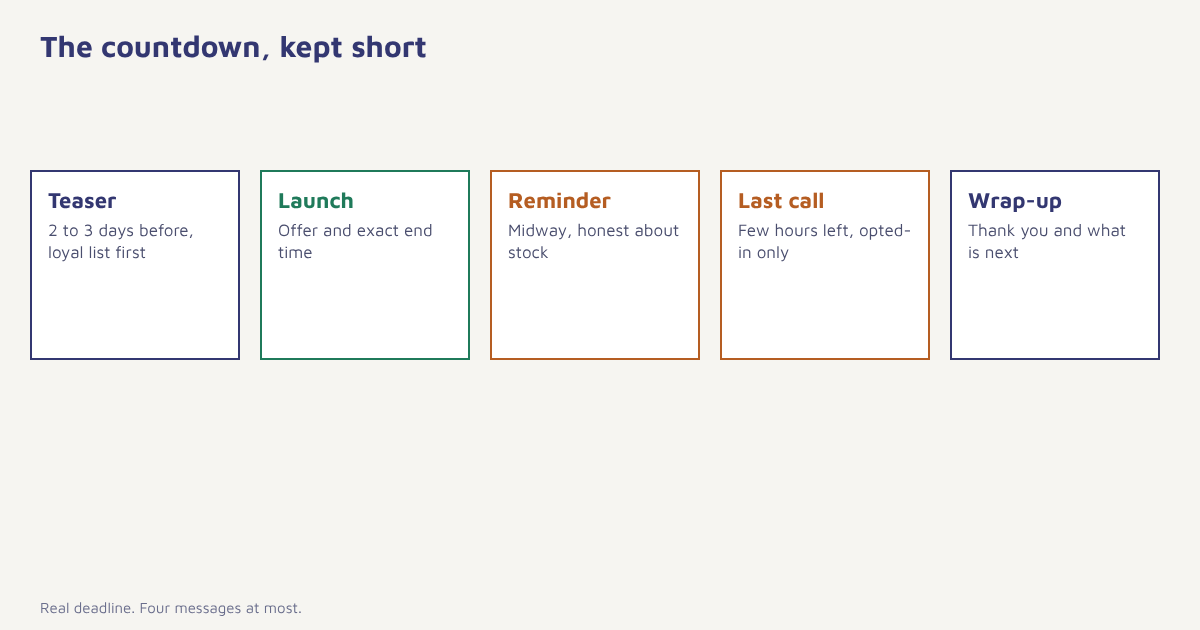
| When | Message | Channel | Goal |
|---|---|---|---|
| 2 to 3 days before | Teaser: something is coming, join the early list | Email, app, site banner | Build anticipation and an interested audience |
| Launch | Offer, products, exact end time | Email, WhatsApp, push (consented) | Announce clearly |
| Midway | Reminder with best sellers or remaining stock | Email or push | Catch those who missed it |
| A few hours before end | Last call, honest about what is left | Push, WhatsApp, SMS (consented) | Convert the undecided |
| After | Thank you, delivery info, what comes next | Reduce anxiety, keep the relationship |
Notice the restraint: one teaser, one launch, one reminder, one last call. More than that and the sale starts to feel like spam, and unsubscribes rise. Choose channels with care. Email suits the full story, push and in-app messages suit a quick nudge, and WhatsApp or SMS suit a short last call to people who opted in. See email vs SMS vs WhatsApp, push vs SMS and the rules in SMS opt-in and opt-out.
Who should hear first
Segment the sale. Your best customers deserve early access, which rewards loyalty without discounting to everyone at once. Shoppers who browsed the sale items or have them on a wish list are the next group. Customers who bought the same items at full price last week are a delicate case: telling them about a deep discount can feel like a betrayal, so consider excluding them or offering a price adjustment. Lapsed customers can receive the offer as a win-back, as described in win-back campaigns. In Flowfox the segment builder lets you build these groups from purchase and browsing events, and a journey can run the whole countdown automatically, with each person entering at the right step.
Keep urgency honest
Urgency works because it is real. A countdown that resets for every visitor, "only 2 left" when stock is plentiful, or a "final day" repeated every week are examples of what regulators and consumer groups call deceptive design, sometimes dark patterns. Consumer protection law in many places, including India’s Consumer Protection Act, 2019 and related guidelines, addresses misleading claims, so check the current rules with your legal advisor. In practice, follow a few habits: state the real end time with a time zone, only claim limited stock if it is limited, show the original price truthfully and honour the offer for everyone who orders before the deadline, even if the site was slow.
A simple honesty test. If a customer screenshotted your message and posted it publicly after the sale, would it still look fair? If not, change the message.
Prepare the store and the team
- Pick the products and the depth of discount. Use margin data, not instinct, and keep a floor price.
- Check stock and fulfilment. Make sure inventory counts are accurate and the warehouse can ship the spike.
- Load-test the site. Slow pages at the moment of launch lose the sale. See conversion rate optimization.
- Prepare support. Write answers to the likely questions: returns, delivery times, stacking with coupons.
- Schedule the messages. Set start and end times in one time zone and test each link and coupon code.
- Set a stop rule. Decide in advance when to end the sale early, for example if stock runs out.
- Review after. Measure orders, revenue, margin, returns and the effect on full-price sales the following weeks.
A worked example (invented)
A footwear store has 600 pairs of last season’s sandals and wants them gone before monsoon stock arrives. It plans a 48-hour sale: a teaser to 3,000 loyal customers three days ahead, a launch email and push at 10 am on day one, a reminder on the evening of day one that shows only sizes still available, and a last-call WhatsApp at 6 pm on day two to opted-in customers who viewed but did not buy. Shoppers who paid full price for similar sandals in the past fortnight are excluded and instead receive an apology-free note about the store’s price-match policy. In the first week afterwards the team compares sales against a normal week, checks the return rate and looks at whether full-price sales dipped. All numbers and the brand are invented to illustrate the planning, not to suggest results you will see.
Measuring a flash sale properly
Revenue on the day tells you little. Compare margin after discount, orders from new versus existing customers, units shifted from the targeted stock, return rate, support contacts and what happened to sales in the following two weeks. A dip afterwards means you borrowed demand from the future instead of creating it. Use a holdout group where practical, so you can see how many of the orders the messages caused. For metrics definitions see email marketing metrics and marketing ROI. If your offer depends on price sensitivity, the idea of price elasticity of demand explains why some products respond strongly to discounts and others barely move.
Common mistakes
- Too many "flash" sales. The urgency disappears and discounts become the expectation.
- Deep discounts on best sellers. You give away margin you would have earned anyway.
- False scarcity. It erodes trust and may break rules.
- Ignoring recent full-price buyers. They feel punished.
- Skipping load tests. A crashing site at launch wastes the whole build-up.
- Messaging without consent. Respect channel permissions. See the DPDP Act guide.
A flash sale works once the customer believes the clock. Spend the trust carefully.
Run the countdown automatically. Build teaser, launch, reminder and last-call messages into one journey.
Read next: ecommerce email marketing, festival campaigns and the blog.
Frequently asked questions
What is a flash sale?
A flash sale is a discount or special offer available for a very short time, often hours to a couple of days, sometimes on limited stock, designed to create urgency.
How long should a flash sale last?
Long enough for your audience to see it and short enough to feel urgent. Many run from a few hours to two days, but test with your own customers and keep the end time real.
How many messages should I send for a flash sale?
A restrained sequence works best: a teaser, a launch message, a reminder and a last call. More than that tends to raise unsubscribes without adding sales.
Which channels are best for flash sale marketing?
Email for the full story, push or in-app for quick nudges, and WhatsApp or SMS for a short last call to customers who have opted in.
Can a fake countdown timer get me in trouble?
It can. Misleading urgency claims may breach consumer protection rules and damage trust. Use real deadlines and real stock claims, and check current regulations.
Do flash sales hurt full-price sales?
They can if overused, because customers learn to wait. Measure sales in the weeks after, protect your best sellers and use flash sales sparingly.
How do I measure whether a flash sale was profitable?
Look at margin after discount, shipping and returns, share of new customers, units of the targeted stock cleared and sales in the following two weeks, ideally against a holdout group.