"Free shipping on orders above Rs 1,499" is one of the most familiar lines in online retail, and one of the easiest to get wrong. Set the bar too low and you give away shipping on orders that would have paid for it anyway. Set it too high and shoppers see it as unreachable, so it does nothing. This guide shows how a free shipping threshold works, how to calculate the right level, the break-even conversion lift needed for it to pay, a worked example checked line by line, how to test it, how to promote it in messages and which alternatives may suit your store better.
What is a free shipping threshold?
A free shipping threshold is the minimum basket value above which you waive the delivery fee. It does two jobs at once. It removes a common reason for abandoning a purchase, since unexpected delivery costs are a widely reported cause of cart abandonment, and it encourages shoppers to add items to reach the line, which raises average order value. The cost is real: for every order that would have paid a delivery fee but now crosses the line, you absorb the shipping cost. The question is whether extra orders and bigger baskets outweigh the fees you give up. General background on how delivery charges work is in the article on shipping and handling.
The numbers you need first
| Input | Where to find it | Why it matters |
|---|---|---|
| Average order value (AOV) | Order data. See AOV | Sets the starting point for the threshold |
| Order value distribution | Share of orders in each price band | Shows how many are close to the line |
| Gross margin per order | Revenue minus cost of goods | What you earn to pay for shipping |
| Shipping cost per order | Courier invoices, packaging, handling | What free shipping really costs |
| Shipping fee charged today | Checkout settings | What you stand to lose on orders above the line |
| Conversion rate and cart abandonment | Analytics. See CRO | Shows whether shipping cost is a barrier |
| Return rate | Order data | Free shipping can increase returns |
Choosing a starting level
A common rule of thumb is to set the threshold somewhat above your current AOV, often in the range of 15 to 30 percent higher, so that a meaningful share of shoppers have to add one more item. This is a starting hypothesis, not a law. If the line is much higher than most baskets, few people will reach it. If it is lower than most baskets, you simply give away shipping. Look at the order distribution: the best level usually sits where a good number of orders fall just below it.
The break-even calculation
Net effect. Net change = (fees lost on orders already above the line) + (extra margin from baskets nudged up, minus fees lost on them) + (margin from extra orders won, minus shipping cost absorbed)
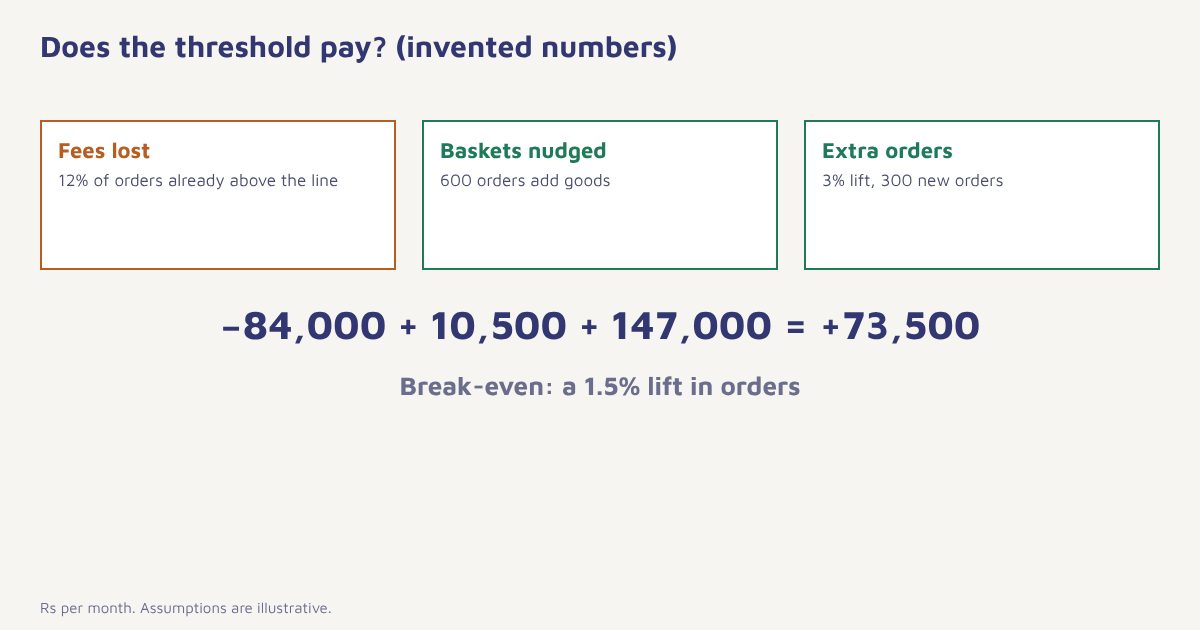
Here is a worked example with invented numbers. A store gets 10,000 orders a month at an AOV of Rs 1,100 and a 35 percent gross margin. It charges Rs 70 for delivery, which equals its cost, so shipping is neutral today. It considers free shipping above Rs 1,500.
| Effect | Assumption | Calculation | Monthly change |
|---|---|---|---|
| Fees lost on orders already above Rs 1,500 | 12% of orders | 10,000 × 12% × Rs 70 | −Rs 84,000 |
| Baskets nudged up to the line | 20% of orders sit at about Rs 1,350; 30% of them add Rs 250 of goods | 600 orders × (Rs 250 × 35% − Rs 70) | +Rs 10,500 |
| Extra orders from higher conversion | 3% more orders, averaging Rs 1,600 | 300 orders × (Rs 1,600 × 35% − Rs 70) | +Rs 1,47,000 |
| Net | +Rs 73,500 |
The result depends heavily on the third line. Without the conversion lift, the same threshold loses Rs 73,500 a month (−84,000 + 10,500). The break-even lift is 1.5 percent more orders: 150 extra orders at Rs 490 each (Rs 1,600 × 35% − Rs 70) is Rs 73,500, which exactly offsets the loss. If your test shows a lift below that, the threshold costs you money. The figures were checked by calculation, but the assumptions are made up and will differ in your store.
orders = 10_000
margin = 0.35
fee = 70            # shipping fee charged = shipping cost
already_above = 0.12 * orders * fee                      # fees lost
nudged = 0.30 * (0.20 * orders)                          # 600 orders
nudge_gain = nudged * (250 * margin - fee)               # +10,500
per_new_order = 1600 * margin - fee                      # 490
breakeven_lift = (already_above - nudge_gain) / per_new_order / orders
print(round(breakeven_lift * 100, 2))                    # 1.5 (% more orders)
Test before you commit
- Calculate break-even. Use your own distribution, margin and shipping cost, as above.
- Pick two or three candidate thresholds. For example about 15, 25 and 35 percent above AOV.
- Run a split test. Show each level to a random share of shoppers for at least two full weeks. See A/B testing and sample size.
- Measure the right things. Conversion rate, AOV, margin per order after shipping, returns and repeat purchase.
- Check segments. Mobile versus desktop, new versus returning, metro versus smaller cities.
- Decide and review. Adopt the level with the best margin per visitor, then revisit each quarter or when costs change.
If your traffic is low, a clean test may take too long. In that case, run the threshold for a defined period, compare with the same period last year or the weeks before and watch margin carefully. The thinking behind such comparisons is the same as in conversion rate optimization.
Promoting the threshold
A threshold only works if shoppers know about it at the right moment. Put it in the header or product page, show a progress message in the cart ("Add Rs 240 more for free delivery") and suggest items that close the gap, using the ideas in cross-selling and upselling and product recommendations. In messages, use it where it helps: a cart reminder can say "you are Rs 240 away from free delivery" and offer an inexpensive add-on, and a back-in-stock or sale email can remind readers about the line. In Flowfox the cart value is an event attribute on the profile, so a journey can send that message only to carts within reach of the threshold, through email, WhatsApp or push, depending on consent. See also abandoned cart recovery.
Alternatives to a flat threshold
| Option | How it works | Best when |
|---|---|---|
| Flat threshold | Free above a fixed basket value | Simple catalogues with a clear AOV |
| Tiered shipping | Lower fees at higher values, free at the top | You want a gentler nudge |
| Threshold by region | Different lines for metro and remote areas | Shipping costs vary widely |
| Membership shipping | Free delivery for loyalty members | You want repeat buyers. See loyalty examples |
| Free shipping on selected items | Waive on products with healthy margin | Some items cannot afford it |
| Free returns instead | Remove the fear of returning | Fashion and other high-return categories |
| Built-in price | Raise product prices slightly and ship free | You want a simple message and accept the trade-off |
Risks and honest messaging
Be clear about what the offer covers, any exclusions and the date it ends if it is time-limited. Misleading delivery claims can breach consumer protection rules; check the current position under India’s Consumer Protection Act, 2019 and related e-commerce guidelines with your legal advisor. Watch for side effects too. A threshold can raise returns when shoppers add filler items just to qualify, and it can encourage splitting orders. Track return rate by basket size, and consider counting only the value after discounts and returns toward the threshold, as many stores do.
Delivery costs in context
Delivery cost is one of the most common reasons shoppers give for leaving a basket in online shopping, which is why the offer matters so much to ecommerce stores. But your own data should settle the question: compare abandonment at the shipping step with abandonment elsewhere in the checkout, and ask a few customers directly. If most drop-offs happen on the payment page, free shipping will not fix them. If the cart-to-checkout step is the leak and your fee is a visible surprise, a threshold is more likely to help. Pair the analysis with the funnel view in funnels before you spend margin on the offer.
Common mistakes
- Copying a competitor’s line. Their margin and shipping cost differ from yours.
- Ignoring fees lost on existing orders. It is often the biggest cost.
- Setting it below AOV. You give away shipping with no nudge.
- Not telling shoppers. A hidden threshold changes nothing.
- No return tracking. Filler items can increase returns.
- Never revisiting. Courier rates and baskets change.
Free shipping is never free. The only question is whether it buys more than it costs.
Nudge shoppers to the line automatically. Send cart messages only to shoppers who are close to the threshold.
Read next: ecommerce email marketing, marketing ROI and the blog.
Frequently asked questions
What is a free shipping threshold?
It is the minimum basket value above which an online store waives the delivery fee, used to remove a barrier to purchase and encourage larger baskets.
How do I choose a free shipping threshold?
Start somewhat above your average order value, often 15 to 30 percent higher as a hypothesis, then check the break-even calculation and test several levels.
How do I calculate whether free shipping pays?
Add the fees you lose on orders already above the line, the net gain from baskets nudged up and the margin from extra orders won, then compare with break-even conversion lift.
Does free shipping increase conversion?
It often removes a reason for abandonment, but the effect varies. Test it against a control to see the lift for your store and compare it with the break-even requirement.
Can a free shipping threshold hurt profit?
Yes, if the conversion lift and basket increase are smaller than the fees you give up on orders that would have paid shipping anyway.
How should I promote free shipping?
Show the threshold in the header, product pages and cart with a progress message, and send reminders to shoppers who are close to the line.
What are alternatives to a flat free shipping threshold?
Tiered shipping, regional thresholds, membership-based free delivery, free shipping on selected items or free returns.