A loyalty programme is easy to launch and hard to get right. Many customers carry a wallet of cards they never use, because the rewards are too distant, the rules are confusing or the programme feels like a way to collect data. The ones that work make the customer feel recognised and give a reason to come back. This guide explains the main types of loyalty programme with real-world style examples, what makes each succeed, how to choose a model for your business, how to run it with email, WhatsApp, SMS and app messages, and how to measure whether it pays for itself. For the basics of the topic, start with our guide to customer loyalty programs.
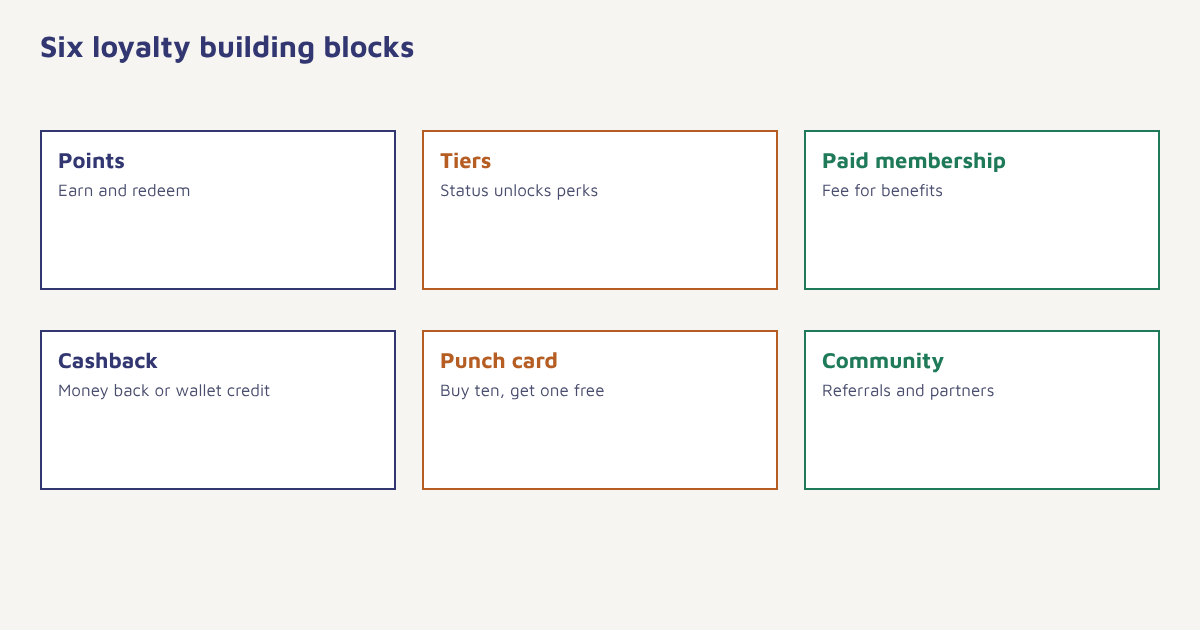
Six loyalty programme models
| Model | How it works | Strength | Watch out for |
|---|---|---|---|
| Points | Earn points on spend or actions, redeem for rewards | Simple and flexible | Points that feel too hard to earn |
| Tiers | Higher status with more spend, with better perks | Motivates upgrades | Tier cliffs that frustrate near-misses |
| Paid membership | Annual or monthly fee for benefits such as free shipping | Commitment and predictable income | Must deliver clear value to justify the fee |
| Cashback | Money back on purchases or wallet credit | Easy to understand | Can train customers to wait for rewards |
| Punch card | Buy a set number, get one free | Perfect for frequent small purchases | Limited to simple repeat buying |
| Community and partner | Rewards through events, referrals or partner brands | Builds belonging and reach | Needs active management |
Examples of loyalty programmes and what to learn from them
The best-known programmes in the world offer lessons even for small brands. Airline frequent-flyer schemes, described under loyalty programs in general terms, use points and tiers to make customers consolidate their travel with one carrier. Coffee chains reward visits with stars or free drinks through apps. Beauty retailers combine points with tiers and early access to launches. Online marketplaces often bundle free shipping into a paid membership. In India, many fashion brands, grocery apps, pharmacies and cafes run points or wallet-credit schemes, and some large platforms link several services into a single membership. Details of specific programmes change often, so check the current terms of any scheme you study, and treat the notes below as patterns rather than facts about particular companies.
| Pattern | What makes it work | Lesson for you |
|---|---|---|
| Coffee app stars and free drinks | Frequent, small, habit-forming purchases with an easy reward | Make the first reward reachable within a few visits |
| Airline miles and status | Aspirational tiers and clear benefits such as lounge access | Offer perks people can feel, not only discounts |
| Beauty points with sample and early access perks | Recognition and discovery, not only price | Reward with experiences and products, not just money |
| Paid shipping membership | Removes friction for frequent buyers | Charge only if the benefits clearly outweigh the fee |
| Supermarket cashback or wallet | Direct and simple value on everyday spending | Keep the rules short and the balance visible |
| Referral-based community | Members bring friends and get rewarded together | Reward both sides and make sharing easy |
What the best programmes have in common
- Easy to understand. A customer can explain it in one sentence.
- Quick first reward. Early wins keep people engaged.
- Real value. Rewards the customer actually wants, at a cost you can sustain.
- Recognition. Name, status and personal touches.
- Visible progress. Balances and next-reward distance are easy to see.
- Mixed rewards. Discounts, early access, free shipping and experiences.
- Fair rules. Clear expiry and honest terms.
How to choose a model
| If your business is | Consider | Why |
|---|---|---|
| Small frequent purchases, such as cafes | Punch card or simple points | Habit and simplicity |
| Ecommerce with repeat buying | Points plus tiers | Order value and frequency both matter |
| High consideration, rare purchases | Referral and community rewards | Few purchases, so reward advocacy |
| Subscription or high-frequency delivery | Paid membership | Convenience is the value |
| Services and bookings | Visit-based rewards and priority access | Reward return visits |
| B2B | Account-level benefits and success programmes | Relationships over points |
How to build and launch one
- Define the goal. Repeat purchase, higher order value, referrals or retention. A programme without a goal drifts.
- Study your data. Look at purchase frequency and value. See RFM analysis.
- Pick one model and keep it simple. Add complexity later.
- Set the economics. Work out the cost of rewards as a share of revenue and test several scenarios.
- Design the journey. Sign-up, welcome bonus, progress messages, reward reminders and expiry notices.
- Launch to your best customers first. Learn from them before opening to everyone.
- Measure against a holdout. Compare members with similar non-members.
- Refine. Adjust earning rates, tiers and benefits using what you see.
Flowfox helps with the messaging side. Store member status and points in the contact profile, create tier-based segments in the segment builder and trigger journeys for welcome offers, near-reward nudges, expiry warnings and birthday messages across email, WhatsApp, SMS and push. The retention use case shows a typical flow.
Messages every loyalty programme needs
| Moment | Message |
|---|---|
| Joined | Welcome, how it works, first reward and a bonus |
| First purchase | Points earned and distance to next reward |
| Close to a reward | You are 50 points away |
| Reward unlocked | Here is how to use it |
| Tier upgrade | Congratulations and new benefits |
| Points about to expire | Use them by a date |
| Birthday or anniversary | A small personal gift |
| Inactive member | We miss you, a reason to return. See win-back campaigns |
A worked example
A pet-food ecommerce brand with 40,000 customers sees that 20 percent of them account for most orders. It launches a three-tier programme: Pal (everyone), Buddy (three orders in a year) and Champion (six orders). Members earn one point per rupee, get a welcome bonus of 100 points and receive free delivery at Buddy and early access to new products at Champion. A journey sends a welcome message with a first-reward target, a nudge when members are within 100 points of a reward and a reminder 14 days before points expire. The brand compares members with a held-back group of similar non-members after six months to see whether order frequency really rose. All names, tiers and figures here are invented to show the design, and your own economics should come from your own margins.
It is worth sketching the economics before launch. If an average member orders four times a year at ₹1,200 and earns one percent back in rewards, the cost of rewards is small compared with the revenue. But if the programme adds free shipping and double points, the cost can climb quickly. Model at least a cautious, an expected and an optimistic case, and set a clear plan to adjust earning rates if redemption runs higher than planned. Accounting for unredeemed points also matters; your finance advisor can explain how liabilities for points are treated in your jurisdiction.
Measuring success
Track enrolment rate, active members, repeat purchase rate, purchase frequency, average order value, redemption rate, cost of rewards as a percentage of member revenue and retention of members versus non-members, as described in our guides to customer retention rate and customer lifetime value. A member group that already bought more before joining will always look better, so use a control group or compare before and after. Also watch for abuse, such as fake accounts farming sign-up bonuses, and for privacy compliance: you hold purchase history and contact data, so follow the principles in our DPDP Act guide. For wider reading on customer relationship ideas, see customer relationship management.
Terms, expiry and fairness
Write the terms in plain words. State how points are earned, when they expire, what happens to them if an order is returned and how the programme can change. Customers forgive limits they were told about. They do not forgive surprises.
Because members trust you with purchase history and contact data, treat their information carefully, and give a simple way to leave the programme. The consumer-facing parts of loyalty schemes are also discussed in the National Consumer Law Center materials in a US context, which can help you think about fair terms even if your own rules differ.
Common mistakes
- Too complicated. If staff cannot explain it, customers will not use it.
- Rewards too far away. People give up.
- Discount addiction. Pure money-off schemes train bargain hunting.
- No communication. Members forget they have points.
- No control group. You cannot prove value.
Loyalty is not bought with points. Points are only how you say thank you.
Run your loyalty programme from one profile. Tier segments, reward reminders and win-back flows across every channel.
Read next: customer engagement, welcome email series and the blog.
Frequently asked questions
What are the main types of loyalty programmes?
The main types are points, tiers, paid membership, cashback, punch cards and community or partner programmes. Many brands combine several.
What makes a loyalty programme successful?
It is simple to understand, gives a quick first reward, offers real value, recognises customers and communicates progress regularly.
How do I choose the right loyalty model?
Match the model to your purchase pattern: punch cards for frequent small buys, points and tiers for repeat ecommerce, paid membership for convenience-led subscriptions.
How much should a loyalty programme cost?
It depends on your margins. Model several scenarios, express reward cost as a share of member revenue and be ready to adjust earning rates.
How do I measure whether a loyalty programme works?
Compare members with a similar control group on repeat purchase, order value and retention, and track redemption rate and reward cost.
Should loyalty programmes use discounts?
Discounts can work but may train customers to wait for deals. Mix them with experiences, early access, free shipping and recognition.
Which channels should I use to run a loyalty programme?
Email for statements and stories, WhatsApp and SMS for timely reminders, push and in-app for progress, always within customer consent.