For decades, SMS has been the default way to reach a phone without an app. RCS, or Rich Communication Services, promises the same reach with more of what modern messaging apps offer: images, carousels, buttons, read receipts and brand verification. On paper it sounds like an upgrade that should replace plain texting. In practice, RCS availability varies by country, operator and device, and a message that cannot be delivered as RCS usually falls back to SMS. This guide compares RCS and SMS fairly: what each is, how they differ in features, reach, cost and use cases, how fallback works and how to decide which to use. Because RCS support and commercial terms change often, treat the specifics as a starting point and check current sources.
What are SMS and RCS?
SMS (short message service) is the plain-text messaging standard built into practically every mobile phone. Messages are short, travel over the mobile network and need no data connection or app. RCS is a newer messaging standard, promoted by the mobile industry and Google, that runs over data connections and adds richer features to the phone’s default messaging app, where it is supported. Our guide to RCS messaging explains the technology in more detail, and our guide to SMS marketing covers the established channel.
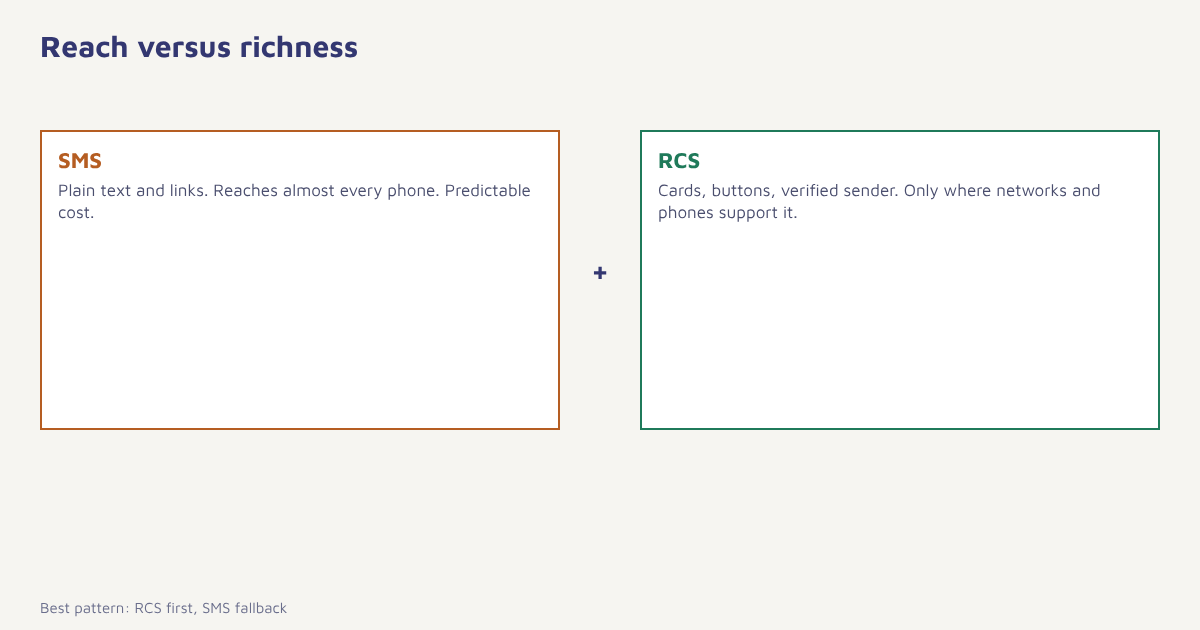
RCS vs SMS side by side
| SMS | RCS | |
|---|---|---|
| Reach | Almost every phone | Phones, networks and apps that support it, which varies by country and operator |
| Needs data? | No, uses the mobile network | Yes, runs over a data connection |
| Content | Plain text and links | Images, video, carousels, buttons, suggested replies |
| Branding | Sender ID | Verified brand profile with name and logo, where available |
| Interaction | Reply or tap a link | Tap buttons, choose from cards, sometimes in-chat actions |
| Read receipts | Delivery reports only, usually | Delivered and read status, where supported |
| Message length | Short; long texts are split | Longer text and richer layouts |
| Fallback | Not applicable | Often falls back to SMS if RCS fails |
| Cost | Predictable per-message rates | Rates depend on the provider, country and message type |
| Regulation and templates | Well established, e.g. DLT in India | Evolving and depends on country and provider |
Check before you plan. RCS business messaging depends on operator and provider support in each market and on the recipient’s phone and settings. Ask your provider for current coverage and pricing in the countries you target, and do not assume that every customer can receive RCS.
What RCS adds
| Feature | Why it matters | Example |
|---|---|---|
| Rich cards and carousels | Show several products with images and buttons | A shoe store shows three styles to scroll through |
| Suggested replies and actions | One tap instead of typing | Confirm, Reschedule, Track order |
| Verified sender | Reduces doubt about who is texting | Brand name and logo in the thread |
| Read receipts and typing indicators | Better feedback for the sender | Know when a reminder was read |
| Larger media | Images and video in the message | Product photo or short demo |
Richer messages can lift engagement in the right use cases, but be careful with claims. Published figures about RCS performance come mostly from vendors and vary widely. Run your own tests.
Where SMS still wins
- Reach. If you must reach everyone, including people with basic phones and poor data, SMS is the safe choice.
- One-time passcodes and critical alerts. These need the most reliable path.
- Simplicity. Plain text is cheap, predictable and easy to template.
- Established compliance. In India, sender IDs and templates under DLT are well understood.
- No dependency on apps or settings. There is nothing for the recipient to enable.
Where RCS can win
- Product discovery. Carousels and images beat plain links.
- Guided service flows. Buttons for booking, tracking and support.
- Brand trust. A verified profile makes messages feel safer to open.
- Feedback. Quick replies make surveys easy. See NPS, CSAT and CES.
- Replacing apps for simple tasks. Some actions can happen inside the conversation.
How fallback works
Because not every recipient can receive RCS, business platforms often send RCS first and fall back to SMS if the phone does not support it or the message cannot be delivered. This gives you the best of both, but you must design for two experiences. The RCS version can be rich. The SMS version must still make sense as plain text with a link. Check that the fallback message is registered and approved where telecom rules require it, and that your reports separate RCS and SMS deliveries so you can see what each channel contributes.
- Check coverage. Ask your provider which of your target countries and operators support RCS business messaging, and what share of your audience has compatible phones.
- Pick one use case. Start with a flow where richness clearly helps, such as order tracking with buttons or a product carousel.
- Write both versions. Create the RCS card and a clear SMS fallback.
- Handle consent and compliance. Use the same opt-in practices as SMS. See SMS opt-in and opt-out.
- Test on real devices. Check rendering, buttons and fallback on different phones and operators.
- Measure against SMS. Compare delivery, engagement and conversion with a matched SMS group.
In Flowfox, the RCS channel and the SMS channel can be used in the same journey, with consent from the contact profile and results in analytics. This makes it easy to try RCS with a segment while keeping SMS as the safety net. Availability of specific features depends on your provider and market.
How to choose
| If your priority is... | Lean towards |
|---|---|
| Reaching every customer reliably | SMS |
| OTPs and critical alerts | SMS |
| Rich product browsing | RCS with SMS fallback |
| Interactive service flows | RCS with SMS fallback |
| Lowest and most predictable cost | SMS |
| Brand trust and verified identity | RCS where available |
| Conversational follow-up | WhatsApp, RCS or SMS, depending on where customers are. See email vs SMS vs WhatsApp |
Remember there are more options than these two. In India, WhatsApp is the dominant chat app, and many businesses pair it with SMS for reach. Compare the trade-offs in push vs SMS and WhatsApp marketing, and think in terms of an omnichannel plan instead of a single winner.
A worked example (invented)
A fashion retailer, invented for this example, wants to promote a new collection to customers who have opted in to SMS. It splits them by phone type, using data from its provider. Customers whose phones can receive RCS get a carousel of three looks with a Shop now button. The rest get a short SMS with a link. The retailer sends both versions to similar groups at the same time and compares click-through rate and orders, keeping a small group that receives nothing as a baseline. In this made-up scenario, the carousel gets more clicks but costs more per message, so the team calculates revenue per message instead of looking at clicks alone. The result decides whether RCS is worth using for that audience. What matters is the method: test on your own customers, and judge by revenue and cost, not by features.
Common mistakes
- Assuming universal RCS support. Coverage varies.
- No fallback. Some customers will never see the RCS message.
- Rich content, weak offer. Better design does not rescue a poor message.
- Comparing clicks only. Use revenue per message and cost.
- Ignoring consent. RCS needs the same permission discipline as SMS.
RCS is SMS with better manners and a smaller audience. Plan for both.
Try RCS with an SMS safety net. Run both channels in one journey and compare results.
Read next: SMS marketing best practices, customer engagement and the blog. For the official specification and current status, consult the GSMA, the industry body behind the standard.
Frequently asked questions
What is the difference between RCS and SMS?
SMS sends short plain text to almost any phone over the mobile network. RCS runs over data and adds images, carousels, buttons, read receipts and a verified sender where supported.
Will RCS replace SMS?
Not soon. RCS support varies by country, operator and device, and SMS remains the universal fallback, so most businesses use both.
Is RCS cheaper than SMS?
Not necessarily. Pricing depends on your provider, country and message type. Compare cost per message and revenue per message in a test.
What happens if a customer’s phone does not support RCS?
Many platforms fall back to SMS, so design a clear plain-text version and make sure it complies with your local SMS rules.
Do I need opt-in for RCS messages?
Yes. Treat RCS marketing like SMS and other channels: get clear consent, record it and honour opt-outs. Check the rules in your market.
Is RCS available in India?
Availability depends on operators, devices and providers and has been changing. Ask your provider for current coverage before planning a campaign.
When should I choose SMS over RCS?
Choose SMS for universal reach, one-time passcodes, critical alerts and simple, predictable messaging.