For years, much of digital marketing ran on data that someone else collected: cookies set by ad networks, audience lists bought from brokers, profiles stitched together by third parties. That ground has been shifting under marketers’ feet through browser changes, new privacy laws and growing public unease. First-party data, the information you collect directly from your own customers and audience, is the asset that holds its value through all of it. This guide explains what first-party data is, how it differs from second-party and third-party data, where it comes from, how to collect it responsibly, how to organise it and what to do with it once you have it.
What is first-party data?
First-party data is information a business collects directly from its own customers, visitors and subscribers, through its own channels, with their knowledge. It includes what they tell you (name, email, phone, preferences), what they do on your website and app (pages viewed, searches, cart additions), what they buy and what they do with your messages (opens, clicks, replies). Because you collected it yourself, you know where it came from, when and under what permission. It sits at the heart of any customer data platform and of the profile that powers segmentation and personalization.
First-, second- and third-party data
| First-party data | Second-party data | Third-party data | |
|---|---|---|---|
| Who collects it | You | Another company, from its own customers | Aggregators who gather it from many sources |
| How you get it | Directly from your audience | Shared by a partner under an agreement | Purchased or accessed through data vendors |
| Accuracy | High, current and specific to you | Good, if the partner is careful | Variable, often generic or out of date |
| Consent clarity | You know what people agreed to | Depends on the partner | Often unclear to you and to the person |
| Exclusivity | Only you have it | Shared with one partner | Available to competitors too |
| Cost | Cost of collection and storage | Partnership costs | Per record or per audience fees |
| Durability | Stays valuable as rules tighten | Depends on the agreement | Most exposed to regulatory and browser change |
The practical difference is trust and control. With first-party data you can explain to a customer exactly why you hold a piece of information and what you do with it. With third-party data, neither you nor the person usually can.
Where first-party data comes from
| Source | Examples of data | Notes |
|---|---|---|
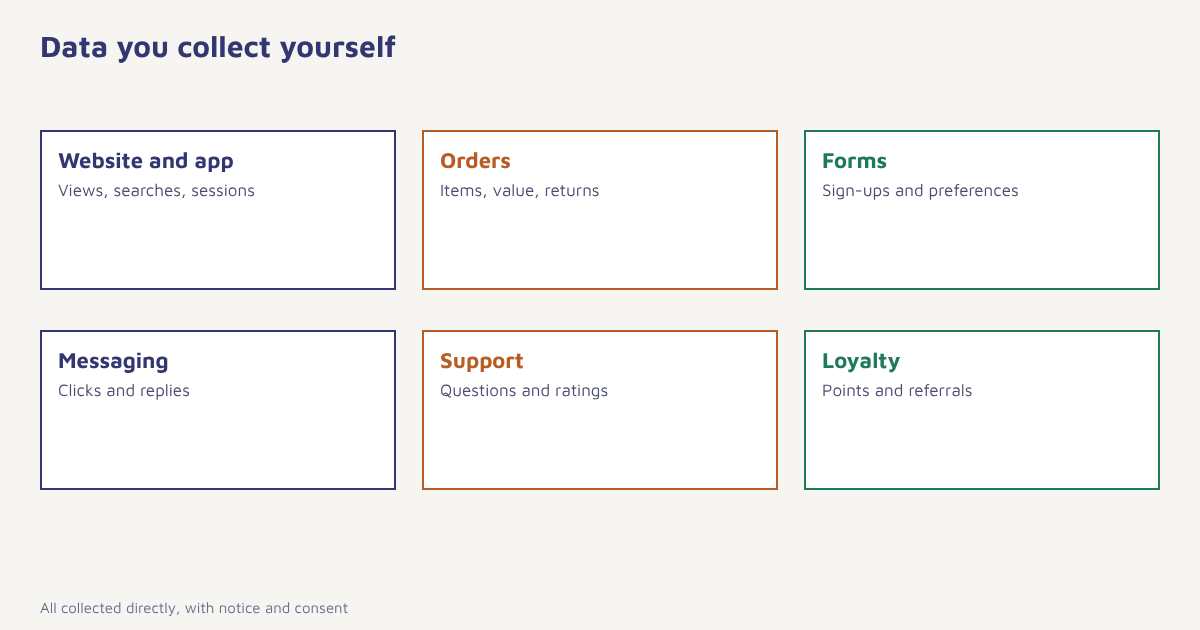
| Website and app | Pages and products viewed, searches, time on page, device, referrer | Needs clear notice and, in many places, consent for analytics and cookies |
| Transactions | Orders, items, amounts, payment method, returns | Your most reliable record of real behavior |
| Forms and sign-ups | Name, email, phone, city, interests | Ask for what you will use, no more |
| Messaging | Delivered, opened, clicked, replied, unsubscribed | Open data is less reliable than clicks. See email open rate |
| Customer service | Questions, complaints, ratings, resolutions | Often the richest source of reasons, not just actions |
| Loyalty and referrals | Points, tiers, redemptions, referrals made | Shows who your best customers are. See loyalty programs |
| Surveys and feedback | Satisfaction scores, product wishes | Stated data. See zero-party data |
| Offline touchpoints | In-store sign-ups, event registrations, call-centre notes | Needs the same consent and identity care as online |
Why first-party data matters now
Three forces have raised its value. First, privacy law. India’s Digital Personal Data Protection Act, 2023, the GDPR in Europe and similar rules put weight on notice, purpose and consent, which are far easier to meet when you collect data yourself. Our guide to the DPDP Act for marketers covers the Indian position. Second, browsers have restricted third-party cookies to varying degrees, and the situation has changed more than once, so check the current position in the browsers your visitors use rather than relying on any one summary. Third, competitors can buy the same third-party audiences, but nobody can buy your customers’ history with you.
First-party data also improves everyday results. Segments built on real purchase and engagement history beat segments built on guesses, and messages that reflect what a person has actually done feel relevant instead of intrusive. See behavioral segmentation and marketing personalization.
How to collect it well
- Decide what decisions the data will serve. Start from use cases such as cart recovery, a welcome series or a win-back flow, then list the fields each one needs.
- Write a plain notice. Tell people what you collect, why, and how to change their mind. Link to it wherever you ask.
- Collect consent per purpose and channel. Email, WhatsApp, SMS and push each need their own permission, recorded with date and source.
- Track events consistently. Agree event and attribute names once, and keep them stable. See the data model.
- Connect identity. Link anonymous visits to known people when they sign in or subscribe, using email, phone or customer ID.
- Bring it together. Send website, app, store and support data into one profile. See customer data platforms and the 360-degree customer view.
- Keep it clean. De-duplicate, correct and retire stale data on a schedule. See email list cleaning.
In Flowfox, the contact profile holds identifiers, attributes and consent in one place, FlowConnect and the API bring data in from your other systems, and migration helps you move records from an older tool without losing history. You can also import existing lists with the import guide.
What to do with it
| Use | How first-party data helps |
|---|---|
| Segmentation | Group people by what they did and bought. See customer segmentation |
| Triggered messages | React to carts, views, payments and inactivity. See event-triggered marketing |
| Personalization | Use names, history and preferences in content |
| Suppression | Stop sending the wrong thing, such as promotions to someone with an open complaint |
| Analysis | Cohorts, retention and lifetime value. See cohort analysis |
| Lookalike and suppression audiences for ads | Upload hashed lists to ad platforms, within consent and platform rules |
A worked example
Imagine an online bookshop with 40,000 customers. Until now it bought audience data to run adverts and sent the same newsletter to everyone. It decides to build on its own data. It records which genres each customer buys, adds one optional question at checkout about reading habits and uses delivery confirmations to trigger a review request. After a quarter it can answer questions it could not before: which authors bring readers back, which customers buy only during sales and which buyers of a first book in a series have not bought the second. A short email to that last group, sent a fortnight after delivery, becomes its best-performing automation. The shop and the numbers here are invented to show the approach; your own results will depend on your customers.
Activating first-party data across channels
Collecting data is only half the job. The value appears when the same profile drives every channel. A customer who views a product three times on the app can receive a push reminder if they have opted in, a WhatsApp message if that is their stated preference, or an email if neither applies. Order data can suppress that reminder the moment they buy. Message engagement shows which channel each person actually reads, so your sends follow the person and not the calendar. To keep this fair and safe, set a frequency cap per person across all channels and record the reason for each message. Our guides to omnichannel marketing and choosing between email, SMS and WhatsApp cover the channel choices, and the background on data management explains why governance matters as much as collection. Review what you hold at least once a year and delete what you no longer use.
Risks and good practice
- Collecting too much. Data you do not use is a liability. Hold what serves a stated purpose.
- Poor identity matching. Merging two people into one profile causes embarrassing mistakes. Start with strong identifiers.
- Silos. Data stuck in separate tools cannot power joined-up messages. See omnichannel vs multichannel.
- No retention rules. Decide how long you keep data and delete it on request.
- Weak security. A rich profile is a target. Limit access and review it. See our security page.
First-party data is the part of your marketing that cannot be taken away by a browser update.
Put your own data to work. Unify events, attributes and consent, then act across email, WhatsApp, SMS and push.
Read next: zero-party data, consent management and the blog.
Frequently asked questions
What is first-party data?
First-party data is information a business collects directly from its own customers, visitors and subscribers through its own channels, such as website behavior, purchases, forms and message engagement.
What is the difference between first-party and third-party data?
First-party data is collected by you from your own audience. Third-party data is gathered by outside aggregators and sold or shared, so its accuracy and consent are harder to verify.
What are examples of first-party data?
Order history, items viewed, email and phone number, loyalty activity, message clicks, support conversations and survey answers are all first-party data.
Is first-party data covered by privacy laws?
Yes. You still need clear notice, a lawful basis such as consent, security and honouring of rights such as access and deletion under laws like the DPDP Act and the GDPR. Check current rules with your legal advisor.
How do I collect first-party data without annoying customers?
Ask for only what you will use, explain the benefit, ask at natural moments such as checkout or sign-up and let people change their preferences easily.
Do I need a CDP to use first-party data?
Not necessarily. Many engagement platforms keep a unified profile with events, attributes and consent, which can cover the same need for many teams.
Why is first-party data more important now?
Privacy rules have tightened and browsers have restricted third-party tracking to varying degrees, while first-party data stays under your control and relevant to your own customers.