In a subscription business, churn is not one event. It is a slow story that starts in the first week, when a new customer fails to reach the first useful result, and ends months later with a cancellation that looks sudden to the team. Reducing it is less about clever win-back offers and more about noticing the story early and changing its ending. This guide is about SaaS churn reduction in practice: where churn comes from, how to separate voluntary from involuntary churn, the usage signals that give early warning, the interventions that work at each stage, how to handle failed payments, how to run exit surveys and how to measure what you did.
Two kinds of churn
Churn is the rate at which customers stop paying. Our guide to the customer churn rate formula explains how to calculate it and churn prediction covers forecasting. For reduction, the first step is to split it into two types, because they need completely different fixes.
| Type | What happens | Typical causes | Main fix |
|---|---|---|---|
| Voluntary | The customer decides to leave | No value reached, price, a competitor, a change in needs, poor support | Better onboarding, adoption, support and offers |
| Involuntary | The subscription ends without a decision | Failed or expired card, bank decline, billing errors | Payment retries, card updaters and reminders |
Involuntary churn can be a surprisingly large share of the total in consumer and small-business subscriptions, but the share varies, so measure your own by tagging cancellation reasons and payment failures separately.
Where churn is born
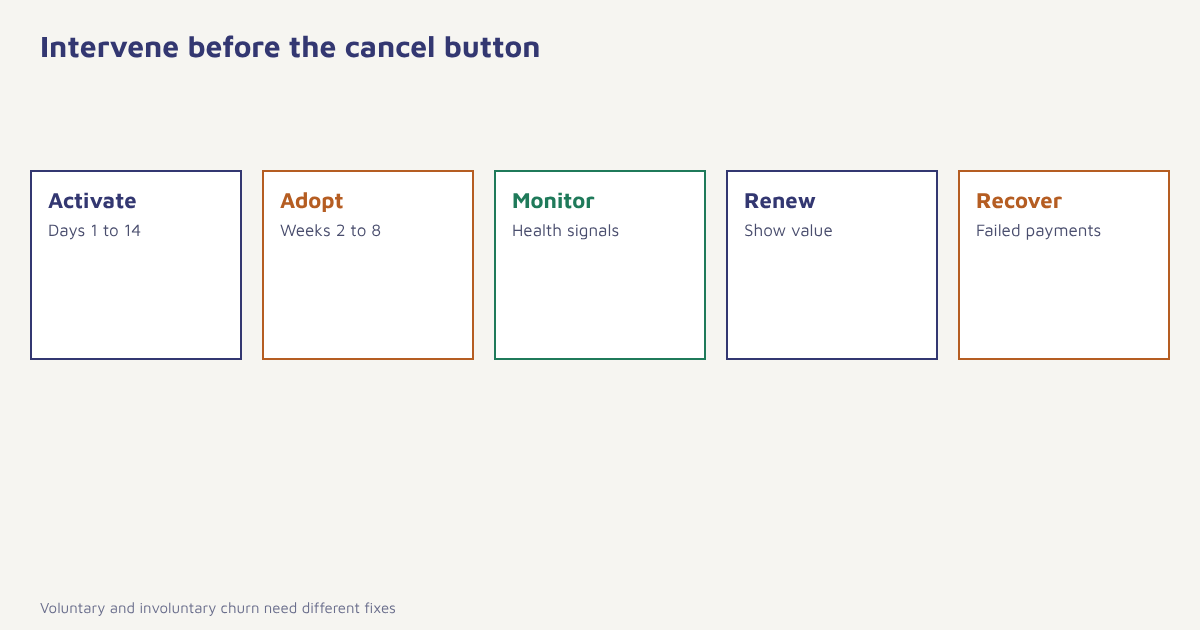
| Stage | Risk | Intervention |
|---|---|---|
| Activation (days 1 to 14) | The customer never reaches a first useful result | Guided setup, checklist, welcome sequence. See SaaS onboarding emails |
| Adoption (weeks 2 to 8) | Use stays shallow or fades | Feature education, in-app prompts, success calls for larger accounts |
| Steady use | Quiet decline, champion leaves, team changes | Health score monitoring, check-ins. See customer health score |
| Renewal | Price shock, forgotten value | Value summary before renewal. See renewal reminders |
| Billing | Card failures, invoices unpaid | Retry logic, dunning messages, easy update link |
| Cancellation | Decision made | Exit survey, pause or downgrade option, win-back later |
Early warning signals
Product usage is the best early indicator. Choose a handful that apply to your product, and set thresholds based on how past churners behaved. These are leading indicators in the sense described in leading vs lagging indicators.
- No login for 14 days or a fall in weekly active users within an account.
- Key feature never used within the first month.
- Admin or main champion has left the company or stopped logging in.
- Rise in support tickets without resolution, or a low satisfaction score. See NPS, CSAT and CES.
- Downgrade request, billing page visits, or cancellation page visits.
- Seats or usage far below the plan limits, which can signal over-paying.
In Flowfox, you can send product events from the app to the contact profile, build these risk signals as segments in the segment builder and trigger a journey for each. Our churn use case shows the flow end to end, and the SaaS solutions page adds sector context.
A step-by-step reduction plan
- Measure churn by type and cohort. Split voluntary from involuntary and look at it by signup month. See cohort analysis.
- Define activation. Find the early action that most separates customers who stay from those who leave.
- Fix the first two weeks. Checklist, welcome emails and in-app guidance towards that action.
- Build health signals. Combine usage, support and billing data into a simple score.
- Create interventions. A helpful email, an in-app tip or a call, depending on account size.
- Fix payment recovery. Retries, reminders, an easy way to update a card.
- Listen at exit. Ask why, offer alternatives and learn from the answers.
Recovering failed payments
A failed payment is not a decision to leave. Often the card has expired, hit a limit or been blocked by the bank. A good recovery process combines several steps: retry the charge on a sensible schedule, send clear and friendly reminders by email, SMS or WhatsApp with a one-click link to update the payment method, keep the service running for a short grace period and explain what will happen next. Card networks and payment providers offer tools that update stored card details automatically, so check what your provider supports. Treat these messages as transactional and keep them calm: nobody likes feeling accused. See transactional emails for tone and structure.
Exit surveys and save offers
When a customer clicks cancel, ask one short question about the main reason, with a few options and an open box. Use the answers to route help: a customer who says "too expensive" might accept a cheaper plan, one who says "missing a feature" may want a roadmap update, and one who says "not using it" might prefer to pause. Offer pause or downgrade alternatives where they make sense, but keep the cancel path honest and easy. Making cancellation hard may keep some revenue briefly, but it harms trust and, in some places, breaches consumer-protection rules on subscription cancellation. The wider topic of manipulative interfaces is covered under dark patterns. Confirm current rules for your market with a legal advisor.
A worked example (invented)
Suppose a small project-management SaaS loses 6 percent of its customers a month. Looking at cohorts, the team finds that most churners never invited a teammate and never created a second project. It defines activation as "two projects and three members within ten days". It adds a checklist in the app, a three-email welcome sequence and a WhatsApp message offering a short setup call for teams who stall. At the same time, it adds card retry logic and a friendly three-step billing reminder. After three months it compares new cohorts against the old, and against a small holdout that got only the old welcome email. The company, figures and results are invented; the point is the order of work: activation first, then monitoring, then recovery.
What to measure
| Metric | Why |
|---|---|
| Churn rate, voluntary and involuntary separately | Different fixes |
| Activation rate within 14 days | Predicts retention |
| Health score distribution | Share of accounts at risk |
| Payment recovery rate | Share of failed charges recovered |
| Save rate | Share of cancel intents that stay |
| Net revenue retention | Includes expansion and contraction |
Connect these to customer retention rate, customer lifetime value and app retention strategies, and review them in analytics every month.
Small accounts and large accounts need different approaches
A company with five thousand self-serve customers cannot call each one, and a company with fifty enterprise accounts should not rely on automated emails alone. Split your base by value. For self-serve and small accounts, rely on automation: in-app guidance, lifecycle emails, WhatsApp or SMS nudges and clear billing messages. For mid-sized accounts, add a light human touch triggered by risk signals, such as a short check-in from a customer success manager when usage drops. For the largest accounts, plan regular reviews that show the value delivered, because the person who signed the contract is often not the person who uses the product every day. The idea of customer success grew out of exactly this need to take responsibility for outcomes after the sale.
Whatever the size, keep the product itself in the loop. If many churners cite the same missing feature or a confusing screen, no message will fix it. Share exit reasons with the product team every month, and tell customers when you have acted on their feedback, which turns a complaint into a reason to stay. Treat churn reduction as a joint effort between product, support, billing and marketing, with one shared number that everyone can see.
Common mistakes
- Treating churn as one number. Involuntary and voluntary need different work.
- Starting at cancellation. The story began weeks earlier.
- Discounting first. It lowers value perception and may not fix the cause.
- Hard-to-find cancel buttons. They damage trust and may break rules.
- Ignoring small accounts. Use automation where calls are not affordable.
By the time a customer cancels, the decision was made weeks ago. Your job is to be useful before that.
Catch churn while it can still be changed. Turn usage signals into journeys across email, WhatsApp, SMS, push and in-app messages.
Read next: win-back campaigns, retention strategies and the blog.
Frequently asked questions
What is SaaS churn reduction?
It is the set of practices that stop subscribers from leaving, including better onboarding, adoption support, usage monitoring, payment recovery and exit handling.
What is the difference between voluntary and involuntary churn?
Voluntary churn happens when a customer decides to leave. Involuntary churn happens when a subscription ends without a decision, usually because of failed payments.
How do I find which customers are likely to churn?
Track signals such as falling logins, unused key features, a departed champion, unresolved support tickets and billing page visits, and compare them with past churners.
How can I recover failed payments?
Retry on a sensible schedule, send friendly reminders with a one-click update link, allow a short grace period and use card updater tools where your provider supports them.
Should I offer discounts to customers who want to cancel?
Use them sparingly. First learn why they are leaving and offer the right fix, such as a cheaper plan or pause, because a discount alone may not address the cause.
What is activation in SaaS?
Activation is the early action or set of actions that most clearly separates customers who stay from those who leave, such as inviting teammates and creating a second project.
How do I measure churn reduction?
Track voluntary and involuntary churn separately by cohort, plus activation rate, payment recovery rate, save rate and net revenue retention, and compare with a holdout.