Customers do not experience your departments. They experience a brand: the ad that caught their eye, the speed of the website, the sound of the delivery person at the door, the tone of the support reply and the email that arrives a week later. Customer experience, or CX, is the sum of all those impressions. It shapes whether people come back and whether they tell others. This guide explains what customer experience is, how it differs from customer service and user experience, the touchpoints that make it up, how to measure it, practical ways to improve it, and a worked example of finding and fixing one broken moment.
What is customer experience?
Customer experience is the overall perception a customer has of your business, built from every interaction they have with it, before, during and after a purchase. It includes emotion as well as function: a delivery that arrives on time but with a rude message may still feel poor, and a delay handled honestly may still feel good. Good CX is consistent, easy and respectful of people’s time. It is also not owned by one team; marketing, sales, product, logistics and support all shape it.
CX vs customer service vs user experience
| Term | Scope | Example question |
|---|---|---|
| Customer experience (CX) | The whole relationship across all touchpoints | How does it feel to deal with us overall? |
| Customer service | Help given when customers ask for it | Did we solve their problem quickly? |
| User experience (UX) | How easy and pleasant a product or interface is to use | Can people complete the task in our app? |
| Customer engagement | How actively customers interact over time | Are they responding and returning? See customer engagement |
Service and UX are parts of CX, not substitutes for it. A beautiful app with slow support, or a brilliant support team inside a confusing checkout, still produces a mixed experience.
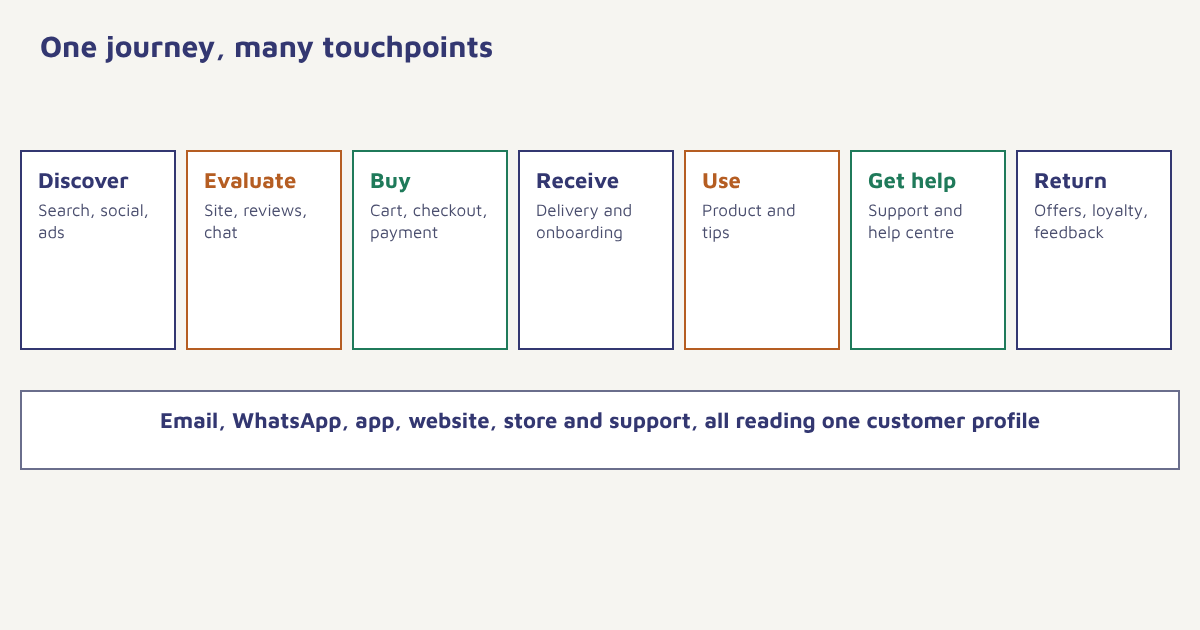
The touchpoints that make up CX
| Stage | Typical touchpoints | What good looks like |
|---|---|---|
| Discover | Search, social, ads, word of mouth | Clear, honest message that matches the product |
| Evaluate | Website, reviews, comparisons, chat | Easy to find answers, real proof |
| Buy | Cart, checkout, payment, confirmation | Few steps, clear total, instant confirmation. See conversion optimization |
| Receive | Delivery tracking, packaging, onboarding | Accurate updates, simple start. See onboarding |
| Use | Product, app, content, tips | Works as promised, helps you get value |
| Get help | Support chat, phone, help centre | Fast, knowledgeable, no repeating yourself |
| Stay or return | Offers, loyalty, reminders, feedback | Relevant and not pushy. See retention strategies |
A customer journey map lays these touchpoints out in order, with what the customer does, thinks and feels at each. It is the best single tool for seeing CX from the customer’s side. Many of the worst experiences come from the gaps between teams, for example a customer being sent a sales email while they have an unresolved complaint.
How to measure customer experience
| Measure | What it captures | Where to read more |
|---|---|---|
| Net Promoter Score (NPS) | Overall loyalty and willingness to recommend | NPS, CSAT and CES |
| Customer satisfaction (CSAT) | Satisfaction with a specific interaction | NPS, CSAT and CES |
| Customer effort score (CES) | How hard something was to do | NPS, CSAT and CES |
| Retention and churn | Whether customers stay | retention rate, churn rate |
| Repeat purchase and lifetime value | Long-term value of the relationship | lifetime value |
| Support metrics | Speed and resolution | First response time, resolution rate |
| Qualitative feedback | Why scores move | customer feedback loop |
No single number captures CX. Use a few scores for direction, behaviour for proof and comments for reasons. Remember that scores differ by country, industry and method, so compare with your own past results first, and read the background in the article on the Net Promoter Score before quoting benchmarks.
Eight practical ways to improve CX
- Map the journey from the customer’s side. Include moments outside marketing, such as delivery and returns.
- Fix the biggest friction first. Use funnel data and complaints to find where people struggle.
- Be consistent across channels. Same facts, same tone on email, WhatsApp, app and phone. See omnichannel vs multichannel.
- Know the customer. Use one profile so people do not repeat themselves. See customer data platform.
- Personalise with care. Use what you know to help, not to surprise. See personalization.
- Communicate proactively. Tell customers about delays or issues before they ask.
- Make it easy to get help. Offer chat on the channel they already use.
- Listen and close the loop. Act on feedback and say what changed.
In Flowfox, these ideas show up as journeys that react to events: a delivery delay triggers an apology and a new date; a support ticket marks the customer so that promotional messages pause; a successful first use triggers a tip; a long quiet period triggers a friendly check-in. Everything runs from one profile across email, WhatsApp, SMS and push, and analytics shows the results. See our ecommerce and fintech pages for sector examples.
A worked example
The company and numbers here are invented. A furniture seller sees good sales but a low repeat rate and many one-star reviews. A journey map reveals the weak point: the gap between ordering and delivery. Customers wait two to three weeks with no news, then a delivery team calls on the day with a one-hour warning. The seller changes three things. First, an automatic message confirms the order and expected date on WhatsApp and email. Second, a mid-way update arrives with a photo of the item being packed. Third, a message the day before gives a two-hour window and a link to reschedule. It also pauses marketing emails for anyone with an open delivery or support issue. Within two quarters, delivery-related complaints fall, the review rating rises and more customers come back for a second purchase. The fix did not need a new product; it needed attention to one forgotten stretch of the journey.
| Before | After |
|---|---|
| Silence for two to three weeks | Confirmation, mid-way update and day-before window |
| Promotional emails during open issues | Promotions paused while an issue is open |
| One-hour delivery warning | Two-hour window with reschedule link |
| Feedback ignored | Short survey after delivery, with replies to low scores |
Customer experience also has a business case. Retained customers cost less to serve than new ones (see customer acquisition cost), they spend more over time and they recommend you. Research and consulting studies often link better experience to higher growth, though the size of the effect varies and is hard to isolate, so check claims against your own data. A broader academic overview appears in the article on customer relationship management.
Who owns the experience?
Because CX crosses teams, it needs a clear owner and shared goals. Some companies appoint a head of customer experience; others give a cross-functional group the job of reviewing the journey monthly. Whichever you choose, put real customer evidence in front of the team: read ten support conversations aloud, watch a few session recordings, call a few customers who left. Share the top three problems and who is fixing them. Reward fixing root causes, not just closing tickets. Small companies can start with a simple monthly routine: review scores, read comments, pick one friction point, fix it and tell customers. Over a year, a dozen fixes make a visible difference. Be wary of vanity programmes with slogans and no changes; customers can tell the difference between a company that says it cares and one that acts on what it hears.
Common mistakes
- Treating CX as a support problem. It spans the whole business.
- Chasing a score. The number matters less than what you change.
- Ignoring the quiet moments. Waiting and uncertainty hurt more than people expect.
- Inconsistent channels. Customers notice when facts differ.
- No owner. Someone must be responsible for the end-to-end journey.
Customers remember how you made things feel at the worst moment. Design for that moment.
Make every touchpoint consistent. Connect events to messages across channels from one customer profile.
Read next: customer feedback loop, customer engagement and the blog.
Frequently asked questions
What is customer experience?
Customer experience is the overall perception a customer has of your business, built from every interaction they have with it before, during and after a purchase.
What is the difference between customer experience and customer service?
Customer service is the help you give when customers ask for it. Customer experience is the whole relationship across all touchpoints, of which service is one part.
How do you measure customer experience?
Use a mix of scores such as NPS, CSAT and CES, behaviour such as retention and repeat purchase, and qualitative feedback that explains the reasons behind the numbers.
What are customer touchpoints?
Touchpoints are any points of contact between a customer and your business, such as ads, your website, checkout, delivery, support conversations and emails.
Why is customer experience important?
Better experience tends to improve retention, repeat purchase and recommendations, which lowers acquisition cost and raises lifetime value, although the size of the effect varies.
How can small businesses improve customer experience?
Map the journey, fix the biggest friction, communicate proactively, keep a single view of each customer, use the channels customers prefer and act on feedback.
What is the difference between CX and UX?
UX focuses on how easy and pleasant a product or interface is to use. CX covers the entire relationship, including UX, service, delivery and communication.