A loyalty programme can make a customer come back for points. Brand loyalty is why they would come back even if the points vanished. It is the quiet preference that makes someone pick your name from a shelf of similar products, forgive a late delivery and tell a friend without being asked. This guide is about that deeper kind of loyalty: what it is, how it forms, how it differs from the mechanics of reward schemes, how to measure it and how to build it through everyday messages and service. For programme design, see our separate guides to loyalty programs and loyalty programme examples.
What is brand loyalty?
Brand loyalty is the tendency of customers to keep choosing one brand over competing ones, based on trust, familiarity and a sense that the brand fits them. Researchers often separate two parts. Behavioural loyalty is what people do: repeat purchases, share of wallet, referrals. Attitudinal loyalty is what they feel: preference, trust and emotional connection. A customer can be behaviourally loyal without feeling anything, for example because switching is a hassle, and that kind of loyalty disappears the moment a rival makes switching easy. The goal is both, together.
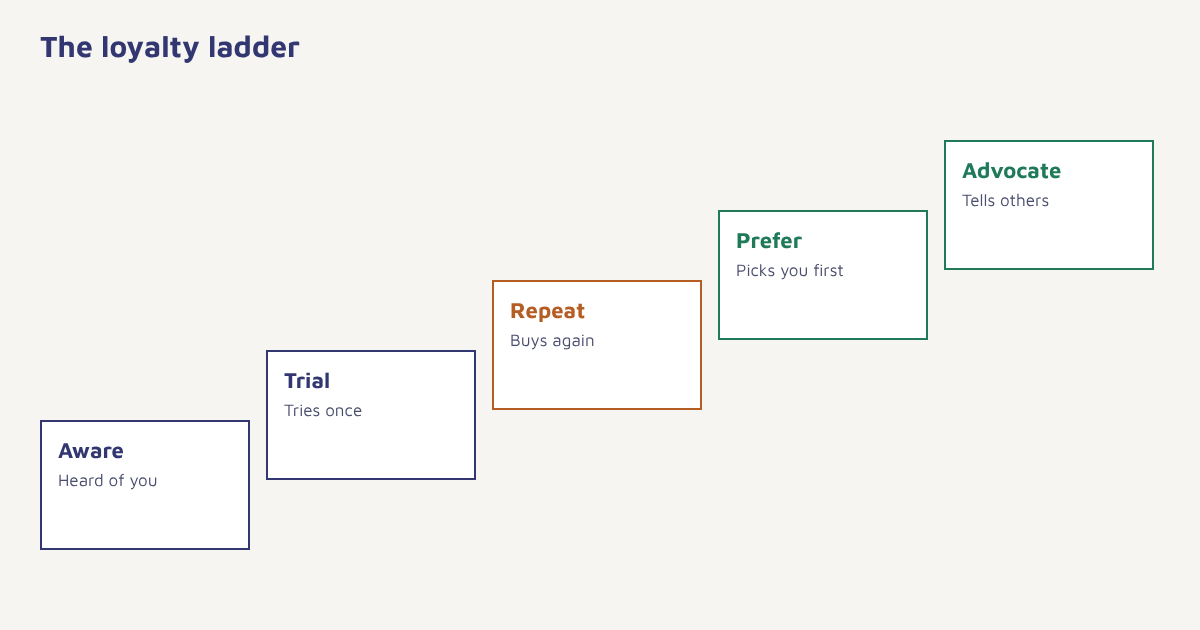
The loyalty ladder
| Stage | Customer thinks | What helps most |
|---|---|---|
| Aware | I have heard of you | Clear identity, helpful content |
| Trial | Let me try once | Easy first purchase, low risk, good welcome. See welcome series |
| Repeat | That worked, I will buy again | Reliable delivery, reminders, follow-up |
| Preference | I prefer you | Consistency, recognition, relevant suggestions |
| Advocacy | I tell others about you | Reasons to be proud, easy ways to share. See customer advocacy |
Loyalty programmes vs brand loyalty
| Loyalty programme | Brand loyalty | |
|---|---|---|
| What it is | A structured scheme of rewards | A relationship built on trust and fit |
| Driver | Incentive | Experience, values and consistency |
| Risk | Points chasers who leave when rewards stop | Slow to build, hard to copy |
| Time to effect | Weeks | Months or years |
| Best use | Encourage repeat behaviour | Make repeat behaviour feel natural |
The two work together. A programme can reward and reinforce loyalty that the brand has already earned, but it rarely creates it alone. Heavy discounting can even weaken it by teaching customers to wait for offers.
What builds brand loyalty
- Consistent quality. The product and service are as good the tenth time as the first.
- Reliability. Orders arrive when promised and problems are solved quickly.
- Shared values. Customers feel the brand stands for something they care about, and acts on it.
- Recognition. The brand remembers who they are. See personalization.
- Community. Customers feel part of something. See user-generated content.
- Fair treatment. Good handling of complaints often builds more loyalty than flawless service, because it shows character.
How to measure brand loyalty
| Measure | Type | How to get it |
|---|---|---|
| Repeat purchase rate | Behavioural | Orders. See repeat purchase rate |
| Retention rate | Behavioural | Customers kept over time. See retention rate |
| Share of wallet | Behavioural | Your share of a customer’s spend in your category (survey or estimate) |
| Net Promoter Score | Attitudinal | Survey. See Net Promoter Score |
| Unprompted recommendation | Attitudinal | Reviews, referrals and mentions |
| Price tolerance | Both | Do customers stay through price changes? |
No single number captures loyalty. Look at behaviour and attitude together, and compare cohorts: if customers acquired this year behave like those acquired three years ago, your relationship is holding. Our guide to cohort analysis shows how.
How to build brand loyalty through messaging
- Define what you want to be known for. Two or three honest qualities, not a list of adjectives. See customer value proposition.
- Win the first order well. A clear welcome, honest expectations and a smooth first delivery matter more than a deep discount.
- Follow up after delivery. Check that all is well, offer help and ask for feedback. See post-purchase emails.
- Recognise repeat customers. A note of thanks, early access or a personal touch costs little.
- Be consistent in tone and promise. Email, WhatsApp, packaging and support should sound like the same company.
- Fix problems visibly. Reply fast, own mistakes and follow up after the fix.
- Ask and listen. Run regular surveys and act on what you learn. See voice of the customer.
In Flowfox, you can build segments of first-time buyers, repeat buyers and long-standing customers in the segment builder and send each a different journey through email, WhatsApp or push, with analytics comparing how each group behaves over time.
A worked example: a local coffee roaster
A small online coffee roaster has plenty of first-time buyers but few repeat customers. It decides not to start a points scheme. Instead it changes four things. New customers get a short guide to brewing the beans they bought, written by the roaster. Five days after delivery a message asks how the first cup went and offers help. Repeat buyers are thanked with a handwritten note in the next parcel and told about small-batch releases before others. When a shipment is late, the customer hears about it first with an apology and a free bag. After six months, the roaster sees more second and third orders, and several customers mention the notes in their reviews. The business and the results are invented, but they show how small acts of care can build preference without a points ledger.
It is worth remembering the limits of loyalty. Customers are loyal to a brand while it keeps its promise, not forever, and a change in quality, price or values can end the relationship quickly. Read the general research on customer loyalty for the range of views, and treat your own customer data as the best evidence of what is happening in your business.
What can weaken brand loyalty
Loyalty is slow to build and quick to damage. The most common causes are a drop in product quality, a change in price that feels unfair, poor handling of a problem and a sense that the brand no longer cares about people like them. Sometimes the damage comes from inside marketing: constant discounting makes full price look like a mistake, and aggressive messaging makes customers feel chased. Watch for early warning signs such as falling repeat purchase among long-term customers, more complaints about tone, rising unsubscribes from your best segment and reviews that say “used to be better”.
When you see them, respond quickly and honestly. Contact a sample of lapsed loyalists, ask what changed and report what you will do about it. Often the fix is small: restore a service that was cut, correct a confusing policy or stop a message that irritates. The research on customer satisfaction and loyalty suggests that satisfaction is necessary but not enough, so keep building the emotional side with recognition, consistency and care. Also test your assumptions. Run a short survey asking why customers choose you over alternatives, and compare the answers with what your marketing says. If customers mention reasons you never highlight, such as friendly support or reliable packing, bring those into your messages. Finally, review your measures yearly and ask whether a loyal customer today would still call you the best choice, or only the familiar one.
Loyalty check. Ask a long-standing customer why they choose you. If the answer is only price or habit, the loyalty is fragile.
Common mistakes
- Buying loyalty with discounts. It trains customers to wait for the next offer.
- Measuring only repeat purchases. Some repeat customers feel trapped, not loyal.
- Inconsistent experience. A great email and a poor delivery cancel out.
- Ignoring lapsed loyalists. Reach out to them. See win-back campaigns.
- Overpromising. A promise you break loses more trust than one you never made.
Points can make a customer return. Only trust makes them stay when a rival offers more.
Recognise your best customers. Build segments of first-time, repeat and long-standing customers and speak to each differently.
Read next: retention strategies, customer-centric marketing and the blog.
Frequently asked questions
What is brand loyalty?
Brand loyalty is the tendency of customers to keep choosing one brand over competitors, based on trust, familiarity and a sense that the brand fits them.
What is the difference between brand loyalty and customer loyalty programmes?
A loyalty programme is a structured reward scheme that encourages repeat behaviour. Brand loyalty is the underlying trust and preference that makes customers choose you, with or without rewards.
What are the types of brand loyalty?
Researchers commonly distinguish behavioural loyalty, which is repeat buying, from attitudinal loyalty, which is preference and emotional connection. The strongest customers show both.
How do you measure brand loyalty?
Use behavioural measures such as repeat purchase and retention rates, and attitudinal ones such as Net Promoter Score and unprompted recommendation, compared across customer cohorts.
How do you build brand loyalty?
Deliver consistent quality, keep promises, recognise repeat customers, handle problems well, communicate in a consistent voice and listen to feedback.
Do discounts build brand loyalty?
Discounts can drive repeat purchases but can also teach customers to wait for offers. They work best alongside a good experience, not as a replacement for one.
Can email and WhatsApp help build brand loyalty?
Yes, when messages are useful and relevant: welcome guides, delivery follow-ups, recognition of repeat buyers and prompt help, sent with permission on the channels customers prefer.