Ask most companies who their marketing is for and they will say “the customer”. Look at the calendar, though, and you often find campaigns planned around stock to clear, quarterly targets and what the team finds easy to send. Customer-centric marketing turns that around. It starts from what the customer needs, wants and does, then builds offers, messages and timing from there. This guide explains what the approach means in practice, how it differs from product-led and sales-led thinking, the data and habits it depends on, a step-by-step way to move toward it and the traps that make it a slogan instead of a way of working.
What is customer-centric marketing?
Customer-centric marketing is an approach in which decisions about products, messages, channels and timing begin with an understanding of individual customers and their situations, and in which success is judged by the value customers receive as well as by the revenue the business collects. It sits close to the ideas behind marketing orientation and customer relationship management. It is not the same as being nice to customers, and it is not the same as personalisation, though personalisation is one of the tools. The test is simple: when a plan is proposed, does it start with a customer need or with an internal goal?
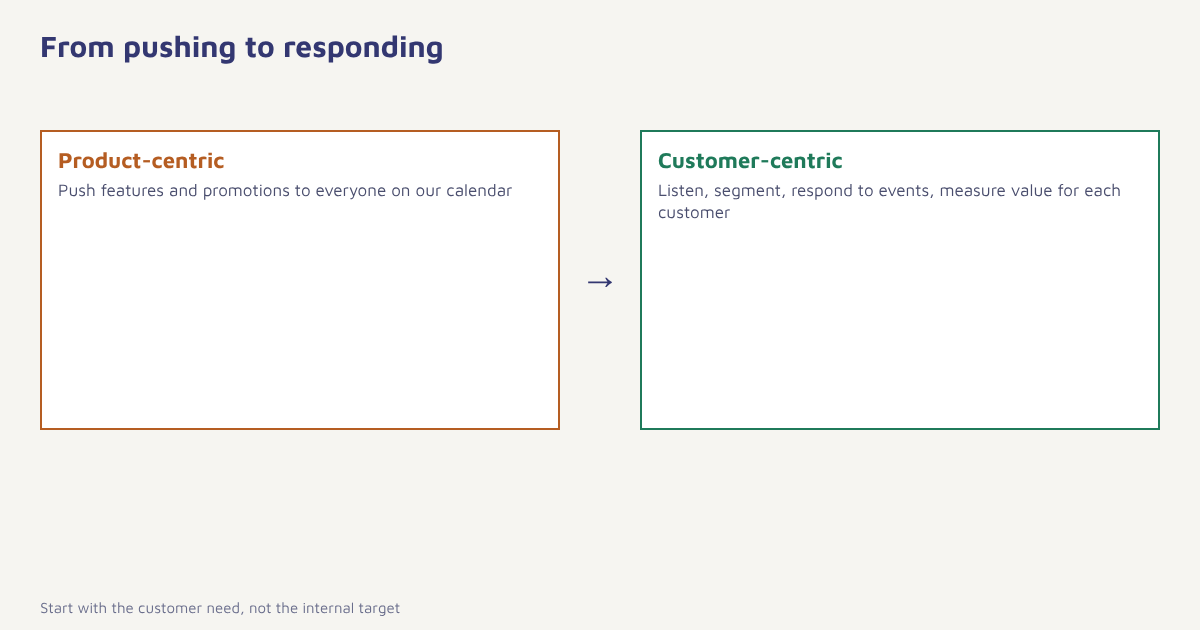
Product-centric, sales-centric and customer-centric
| Product-centric | Sales-centric | Customer-centric | |
|---|---|---|---|
| Starting point | What we make | What we need to sell this month | What the customer is trying to do |
| Typical message | Features and specifications | Discounts and deadlines | Relevant help at the right moment |
| Audience | Everyone, in one list | Whoever is easiest to convert | Segments and individuals |
| Timing | Launch calendar | Month-end push | Customer events and life stage |
| Success measure | Units shipped | Revenue this quarter | Retention, lifetime value and satisfaction |
| Risk | Building what nobody wants | Training customers to wait for sales | Needs data, discipline and patience |
Most real businesses mix all three. The point is to know which mode is driving a given decision and to shift the balance deliberately, instead of by accident.
Five working principles
- Know the person, not just the persona. Use real behaviour and consented profile data alongside research. See customer data platforms.
- Be relevant or be quiet. A message that does not fit the recipient costs trust. Fewer, better messages beat more.
- Respect permission and preference. Channel, frequency and topic choices belong to the customer. See the DPDP Act guide.
- Measure the relationship. Track repeat purchase, satisfaction and churn along with campaign clicks. See retention rate and customer lifetime value.
- Close the loop. Feedback must change something. See the customer feedback loop.
The data it depends on
| Data | What it tells you | Where it lives |
|---|---|---|
| Profile attributes | Who the customer is, language, city, preferences | Contact profile |
| Behaviour events | What they viewed, bought, ignored | Event store. See the data model |
| Consent and channel choices | How they agreed to be contacted | Consent record per channel |
| Feedback | What they say about you | Surveys, reviews, support |
| Value signals | Spend, frequency, margin, tenure | Orders and billing |
You do not need all of it on day one. A modest amount of well-organised data, such as order history, a few attributes and consent, is enough to start. The difficult part is usually joining it up. Flowfox keeps events, attributes and consent on one contact profile, so segments in the segment builder and journeys use the same picture of the customer that analytics reports.
How to move toward customer-centric marketing
- Audit one month of messages. List everything you sent and ask of each: what customer need did this answer? Be honest about the ones that answered only an internal target.
- Talk to customers. Ten short conversations with recent buyers and recent leavers will reveal more than another dashboard. See voice of the customer.
- Map the customer journey. Mark the moments that matter, from first search to repeat purchase. See customer journey mapping.
- Segment by need and behaviour. Start with four or five groups you can treat differently. See behavioral segmentation.
- Replace one broadcast with a triggered message. For example, a post-delivery help message instead of a generic sale blast.
- Add customer measures to the dashboard. Repeat purchase, satisfaction, complaint and unsubscribe rates sit next to revenue.
- Review monthly with a customer question. What did customers need this month that we did not provide?
A worked example: a home-appliance retailer
Imagine a retailer that sells kitchen appliances online. Its calendar is full of sales, and its customers hear from it only when something is discounted. After an audit the team notices that most buyers of a mixer-grinder have questions in the first week and that many return the product because the jar lid is hard to fit. They create a short post-purchase journey: a how-to guide and a two-minute video on day two, a check-in message on day five, an offer of help from support if the buyer replies and a request for a review after three weeks. Buyers who report a problem are removed from promotions until it is solved. The brand and the results are invented for illustration, but the pattern is common: the change is not a bigger campaign, it is a more useful one, built from a customer problem the business had been ignoring.
Notice what the example does not require. It needs no new channel, no artificial intelligence and no large budget. It needs a habit of asking what the customer is going through, a profile that records the purchase date and a journey that waits and then speaks. For more on how experience shapes outcomes, read about customer experience and customer lifecycle marketing.
Handling the tension with business goals
Customer-centric does not mean ignoring revenue. Customers rarely complain about relevant offers; they complain about irrelevant ones. The skill lies in finding where customer interest and business interest overlap: a replenishment reminder just before a product runs out serves both, a discount for someone who would have bought anyway serves only one. When goals conflict, such as a request to send a promotion to a customer with an open complaint, write down the rule in advance (for instance, suppress promotions while a ticket is open) so the decision is not reargued every week. Also resist the urge to overcorrect. Asking customers for everything they want leads to inconsistent products; the aim is to understand needs deeply, then decide with judgement. A useful companion is the reasoning in the guide to the STP framework, which helps choose whom to serve in the first place.
Habits that keep a team customer-centric
Principles fade unless they are built into routines. Three habits make the biggest difference. First, put a customer voice into every planning meeting: a recent support chat, a review or a call recording, read aloud, before anyone opens the campaign calendar. Second, give every campaign brief a line that names the customer need it answers and the customer measure it should improve, such as fewer complaints or more repeat orders. Third, review a sample of what customers actually received, on their phones, once a month. Teams that do this often discover duplicate messages, broken links and tone problems that no dashboard reveals.
It also helps to be clear about what you will stop doing. Customer-centric marketing usually means fewer broadcasts, tighter frequency limits and more suppression rules, such as pausing promotions for customers with an open complaint. These choices can reduce short-term send volume while improving results per message, which is why leadership should agree the measures in advance. The history of the idea, from the shift in business thinking described in the article on customer satisfaction, shows how often companies rediscover it. Treat it as a discipline you practise, and your customers will notice the difference long before your competitors do.
A quick test. Pick any campaign on your calendar and finish the sentence: “Customers need this because…”. If you cannot, the campaign serves an internal goal.
Common mistakes
- Using the phrase but not the practice. A slogan on a slide changes nothing.
- Personalising without permission. Relevance does not excuse collecting data without consent.
- Measuring only campaign clicks. You will optimise for the wrong thing.
- Collecting feedback and doing nothing. Customers notice.
- Treating all customers alike. Needs differ widely.
You know a company is customer-centric when its calendar is built from customer events, not from its own deadlines.
Build marketing around what customers do. Segment by behaviour and respond across email, WhatsApp, SMS and push.
Read next: brand loyalty, customer engagement and the blog.
Frequently asked questions
What is customer-centric marketing?
It is an approach in which decisions about products, messages and timing start from customer needs and behaviour, and success is judged partly by the value customers receive.
How is customer-centric marketing different from personalization?
Personalization is a tool that tailors content to individuals. Customer-centric marketing is a broader way of working that also shapes products, timing, measurement and priorities.
What are the benefits of a customer-centric approach?
It tends to improve relevance, trust, retention and lifetime value, and reduces wasted sends and unsubscribes, though results depend on execution.
What data do I need to start?
Order history, a few profile attributes, behaviour events and recorded consent are enough to begin, along with direct feedback from customers.
Does customer-centric mean giving customers everything they ask for?
No. It means understanding their needs deeply and then using judgement to decide what to offer, while keeping the business sustainable.
How do I measure customer-centric marketing?
Track repeat purchase rate, retention, satisfaction scores, complaint and unsubscribe rates and customer lifetime value alongside campaign results.
Where should a small team begin?
Audit a month of messages for customer need, talk to ten customers and replace one broadcast with a triggered message that answers a real moment.