Customers are telling you what they want all the time: in support chats, product reviews, survey comments, sales calls, social posts and even in what they do not click. Voice of the customer, or VoC, is the discipline of collecting those signals, making sense of them and putting them to use. The aim is to replace guesses about what customers think with evidence. This guide explains what VoC is, the sources worth tapping, how to combine direct and indirect feedback, a practical method to analyse comments, how to turn findings into action and how to avoid the common failure of collecting feedback that nobody reads. For the narrower process of replying to individual feedback, see the guide to the customer feedback loop.
What is voice of the customer?
Voice of the customer is a term for the process of capturing customers’ expectations, preferences and frustrations, then using them to guide product, service and marketing decisions. It began in quality management and product development and is now widely used in marketing and customer experience. A good VoC programme answers three questions: what do customers say, why do they say it and what should we change as a result? It differs from a single survey in that it combines many sources over time.
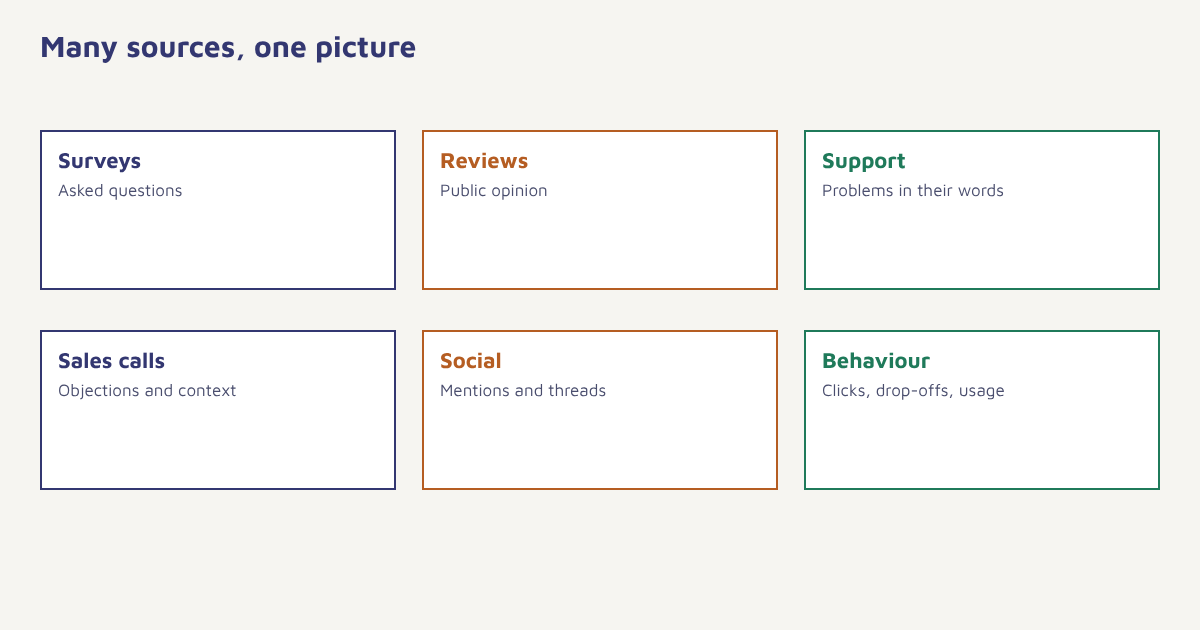
Sources of customer voice
| Type | Source | Strength | Weakness |
|---|---|---|---|
| Direct, asked | Surveys, interviews, feedback forms. See app survey questions | You choose the question | Response bias, low response rates |
| Direct, volunteered | Support tickets, chats, emails, reviews, social comments | Honest, in the customer’s words | Skews to extremes |
| Indirect, behavioural | Clicks, searches, drop-offs, usage, returns | Shows what people do | Does not say why |
| Frontline | Sales calls, onboarding calls, account notes | Rich context | Recorded unevenly |
| Competitive | Reviews of rivals, forum posts | Reveals unmet needs | Not your customers |
No source is complete. Surveys give structure but only from those who answer, support tickets show problems but not satisfied silence, and behaviour shows the what but not the why. The strength of VoC comes from combining them.
A practical method: from comments to themes
- Gather in one place. Export survey answers, tickets, reviews and chat transcripts for a period, such as the last 90 days.
- Remove personal identifiers. Keep customer names and contact details out of the analysis file, to respect privacy.
- Read a sample first. Read 100 comments yourself before using any tool. You will see patterns that software misses.
- Create a simple tag list. For example delivery, price, product quality, ease of use, support, trust. Adjust as you read.
- Tag every comment. One or two tags each. Tools using text analysis can help, but check their output. See sentiment analysis.
- Count and weigh. Count how often each theme appears and by which segment. Weigh by customer value and severity.
- Pick the top three themes. Write each as a problem statement with two or three real quotes.
- Assign owners and dates. A theme with no owner will not be fixed.
Combine the voice with the numbers
A comment gains meaning when linked to behaviour. If many customers complain about delivery times, check whether late deliveries correlate with lower repeat purchase. If reviews praise a feature that few use, ask why. In Flowfox, survey answers and events sit on the same profile, so you can build a segment of customers who gave a low score and had a late order, then follow up personally. See the data model, segment builder and analytics. Measures such as the Net Promoter Score and CSAT and CES give a scoreboard, while open comments explain it.
Putting VoC to work
| Team | How it uses the voice of the customer |
|---|---|
| Marketing | Borrows customers’ own words for headlines and emails. See email copywriting |
| Product | Prioritises fixes and features by theme and value |
| Support | Writes help articles for the most common questions |
| Sales | Prepares answers to the objections customers raise |
| Leadership | Tracks themes over time alongside revenue and retention |
Share findings in a short monthly note: the top three themes, a few verbatim quotes, what you will do and what you did last month. Customers also like to know that their voice counts, so tell them: “You asked for faster refunds, so we changed it.” That sentence in a follow-up message builds loyalty and encourages more feedback.
A worked example: a learning app
An online learning app collects 1,200 comments from reviews, support tickets and an in-app survey. After tagging a sample, the team finds five themes: video quality, price, difficulty of the exercises, trouble restarting a course and certificate delays. Counting shows that restart problems and certificate delays are mentioned less often than price, but they come mostly from customers who then stop using the app, while price comments come mostly from people who never paid. The team decides to fix restart and certificates first and to test a price explanation rather than a price cut. Within a quarter, support tickets on those two themes fall and the app tells users so in a message. The app, comment numbers and outcomes are invented to illustrate the reasoning, in which weighing by what happens next matters as much as counting.
Privacy and consent
Feedback often contains personal data. Tell customers how you will use their comments, keep identifiers out of analysis where possible, limit who can see raw data and delete it when you no longer need it. If you quote a customer publicly, ask permission. See the DPDP Act guide for Indian rules and take advice on others. For the idea behind rigorous collection and coding of comments, the general account of qualitative research is a useful background read.
Bias and blind spots to watch for
Every source of customer voice has distortions, and a good programme names them. People who respond to surveys tend to be either delighted or upset, which hides the middle. Reviews skew toward recent experiences and toward products that provoke strong feelings. Support tickets overrepresent problems and customers who are comfortable writing in. Social posts come from those who like to share publicly. Behavioural data is free of opinion but easy to misread. If a page has high exit rate, are people confused or did they find what they came for?
You can reduce these distortions in three ways. First, compare sources and look for themes that appear in more than one. Second, deliberately seek quiet voices, for example by calling a random sample of customers who never wrote in, or by offering feedback in several languages and channels. Third, check your analysis for the effect of your own questions: leading wording gets leading answers. Keep a short log of what you asked, when and how, so that changes in the data can be told apart from changes in the question. The general background on response bias is worth knowing for anyone who runs surveys.
Finally, keep a place for judgement. Customers describe symptoms well and solutions poorly. When many say “I want a faster checkout”, the real cause might be a confusing form, a slow page or a lack of payment options, and the way to find out is to watch sessions and test changes. VoC tells you where to look. Your team still has to work out what to build, and whether the benefit justifies the cost.
Start small. You can run a first VoC review with a spreadsheet, 100 comments and one afternoon.
Common mistakes
- Collecting more than you can read. Fewer sources, well used, beat many ignored.
- Trusting only scores. The comment explains the number.
- Listening only to the loudest. Weigh by value and severity, and look for quiet segments.
- No owner. Insights without owners go nowhere.
- Not closing the loop. Customers stop talking if nothing happens.
Customers have already told you what to fix. The work is reading it properly and doing something about it.
Connect what customers say to what they do. Combine survey answers and behaviour on one profile and follow up automatically.
Read next: customer experience, customer-centric marketing and the blog.
Frequently asked questions
What is voice of the customer?
Voice of the customer is the process of capturing customers’ expectations, preferences and frustrations from many sources and using them to guide product, service and marketing decisions.
What are the sources of voice of the customer data?
Surveys, interviews, support tickets, chats, reviews, social posts, sales calls and behavioural data such as clicks, drop-offs and usage.
How do you analyse customer feedback?
Gather comments in one place, read a sample, create a tag list, tag each comment, count and weigh the themes by customer value and severity, then assign owners to the top themes.
What is the difference between VoC and customer surveys?
A survey is one tool. A VoC programme combines surveys with many other sources over time and turns the findings into action.
How is VoC different from the customer feedback loop?
VoC focuses on collecting and analysing feedback across sources to find themes. The feedback loop focuses on responding to individual feedback and telling customers what changed.
How often should I review voice of the customer data?
Monthly is a good rhythm for summaries, with real-time alerts for urgent problems and a deeper review each quarter.
Do I need special software for VoC?
Not at the start. A spreadsheet and manual tagging of a sample can reveal the main themes. Software helps as volume grows, but its output should still be checked.