Some customers do more than buy. They answer questions in a forum, post a photo, write a detailed review, bring their colleagues along or defend you in a comment thread. These people are advocates, and they are worth far more than their own orders. This guide explains what customer advocacy is, how it differs from referral schemes and ordinary satisfaction, how to find your advocates, how to give them reasons and ways to speak up, how to keep the whole thing honest and how to measure what it adds. For incentive-based sharing, see the separate guide to referral marketing programs.
What is customer advocacy?
Customer advocacy is a practice in which a company deliberately builds relationships with customers who are happy enough to recommend it, and supports them in doing so, while also acting on their needs inside the business. The idea overlaps with word of mouth and with customer advocacy as discussed in marketing and customer-success literature. The key word is deliberate. Satisfied customers talk about you anyway. Advocacy programmes make it easier and more rewarding, mostly in non-monetary ways, and make sure the voice of the customer is heard internally.
Advocacy, referral and satisfaction compared
| Satisfaction | Advocacy | Referral program | |
|---|---|---|---|
| What it is | Customer is content | Customer actively recommends | Customer is rewarded for bringing someone |
| Trigger | Good experience | Good experience plus an invitation and a channel | Incentive plus a share link |
| Motivation | Not applicable | Pride, belonging, helping others | Reward for both sides |
| Typical outputs | Survey scores | Reviews, stories, speaking, peer help | Tracked sign-ups |
| Risk | Silent customers | Over-asking, fatigue | Low-quality referrals, reward chasers |
Why advocacy is worth the effort
- Trust. People believe people like themselves more than they believe brands. This shapes the evaluation stage in consumer behavior.
- Lower acquisition cost. Recommendations can bring in customers at little cost. See customer acquisition cost.
- Better retention. Customers who feel part of something stay longer. See retention rate.
- Better product decisions. Advocates know the product deeply and give candid advice.
- Resilience. In a crisis, a brand with vocal supporters is better placed.
Finding your advocates
| Signal | Where to look |
|---|---|
| High satisfaction scores | Promoters in your Net Promoter Score survey |
| Repeat purchases over a long period | Orders and tenure |
| Reviews and photos | Your user-generated content |
| Referrals made on their own | Referral and discount code data |
| Active in community or support | Forums, social mentions, helpful replies |
| Heavy product use | Usage events in the app or platform |
A simple scoring approach works well. Give points for survey promoters, repeat orders, reviews and referrals, and treat the top group as candidates, as in lead scoring applied to existing customers. In Flowfox, such a group is a segment built from events and survey answers in the segment builder, refreshed automatically.
How to build a customer advocacy programme
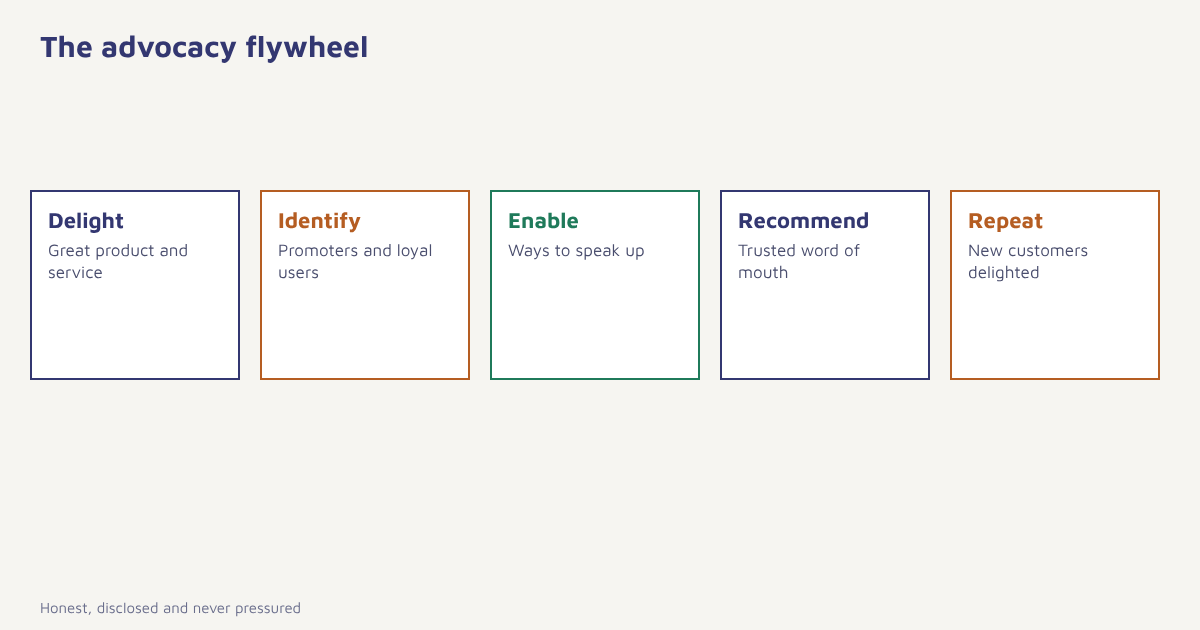
- Make customers genuinely happy first. Advocacy cannot cover for a weak product or poor service.
- Define advocate segments. For example promoters with three or more orders, or users who reached a key milestone.
- Offer ways to speak up. Reviews, short testimonials, case stories, beta feedback panels, community answers or conversation with prospects.
- Make it easy. Pre-filled forms, one-tap review links in email and WhatsApp, and prepared but editable questions.
- Recognise, don’t just reward. Early access, named credit with permission, direct contact with the team, and invitations to events.
- Close the loop. Tell advocates what changed because of their input.
- Respect their time and limits. Ask no more than a few times a year, and let them say no without penalty.
Keep it honest
Advocacy works only if it is real. Do not script reviews, do not hide that a customer received a perk when they speak publicly and do not pressure anyone. Many countries have rules on endorsements and unfair trade practices, and platforms have their own policies, so take advice for your own markets; the astroturfing problem, where fake grassroots support is manufactured, shows how quickly trust can collapse. Where a gift or perk was given, say so clearly. Always get permission before using a customer’s name, face or words. See the DPDP Act guide for handling personal data.
A worked example: a project-management tool
A project-management software company notices that a small group of users keep posting helpful answers in its community forum. It identifies them by combining three signals: a promoter score of nine or ten, more than a year of use and at least ten forum answers. These 60 users are invited, by a personal message from the head of customer success, to a private advisory group. Members get early access to features, a monthly call with the product team and a profile badge in the forum. Once a quarter they are asked, never obliged, to share a short story or take a call with a prospect. After a year the company has a library of customer stories, faster product feedback and a noticeable share of sign-ups that mention a community member by name. The company, group size and results are invented for illustration.
Measuring advocacy
| Measure | What it shows |
|---|---|
| Share of customers who are promoters | Size of the potential base |
| Reviews and stories gathered per quarter | Output of the programme |
| Sign-ups citing a customer or recommendation | Influence on acquisition |
| Retention of advocates vs others | Relationship strength. Compare with cohorts |
| Product changes traced to advocate input | Value to the business |
Be careful with attribution. People who hear a recommendation often search, visit and sign up later through another route, so rely on survey questions such as “how did you hear about us?” as well as links and codes. Our guide to attribution models explains the limits. For the wider picture of keeping customers close, see customer engagement and brand loyalty.
Using email, WhatsApp and in-product moments
Advocacy is usually triggered at a moment of success. In a software product, that may be the day a team completes its first project. In ecommerce, it may be a week after a delivery when the customer has used the item. Build these moments into journeys: a message that celebrates the milestone, a single question, and then, only for those who respond warmly, an invitation to share. Choose the channel by preference and permission. A short WhatsApp message may suit a consumer brand, while email suits a longer story request. See review request emails and WhatsApp marketing for message ideas.
Give each invitation a clear, small ask with an easy way to decline. “Would you be willing to answer three questions about how you use us?” will always do better than “Please promote us”. Offer a choice of ways to help, from a one-line quote to a call with a prospect, so that busy customers can pick what fits. Thank everyone who responds, even briefly, and report back on what happened to their contribution. Over time, build a simple record of who has helped, in what way and when, so that you do not ask the same person too often. Related thinking appears in discussions of community management, where trust and reciprocity matter as much as incentives.
Rule of thumb. Ask for help only after a clearly good experience, and make every request small, optional and easy to decline.
Common mistakes
- Asking before delighting. Requests land badly after a poor experience.
- Treating advocates as free marketing. Offer something real in return.
- Over-asking. The best advocates are also your busiest customers.
- Hiding perks. Undisclosed rewards erode credibility.
- Not acting on their advice. If nothing changes, they stop contributing.
An advocate is a customer who has decided your success matters to them. Treat that as a gift, not a channel.
Find the customers who already speak for you. Segment promoters and loyal users, then invite them with a personal journey.
Read next: voice of the customer, review request emails and the blog.
Frequently asked questions
What is customer advocacy?
Customer advocacy is the deliberate practice of building relationships with happy customers who recommend the company, supporting them in doing so and acting on their input inside the business.
How is customer advocacy different from a referral programme?
A referral programme rewards customers for bringing new people through a tracked link. Advocacy is broader and relies mainly on trust, recognition and shared goals, with recommendations as one outcome.
How do I identify customer advocates?
Look for promoters in your Net Promoter Score survey, long-term repeat buyers, people who write reviews or help others, and heavy users, then combine those signals into a segment.
What should I offer advocates?
Non-monetary recognition often works best: early access, direct contact with your team, named credit with permission, invitations and visible influence on the product.
Do I have to disclose rewards given to advocates?
In many places and on many platforms, yes. Disclose perks clearly and take advice on the endorsement rules in your markets.
How do I measure customer advocacy?
Track the share of promoters, reviews and stories collected, sign-ups that cite a recommendation, retention of advocates compared with others, and product changes that came from their input.
How often should I ask advocates for help?
Sparingly, usually a few times a year at most, and always let them decline without any penalty.