People believe friends far more than they believe adverts. A referral programme turns that simple fact into a structured way of growing: existing customers invite people they know, and both sides receive something when the friend joins or buys. Referral customers are often cheaper to win and tend to stay longer, but only when the programme is easy to join, fair and honest. This guide explains what a referral marketing programme is, how it differs from word of mouth and affiliate marketing, the different reward structures, the steps to build one, how to promote it by email, WhatsApp and in-app messages, how to measure it and how to prevent fraud.
What is a referral marketing programme?
A referral programme, sometimes called a refer-a-friend or referral marketing scheme, formally invites customers to recommend a business and rewards them when a referred person takes a defined action, such as signing up, making a first purchase or subscribing. Natural word of mouth happens without prompting. A programme adds a link or code, a clear offer and tracking. It is also different from affiliate marketing, where publishers or partners promote you for a commission and may have no personal relationship with the buyer. Referrals sit between loyalty and acquisition: they reward existing customers (see loyalty programs) and bring in new ones (see customer acquisition cost).
How a referral programme works
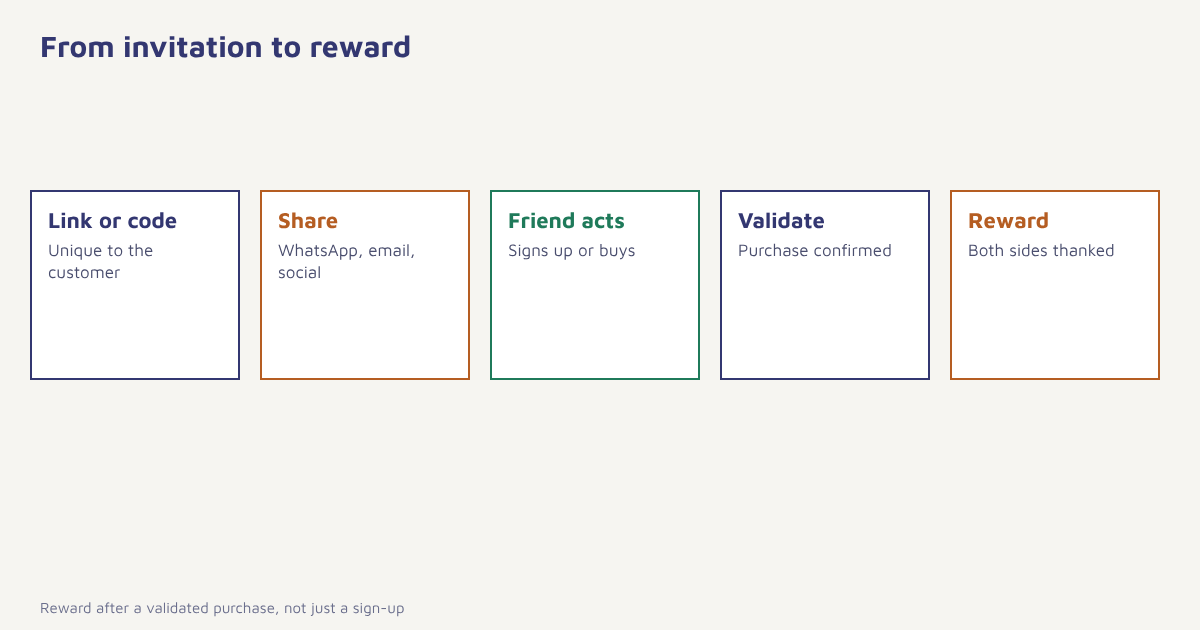
- The customer gets a unique link or code. It is created automatically and tied to their profile.
- They share it. By WhatsApp, SMS, email, social posts or in person.
- The friend arrives and acts. They sign up, buy or subscribe.
- The system attributes the action. The link or code identifies who referred whom.
- Rewards are issued after validation. Once the purchase is confirmed and the return window has passed, for example.
- Both sides are thanked. A message confirms the reward and invites another referral.
Reward structures
| Structure | How it works | Good for | Watch out for |
|---|---|---|---|
| Double-sided | Both referrer and friend get a reward | Most consumer brands | Cost per referral doubles |
| Single-sided, referrer only | Only the customer is rewarded | B2B, high-value products | Friend has less reason to act |
| Single-sided, friend only | Friend gets a welcome offer | Low-margin goods | Referrer has no motive |
| Tiered | More referrals unlock bigger rewards | Brands with active fans | Can attract gaming |
| Non-cash | Credits, free products, early access, donations | Brands with strong identity | Make value clear |
| Cash or bank transfer | Direct payout | Financial products, services | Rules, tax and fraud risk |
The best reward fits your economics and your customer. A reward worth about the amount you would otherwise pay to acquire a customer is a reasonable starting guide, but check against margins and lifetime value (see customer lifetime value). Rewards that feel generous, simple and immediate usually beat complicated ones. If you reward with credit, say when it expires.
How to build a referral programme
- Check you are ready. Referral programmes amplify satisfaction. If customers are unhappy, fix that first. A satisfaction survey shows where you stand.
- Define the qualifying action. First paid order? Subscription activation? Choose something that proves a real customer.
- Set the reward and limits. Amount, expiry, maximum per customer, eligible products.
- Choose tracking. Unique links or codes tied to profiles. Make sure data reaches your platform. See the data model.
- Design the share experience. One tap to share by WhatsApp or copy a link, with a pre-written message the customer can edit.
- Write the terms. Short, plain language rules on eligibility, validation and abuse.
- Launch to your best customers first. Learn before you promote widely.
Promote it where customers already are
| Moment | Message | Channel |
|---|---|---|
| After a positive review or high survey score | “Glad you loved it. Share it with a friend.” | Email, in-app |
| After delivery of a first order | Invite with link and reward details | WhatsApp (opted in), email |
| On the order confirmation page | Share button with the offer | Web, app |
| Tier or milestone reached | Recognition plus invitation. See gamification | Push, email |
| Periodic reminder | Reward balance and top referrers | Email, in-app |
Timing matters most. Ask when the customer is happiest, not at the moment of sign-up. In Flowfox, a journey can wait for a positive signal, such as a high rating, then send the invitation by email or WhatsApp and later confirm the reward. The segment builder can isolate loyal customers most likely to share. For ecommerce examples, see our ecommerce solution page, and for the messaging rules on WhatsApp, read WhatsApp marketing.
Measuring a referral programme
| Metric | Formula or meaning |
|---|---|
| Participation rate | Customers who share at least once ÷ eligible customers |
| Referral conversion rate | Referred visitors who complete the action ÷ referred visitors |
| Referrals per participant | Successful referrals ÷ sharing customers |
| Cost per referred customer | Rewards plus programme cost ÷ new customers |
| Quality | Retention and lifetime value of referred vs other customers |
| Viral coefficient | Average successful referrals per existing customer |
Compare referred customers with those from other channels, including repeat rate and refund rate. The idea of a viral loop is described under viral marketing, though most real businesses see a modest viral coefficient well below one and treat referral as one channel among several. Use A/B tests on reward size and wording instead of guessing.
Fraud, fairness and rules
- Self-referral. Block rewards where referrer and friend share a device, payment method or address.
- Fake accounts. Require a validated purchase, not just a sign-up.
- Coupon sites. Keep codes personal and non-transferable where needed.
- Spam. Do not let customers bulk-message contacts; share only by personal action. Unsolicited promotion can breach messaging rules and platform policies.
- Consent and data. Do not upload a customer’s address book. Ask the friend for their own consent. See the DPDP Act guide.
- Advertising rules. Disclose rewards honestly. Regulations on incentives and endorsements vary; take advice for your sector.
A worked example (invented)
A subscription skincare brand pays about ₹600 in marketing cost to win a new subscriber. It launches a double-sided offer: the friend gets 15 percent off the first box, and the referrer gets ₹300 credit once the friend’s first box is delivered and not returned. Invitations go to customers who gave a four- or five-star rating, by email and WhatsApp for those who opted in. After three months, the brand finds that referred customers cancel less often than those from paid ads, but a small group is gaming the system with duplicate accounts. It adds a delivery-address check and a monthly cap of ten rewards per customer. The brand, numbers and results are invented to illustrate the approach.
Referrals beyond consumer brands
Referral programmes are not limited to shops and apps. B2B software companies often get their best customers from recommendations, and a structured scheme can speed this up: a case-study request after a successful rollout, a partner introduction with a clear commission or a customer advisory group. The reward may be a service credit, a donation or simply early access to features, because business buyers are usually motivated by reputation and results more than by small cash gifts. Rules matter more here, since employees may be restricted from accepting gifts. Read about word of mouth for the underlying idea, and keep the process light: a short form, a named contact and a fast reply.
Fairness test. Would the friend still feel good about the offer if they knew exactly what their friend was paid? If not, change the structure.
Common mistakes
- Launching to everyone at once. Test with loyal customers first.
- Hiding the offer. A link buried in a footer gets few shares.
- Rewarding sign-ups, not purchases. It invites fake accounts.
- Complicated terms. Keep rules short.
- No follow-up. Thank referrers and show their progress.
Customers do not recommend a company because they are paid. They recommend it because it made them look good to a friend. The reward is just the thank-you.
Turn happy customers into your best channel. Trigger referral invitations from positive signals and track every reward.
Read next: customer engagement, user-generated content and the blog.
Frequently asked questions
What is a referral marketing programme?
A referral programme invites existing customers to recommend your business and rewards them, and often the friend, when the referred person takes a defined action such as a first purchase.
How is referral marketing different from affiliate marketing?
Referral marketing relies on personal recommendations from customers. Affiliate marketing pays partners or publishers a commission for promoting you, usually without a personal relationship.
What is a good referral reward?
One that feels generous and simple and fits your economics. A common starting guide is a reward near what you would pay to acquire a customer, checked against margin and lifetime value.
When should I ask customers to refer?
When they are happiest, for example after a positive review, a high survey score or successful delivery, not at sign-up.
How do I prevent referral fraud?
Reward only validated purchases, block self-referrals using device, address and payment checks, cap rewards per customer and watch for patterns.
How do I measure referral success?
Track participation rate, referral conversion, cost per referred customer, and the retention and lifetime value of referred customers against other channels.
Can I send referral invitations on WhatsApp?
Yes, to customers who have opted in, using approved templates where required. Let customers share personally and do not upload their contacts.