Games are good at one thing most marketing is not: making people want to come back. Points, progress bars, streaks and badges turn ordinary tasks into something with momentum. Gamification applies those ideas outside games, in loyalty programmes, apps, onboarding and campaigns. Done well, it makes useful behaviour feel rewarding. Done badly, it feels childish or manipulative, and it is expensive to build and maintain. This guide explains what gamification is, the elements it uses, the psychology behind it, examples across channels, a plan to launch a simple version, how to measure it and the ethical lines you should not cross.
What is gamification in marketing?
Gamification means using game design elements, such as points, levels, challenges, rewards and leaderboards, in non-game contexts to encourage engagement or a desired action. In marketing, the actions might be completing a profile, making a repeat purchase, writing a review, referring a friend or opening the app daily. It is different from running a one-off game or contest: gamification is a standing structure that rewards behaviour over time. It sits close to loyalty programs, and many loyalty schemes are gamified without being called that.
The building blocks
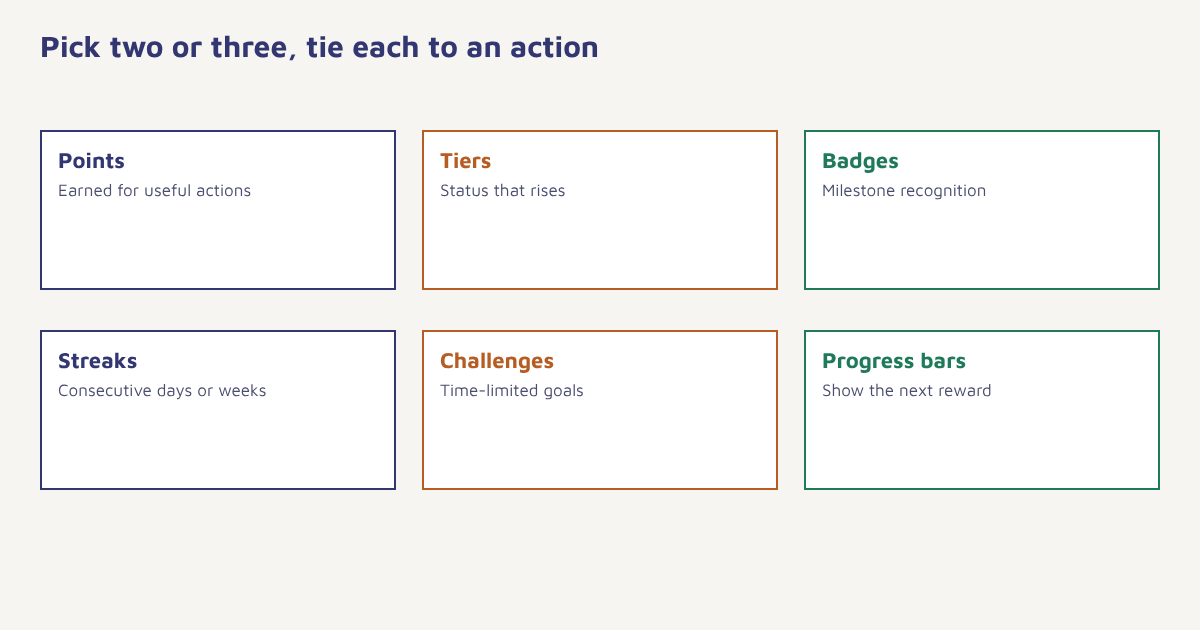
| Element | How it works | Example action it rewards |
|---|---|---|
| Points | Earn a number for each action | Purchases, reviews, referrals |
| Levels and tiers | Status that rises with points | Bronze to Gold membership |
| Badges | Visual recognition for a milestone | First order, ten reviews |
| Streaks | Reward for consecutive days or weeks | Daily check-in, weekly order |
| Challenges and quests | Time-limited goals with a prize | “Try three new products this month” |
| Progress bars | Show how close the next reward is | Profile 70% complete |
| Leaderboards | Rank against others | Top reviewers, top referrers |
| Surprise rewards | Unexpected bonus | Random free shipping |
Why gamification can work
Several well-known ideas from behavioral economics and psychology help explain it. People like to see progress toward a goal, so a progress bar makes completion more likely. They dislike losing something they have built, so a streak creates a reason to return. Status and recognition matter to many, so tiers and badges carry weight. And uncertain rewards can be more motivating than fixed ones. These effects are real but varied: they work differently for different people, and they fade if the underlying product is not useful. Gamification amplifies value; it cannot create it. See our guide to consumer behavior for the wider context.
Examples across the customer journey
| Stage | Gamified idea | Channel |
|---|---|---|
| Sign-up | Profile completion bar that unlocks a welcome reward | Web, app, email reminder |
| Onboarding | Checklist with badges for each step. See customer onboarding | In-app messages |
| First purchase | Mystery reward on a first order | Email, WhatsApp |
| Repeat purchase | Order streak or tier progress | App, email |
| Advocacy | Referral ladder with rewards. See referral marketing program | Email, WhatsApp, app |
| Feedback | Points for a review or survey. See user-generated content | Email, in-app |
| Re-engagement | Comeback challenge with a small bonus. See win-back campaigns | Push, email |
Think about how each message lands. A streak reminder at 8 pm works if the user has chosen that rhythm. The same message every night, whatever the person does, becomes noise. Flowfox journeys can read points, streaks and tier from the contact profile so that reminders, congratulations and rewards depend on where each person actually is, across push, email and WhatsApp.
How to launch a simple gamified programme
- Choose the behaviour. Pick one or two actions that matter: repeat orders, reviews, referrals, profile completion.
- Check the behaviour is worth rewarding. Would you want more of it, even without the game? If not, change the target.
- Pick two or three elements. For example points, a progress bar and one tier. Resist adding everything.
- Set simple rules. People should understand how to earn and spend in under a minute.
- Budget the rewards. Estimate cost per point and the cost of the top tier. Cap it.
- Pilot with a segment. Launch to a group of engaged customers. See behavioral segmentation.
- Measure against a control. Compare behaviour of players and non-players.
Measuring gamification
The test is not how many badges were handed out. Compare participants with a similar group that did not join: purchase frequency, average order value, time between orders, referral and review rates, and retention. Also track cost per incremental action, because a reward that costs more than the behaviour is worth is a loss. Watch for gaming of the system, such as fake reviews to earn points, and for fatigue, where activity spikes then drops once the novelty fades. Our guides to customer lifetime value and A/B testing explain how to judge value over time.
Keep it honest
Game mechanics can be used to help people or to hook them. Be transparent about how points work and when they expire. Avoid pressure tactics such as fake countdowns, punishing people for missing a day or making rewards hard to redeem. Do not collect extra personal data just to power the game, and follow privacy rules: the DPDP Act guide explains consent in India. Be careful with anything resembling gambling, as contests, lotteries and paid chances to win are regulated and the rules differ by place; take legal advice before launching prize draws. The broader idea of loyalty programs shows how schemes that deliver real value last longer than ones that rely on tricks.
A worked example (invented)
A pet-supplies store adds a simple “Paw Points” scheme to its app. Customers earn points for orders, reviews with a photo and referrals, and see a progress bar toward free delivery for a month. There are three tiers, and only the top one carries a real cost. Streaks are weekly, not daily, because pet food is not a daily purchase. A journey congratulates customers when they reach a tier, reminds those within one order of the next tier and stays quiet for customers who have opted out of promotional messages. After a quarter, the store compares members with similar non-members and finds more repeat orders among members, then removes a badge that nobody cared about and doubles points for photo reviews. The brand and figures are invented.
Design principles that keep it from feeling forced
The programmes that last tend to follow a few habits. They reward effort the customer already wants to make, so the game feels like a bonus, not a chore. They make progress visible, with a clear picture of what is next and how far away it is. They keep early rewards easy, so new members feel success in the first week, and they make later rewards meaningful but not impossible. They offer choice: some people like leaderboards, many hate them, so make competitive features optional. And they avoid punishing absence. A streak that resets to zero after one missed day can cause frustration and quitting, so consider a freeze or a grace day.
Test the idea on paper before you build. Write down the three most common customer types, walk each through the first month and ask what they would do and how they would feel. If a casual customer would feel left behind, the design needs another path. Test with real people as well, because teams that build a scheme often overestimate how much customers care about it. Keep a short list of metrics, review them monthly and be ready to remove elements that do not earn their place. The same discipline helps in loyalty programmes, in mobile app engagement and in festival campaigns, where limited-time challenges can add energy without long-term complexity.
Common mistakes
- Adding game elements to a poor product. It does not rescue weak value.
- Too many mechanics. Complexity kills participation.
- Rewards that cost more than they return. Model the economics.
- Leaderboards that discourage most people. Only the top few feel good.
- No exit. Let people mute reminders and opt out.
Good gamification does not trick people into using a product. It makes a useful habit feel like progress.
Reward the behaviour you want more of. Trigger congratulations, reminders and tier updates from live customer data.
Read next: customer engagement, app retention strategies and the blog.
Frequently asked questions
What is gamification in marketing?
Gamification in marketing uses game elements such as points, levels, badges, streaks and challenges to encourage actions like repeat purchases, reviews, referrals and app use.
What are examples of gamification?
Profile completion bars, onboarding checklists with badges, loyalty tiers, purchase streaks, referral ladders and comeback challenges.
Does gamification increase engagement?
It can, when it rewards useful behaviour and the product itself delivers value. Effects vary and often fade, so measure against a control group.
What is the difference between gamification and a loyalty program?
A loyalty programme rewards repeat business. Gamification is a set of design techniques, and many loyalty programmes use them, though gamification can also reward actions other than purchases.
Is gamification legal?
Most mechanics are fine, but contests, prize draws and paid chances to win are regulated and vary by location. Take legal advice before launching them.
How do I measure the success of gamification?
Compare participants with a similar control group on purchase frequency, order value, retention, referrals and reviews, and track cost per incremental action.
Which elements should I start with?
Start with two or three, such as points, a progress bar and one tier, tied to one clear behaviour.