Most happy customers never write a review. Not because they mind, but because no one asked at the right moment in the right way. A well-timed review request email turns quiet satisfaction into the ratings and comments that help the next shopper decide, feed your product pages and tell you what to fix. This guide covers when to ask, what to say, how to handle unhappy customers fairly, the rules about incentives and honesty, subject line and copy examples, and how to measure whether your requests work. It is about the asking: our guide to user-generated content covers the wider use of what customers create.
Why review requests matter
Shoppers read online reviews before they buy, especially when they cannot touch the product. Reviews add proof at the exact point of doubt, give search engines fresh content and reveal problems your own team might never see. A steady flow of recent, specific reviews beats a pile of old ones. And since the people who feel strongly, positive or negative, are the ones most likely to write unprompted, asking everyone gives you a more balanced picture. The link to conversion is covered in conversion rate optimization.
When to ask
| Product type | Suggested wait after delivery | Why |
|---|---|---|
| Fashion and accessories | A few days | They have tried it on and worn it |
| Electronics and gadgets | One to two weeks | Time to set up and use |
| Skincare, food and consumables | Long enough to see results or finish a pack | Opinion needs experience |
| Books and courses | After a meaningful portion is completed | Reviews depend on content seen |
| Services and bookings | The day after the service | Memory is fresh |
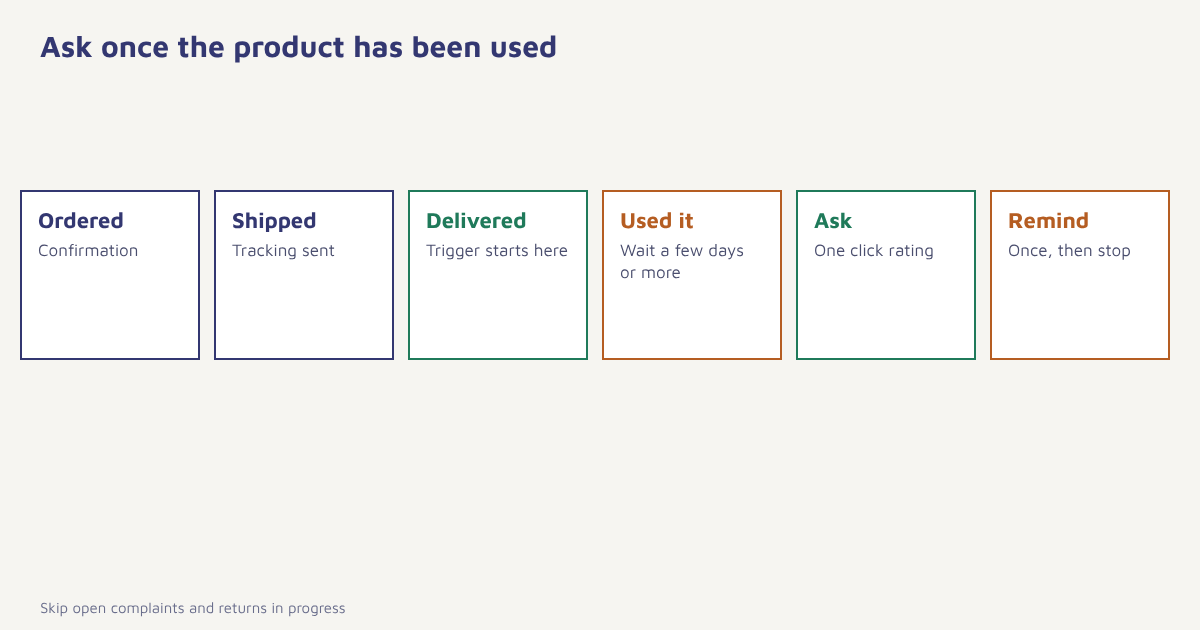
These are starting points, not rules. Test different waits and compare the share of requests that become reviews and the quality of the text. Trigger the email from the delivery event, not the order date, so that late shipments do not receive a request for a product still in transit. Skip customers with an open complaint or a return in progress, and wait for the issue to be resolved. In Flowfox, a journey can do exactly this, reading order and delivery events from the data model and checking consent for each channel before sending.
Which channel to use
| Channel | Strengths | Cautions |
|---|---|---|
| Room for product images, a clear button, easy follow-up | Crowded inbox; keep the subject specific | |
| Quick, personal, one-tap replies | Only with opt-in and within template rules. See WhatsApp Business API | |
| SMS | Short and fast | Template and consent rules apply. See opt-in and opt-out |
| In-app | Reaches active users in context | Do not interrupt a task. See in-app messaging |
What to write
A good request is short, specific and easy. Name the product, say why the opinion matters, make the first step a single click and explain what happens next. A rating question first, with the text box after, converts better than a long form, because the first tap is nearly effortless.
| Element | Weak | Stronger |
|---|---|---|
| Subject line | We want your feedback! | How are the new running shoes working out? |
| Opening | Dear customer, please leave a review. | Hi Asha, your Trail Runners arrived last week. How do they feel on the road? |
| Reason | Reviews help us. | Your honest view helps other runners choose the right size. |
| Button | Submit | Rate your shoes |
| Closing | Thanks, team | Thanks for shopping with us. If something is not right, reply to this email and we will help. |
More on writing emails people answer is in email copywriting and email subject lines. Keep the design plain, as described in email design best practices, with a large button and no distractions.
Handling unhappy customers fairly
Some customers will be disappointed. The question is how to treat them. A common but risky practice is "review gating": sending happy customers to a public review site and unhappy ones to a private form. Several review platforms and regulators discourage or prohibit selectively inviting only positive reviews, because it distorts the picture and can mislead shoppers. A safer approach is to ask everyone the same question, publish what comes back and respond to criticism in public with a helpful, calm reply. Offer to fix the problem through support, but do not make that a condition of leaving a review, and never ask a customer to change or remove an honest review in exchange for compensation.
Rules on incentives and honesty
Rewarding reviews is a grey area. Many platforms ban paid or incentivised reviews unless the incentive is disclosed, and consumer protection law in many countries, including rules on endorsements and unfair trade practices, covers fake or misleading reviews. In India, check the current guidance under the Consumer Protection Act, 2019 and platform policies with your legal advisor. In practice: never write or buy reviews, never suppress negative ones to inflate ratings, disclose any incentive clearly, do not condition a reward on positive content and follow the rules of each review site you use. Personal data in reviews, such as names and photos, is also covered by the DPDP Act, so say how you will use what customers submit.
Check the source, not only the rule. Review policies change. Read the current terms of each review platform and your payment or marketplace partner before you launch a request programme.
Setting up a review request flow
- Choose the trigger. Delivery confirmed, or a set number of days after, per product type.
- Exclude the right people. Open complaints, returns in progress and customers without consent for the channel.
- Write one request and one reminder. The reminder follows several days later and only goes to those who did not respond.
- Link straight to the rating. Let the first click record the star rating, then ask for text and an optional photo.
- Say thank you. A confirmation message after submission, with a note on when the review will appear.
- Reply to reviews. Thank positive reviewers and answer critical ones with specifics.
- Close the loop. Pass recurring complaints to product and support. See the customer feedback loop.
A worked example (invented)
A cookware brand sends review requests ten days after delivery, which is when most customers have cooked with a pan a few times. The first email shows the product photo, asks "How does it cook?" and offers a one-tap five-star scale. A reminder goes out five days later to those who did not click. The brand tests two waits, seven and ten days, across alternate weeks and tracks the share of requests that lead to a review, the average length of the text and the proportion of reviews with photos. It also keeps a small group without requests to see whether natural review volume changes. The brand and figures are invented; the point is the method of testing wait times and measuring the quality of reviews as well as the count.
Measuring the programme
Track the request-to-review rate, the average rating, the share of reviews with detail or photos, the time from delivery to review and the effect on conversion for products with and without reviews. Compare with a holdout group when you can. Be careful with averages: a small number of reviews can swing a rating. For an overview of review ratings as a signal, see the article on social proof. Related metrics are explained in NPS, CSAT and CES, and net promoter score shows how to turn the same question into a trackable measure.
Common mistakes
- Asking too early. The customer has not used the product yet.
- Asking too often. Repeated reminders annoy and raise unsubscribes.
- Gating by sentiment. It risks breaking platform and legal rules.
- Long forms. A one-tap rating first works better.
- Ignoring negative reviews. A courteous reply can win trust.
- Not feeding results back. Reviews are product research.
Ask everyone, publish what comes back and answer the bad ones as carefully as the good ones.
Automate review requests after delivery. Trigger the right message, on the right channel, only to customers who should get it.
Read next: post-purchase emails, customer advocacy and the blog.
Frequently asked questions
When should I send a review request email?
After the customer has had time to use the product, usually a few days to a couple of weeks after delivery depending on the product. Trigger from the delivery event and test the wait.
How many review request emails should I send?
One request and at most one reminder to people who did not respond. More tends to annoy customers and raise unsubscribes.
Can I offer a reward for reviews?
Many platforms and consumer rules restrict incentivised reviews. If allowed, disclose the incentive clearly and never make the reward depend on positive content. Check current policies.
Is review gating allowed?
Selectively inviting only happy customers to post public reviews is discouraged or prohibited by many platforms and may mislead shoppers. Ask everyone the same question.
How do I respond to a negative review?
Reply promptly and politely, thank the customer, address the specific issue and offer a way to fix it through support, without pressuring them to remove the review.
What should a review request subject line say?
Name the product and make it specific and personal, for example a question about how the item is working, instead of a generic request for feedback.
How do I measure whether review requests work?
Track the request-to-review rate, average rating, share of detailed or photo reviews, time to review and the conversion difference for products with and without reviews.