Black Friday and Cyber Monday are the loudest days in the shopping calendar, and every inbox is full of the same “BIGGEST SALE EVER” subject lines. Brands that win do not simply shout louder. They plan weeks ahead, warm up their list, segment carefully, protect their sending reputation and keep the offers believable. This guide gives a practical email plan for Black Friday: a timeline, the emails to send, subject line and offer ideas, segmentation, deliverability precautions, SMS and WhatsApp support, and a short checklist for the final week. It applies in India too, where the sale season runs alongside Diwali hangover offers and end-of-year buying.
Why Black Friday email needs its own plan
Black Friday falls on the day after US Thanksgiving, and the shopping weekend now runs through Cyber Monday and often a full week of deals. Even in markets without the holiday, many retailers and online brands run a sale around it. Three things make the period different from ordinary campaigns. Volume spikes, so a sudden jump in sending can damage reputation. Competition for attention is at its peak, so generic messages vanish. And customers have learned to wait for deals, so pricing and timing matter more than usual. A plan that treats it like a normal Tuesday newsletter will leave money on the table.
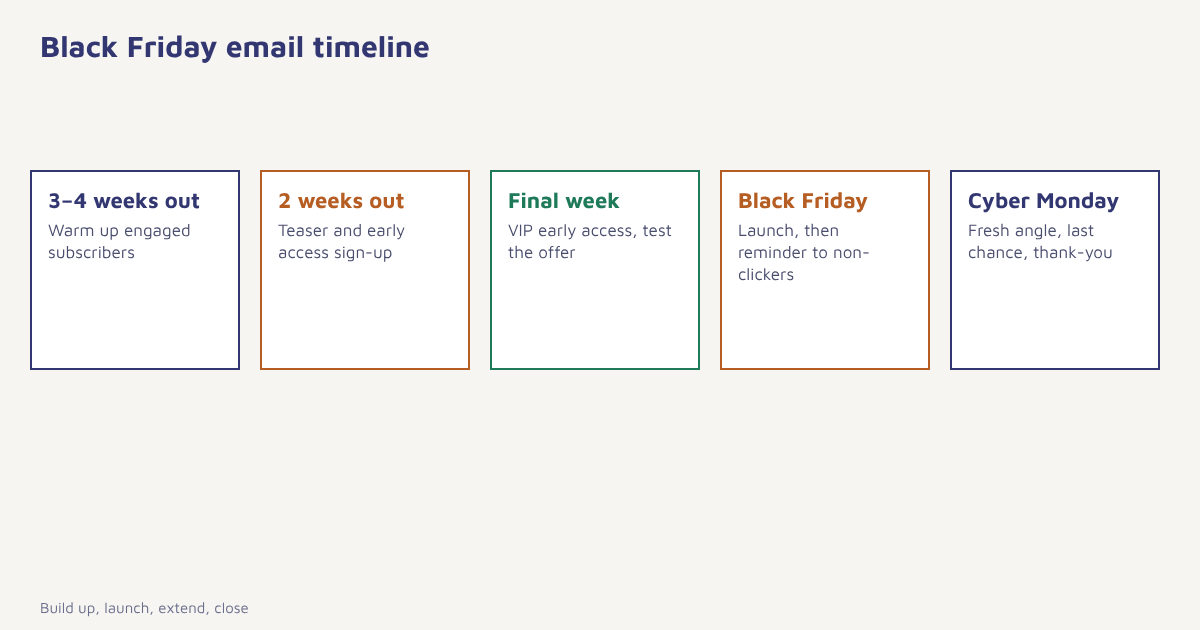
A four-week timeline
| When | What to send | Goal |
|---|---|---|
| 3 to 4 weeks before | Warm-up emails to engaged subscribers, wishlist and reminder sign-up | Lift engagement and collect intent |
| 2 weeks before | Teaser: what is coming and how to get early access | Build anticipation |
| Final week | Early access for VIPs and loyal customers | Reward the best customers and test the offer |
| Black Friday morning | Main launch with clear offer and deadline | Capture peak demand |
| Black Friday evening | Reminder to openers who did not click | Recover attention |
| Saturday and Sunday | Bestsellers and back-in-stock | Catch weekend browsers |
| Cyber Monday | Fresh offer or extended deal | Second wave |
| Last day | Final hours countdown | Urgency that is honest |
| After the sale | Thank-you, order updates, review request | Retention and trust |
Adjust the dates to your market and calendar. The aim is not to send more emails, but to place each one where it has a clear purpose.
Warm up the list and protect your reputation
Mailbox providers pay attention to sudden changes in volume and engagement. If you normally send 20,000 emails a week and suddenly send 500,000 to the whole list, including people who have not opened in a year, bounces and complaints can spike and push your mail toward spam. Start sending to your most engaged subscribers a few weeks earlier, increase volume gradually, and suppress long-inactive addresses. Our guides to email warm-up and deliverability explain how, and SPF, DKIM and DMARC should be correct before the season begins. Check them in advance, not on the Friday morning. Review your bounce rate after every send in the run-up.
The emails to send
- Teaser. Tell people the sale is coming, show a hint of the categories and offer a way to get early access, such as a reminder sign-up.
- Early access. Give VIPs, loyalty members and recent purchasers a head start. It rewards loyalty and gives you a safe test of stock and site speed.
- Launch. One clear headline, one primary call to action, the best offers above the fold and a visible end time.
- Reminder to non-clickers. Resend to openers who did not click, with a different subject and the strongest product.
- Back-in-stock and bestsellers. Sold-out items create disappointment and demand. Tell people when they return.
- Cyber Monday. A fresh angle, not a repeat, such as extended offers or free shipping.
- Last chance. Send in the final hours, only if the deadline is real.
- After the sale. Thank customers, confirm shipping and ask for reviews.
Subject lines and offers that stand out
| Style | Example | Why it works |
|---|---|---|
| Clear offer | Up to 40% off sitewide, ends Monday midnight | Specific and honest |
| Early access | You are in: shop before everyone else | Personal and exclusive |
| Category focus | Winter jackets from ₹1,999 | Relevant to browsers |
| Reminder | Your wishlist item is on sale | Personal and timely |
| Last chance | Final 6 hours: free shipping ends tonight | Real deadline |
Avoid the overused “Biggest sale of the year!!!” and heavy use of capital letters or exclamation marks. Our guide to email subject lines has more on wording, and A/B testing lets you try two versions on a small slice of the list before you send the rest. For design tips for busy, image-heavy emails, see email design best practices.
Choosing the offer
Percentage discounts are the default, but they are not the only option. Free shipping, bundles, gift with purchase, loyalty points multipliers and early access all protect margin better than deep discounts. Customers who have been buying at full price may feel cheated by a deep cut, so think carefully about how to treat them. A sensible approach is to offer tiers: a better offer for loyal customers, a standard offer for everyone else and a smaller one for those who have bought recently. Always calculate margin after discount, shipping and returns before committing. Be accurate with claims such as “lowest price ever”, because consumer protection rules in many places restrict misleading price comparisons.
Segment, do not blast
| Segment | Message |
|---|---|
| VIP and loyal customers | Early access and bonus points. See loyalty programs |
| Recent buyers (last 30 days) | Complementary products, not the item they just bought |
| Wishlist and cart abandoners | Reminder when the item goes on sale. See cart recovery |
| Category browsers | Deals in the category they viewed |
| Price-sensitive buyers | Lead with savings and bundles |
| Lapsed customers | A comeback offer. See win-back campaigns |
| Unengaged subscribers | Reduce or suppress to protect reputation |
In Flowfox, the segment builder creates these groups from purchase, browsing and engagement data, and journeys handle triggers such as wishlist price drops. The ecommerce solution page shows how stores use them, and the behavioral segmentation guide explains how to set the rules.
Support email with other channels
Email carries the story, but other channels carry the urgency. A short SMS or WhatsApp message at launch and in the final hours reaches people quickly, as long as they have consented to those channels. Push notifications work well for app users. Agree a total number of messages per person per day across channels so that coordination does not become spam. Read our comparison of email, SMS and WhatsApp and the guide to omnichannel versus multichannel for how to share the load. If you run sales in India, the same planning applies to festival campaigns.
A worked example
Imagine an online home-décor store with 80,000 subscribers, of whom 30,000 opened an email in the last 90 days. Four weeks before Black Friday, it sends two warm-up emails with useful gift guides to the 30,000 engaged contacts only. Two weeks before, it invites everyone to join an early access list and collects 9,000 sign-ups. In the final week it gives them a 24-hour head start, which lets it spot a broken coupon code and a slow product page before the main launch. On Black Friday it sends the main email in three waves over a few hours, starting with the most engaged group, while watching complaint and bounce rates. A reminder follows in the evening to openers who did not click. The store ends with a thank-you email and a review request. The store, list sizes and steps here are invented to show the sequence, not real results.
Final-week checklist
- Authentication passes and domains are warmed up.
- Coupon codes tested on desktop and mobile, including stacking rules.
- Site and checkout tested for load, and stock levels checked.
- Segments and exclusions built and reviewed.
- Every email previewed on phone, in dark mode and in a text-only version.
- Unsubscribe link, physical address and offer terms present.
- Support team briefed on deals, shipping times and returns.
- Monitoring plan agreed: who watches bounces, complaints and site performance, and what triggers a pause.
Rules and wording to respect
Keep claims honest. If you show a crossed-out price, it should be a real previous price. If a deal ends at midnight, it should end at midnight. Misleading discounts invite complaints and, in many places, regulator attention.
Email sending rules apply in every season. In the US, the FTC CAN-SPAM guide sets out requirements such as a working unsubscribe and an accurate sender identity, and recipients in other regions are covered by their own laws. The shopping weekend that follows, Cyber Monday, is another peak where the same care applies. Ask your legal advisor to review any claim you are unsure about, especially price comparisons.
Common mistakes
- Blasting the whole list. It harms reputation and engagement.
- Starting too late. Warm-up takes weeks.
- Fake urgency. Countdowns that reset break trust.
- Ignoring mobile. Most holiday emails are read on phones.
- Forgetting the aftermath. Delivery delays and returns decide whether customers come back.
On Black Friday everyone is shouting. The brand people remember is the one that was clear, honest and on time.
Plan the sale season in one place. Segment, schedule and send across email, SMS, WhatsApp and push.
Read next: Christmas promotion ideas, retention strategies and the blog.
Frequently asked questions
When should I start sending Black Friday emails?
Start warming up your engaged subscribers three to four weeks before, send a teaser and early access invitation in the following weeks, and launch on the day with a clear deadline.
How many emails should I send during Black Friday week?
There is no fixed number. Send each email with a clear purpose, such as launch, reminder and last chance, segment by engagement and cap total messages per person.
How do I avoid the spam folder during peak season?
Authenticate your domain, warm up volume gradually, send first to engaged subscribers, suppress inactive addresses and monitor bounces and complaints during the campaign.
What should a Black Friday subject line include?
A clear offer or benefit, and a real deadline where relevant. Avoid excessive capital letters, exclamation marks and exaggerated claims.
Should I give the same discount to everyone?
Not necessarily. Offering better terms to loyal customers and different offers by segment protects margin and rewards loyalty.
Should I use SMS and WhatsApp for Black Friday?
They can add urgency at launch and in the final hours, but only to contacts who have consented to those channels, and within a cap on total messages.
What should I do after the sale ends?
Send a thank-you and order updates, ask for reviews, and move buyers into a post-purchase journey to encourage a second order.