Christmas shopping begins long before December 25. Gift guides appear in October, early deals in November and last-minute shoppers keep buying until the final delivery cut-off. For brands, the season offers a long run of moments, from first browsing to post-holiday gift-card spending, and each one can support a different promotion. This guide shares Christmas promotion ideas that work across email, WhatsApp, SMS, push and your website, a calendar for planning them, ways to protect margin, ideas for small businesses and for India, where the season is smaller but growing in many cities and communities, and a way to measure what worked.
Why a calendar beats a single sale
Holiday season retail behaves as a series of waves. Early shoppers plan and compare. Mid-season shoppers respond to deals. Late shoppers want delivery certainty. After Christmas, many people spend gift money and look for bargains. If you send the same offer all the way through, you meet only one of these groups well. A calendar lets you match message, offer and channel to each stage.
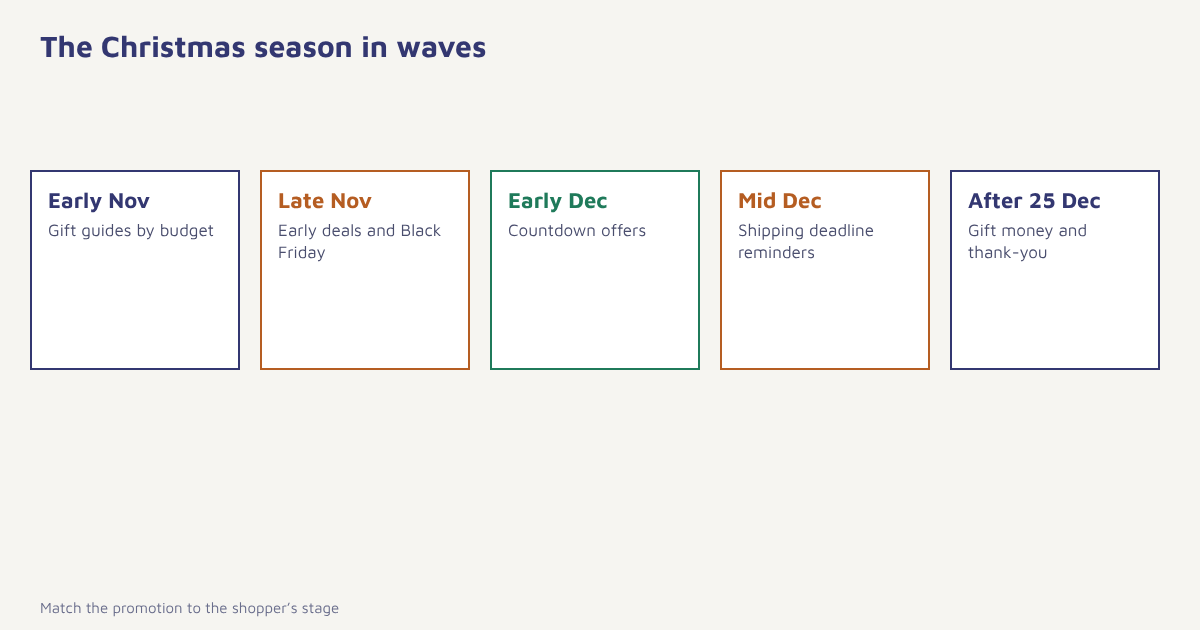
A Christmas promotion calendar
| Period | Idea | Channel |
|---|---|---|
| Late October to early November | Gift guides by budget and recipient | Email, website, social |
| Mid November | Early bird offers and wishlist reminders | Email, push |
| Black Friday week | Main sale. See Black Friday email marketing | Email, SMS, WhatsApp, push |
| First half of December | Advent-style countdown deals | Email, app, push |
| Mid December | Shipping deadline reminders | Email, SMS, WhatsApp |
| Final days | Last-minute and gift cards or digital delivery | SMS, WhatsApp, push |
| Boxing Day and after | Clearance and gift-money offers | Email, push |
| January | Thank-you, new-year resolutions and win-back | Email, WhatsApp |
Twelve promotion ideas
| Idea | How it works | Good for |
|---|---|---|
| Gift guides | Curated lists by recipient, budget or interest | Helping indecisive shoppers |
| Advent calendar deals | A new small offer each day for 12 or 24 days | Daily engagement |
| Free gift wrapping or message cards | Add a thoughtful extra rather than a discount | Raising perceived value |
| Bundles and gift sets | Pre-packaged combinations at a modest saving | Raising order value. See cross-selling and upselling |
| Spend and save | Get a reward at a spend level | Raising basket size |
| Free shipping by a date | Guaranteed delivery before Christmas | Reassuring late shoppers |
| Gift cards and e-vouchers | Instant delivery by email or WhatsApp | Last-minute buyers |
| Loyalty bonus points | Double points on selected days. See loyalty program examples | Rewarding regulars |
| Referral offers | Share with friends and both get a reward | New customers |
| Charity link | Part of the sale supports a cause, stated clearly | Brand values |
| Secret sale for subscribers | Private link for the list | Rewarding the audience |
| After-Christmas offers | Use-your-gift-money deals | Extending the season |
Pick four or five, not all twelve. A focused plan executed well beats a crowded one.
Christmas promotions in India
Christmas is celebrated by a minority of Indians, but the season has a wider reach in cities, in states with large Christian populations such as Kerala, Goa and the north-east, and as a year-end shopping and travel period for many others. Hotels, cafes, bakeries, fashion and gifting brands often run Christmas and New Year offers. If your customers are mostly in these groups, a full Christmas campaign makes sense. Elsewhere, a lighter “year-end” theme may fit better. Be respectful and accurate in your messages, and use local language where it helps. See our guide to festival marketing campaigns for planning around Indian festivals, and check how Christmas fits with your wider calendar. The festival also overlaps with festival use cases that many brands already run.
Ideas for small businesses
- Personal notes. A handwritten card or a short personal email stands out in a crowded inbox.
- Local delivery cut-offs. Promise delivery by a date and keep the promise.
- Bundle your bestsellers. Gifting is easier when someone else has chosen.
- Partner with another local brand. A joint gift box doubles your reach.
- Use WhatsApp for orders. Many small shops can take gift orders in chat. See WhatsApp marketing.
How to plan the season
- Review last year. Look at sales by week, bestsellers, returns and delivery problems.
- Set targets. Revenue, new customers and repeat rate, not just sales volume.
- Choose four or five promotions. Match them to the calendar and your margin.
- Build segments. Gift buyers, loyal customers, lapsed customers and new subscribers each need a different message. See segmentation.
- Prepare content early. Gift guides, banners, product pages and templates before the rush.
- Test the basics. Delivery cut-offs, coupons, checkout and stock.
- Run and monitor. Watch results daily and adjust offers carefully.
- Follow up. Thank buyers, ask for reviews and invite them to join your loyalty programme.
In Flowfox, campaigns schedule the sends, journeys handle triggers such as shipping reminders, and the email builder lets you reuse a festive template across channels. The segment builder separates gift buyers from regulars, for example people who bought a gift last year.
Protect your margin
Deep discounts in December can leave you with brisk sales and thin profit. Work out the margin per product after discount, shipping, packaging and likely returns. Prefer value-adds such as free gift wrap, bundles or bonus points to blanket price cuts. Stage clearance for after Christmas, when shoppers expect it. Keep an eye on stock: running out of bestsellers early disappoints customers, while overstocking leaves you discounting in January. A short daily meeting in the peak weeks, with sales, stock and support at the table, usually catches problems quickly.
A worked example
Consider an online chocolate and gifting brand with 25,000 customers. In early November it sends a gift guide organised by budget (under ₹500, under ₹1,000 and premium hampers). In late November it offers early access to hampers for subscribers, with free personalised message cards. In December it runs a countdown with a shipping deadline banner on the site and in emails, and sends an SMS reminder two days before the cut-off to customers with wishlist items. On the final days it promotes e-gift vouchers delivered instantly by email or WhatsApp. After Christmas it sends a thank-you and a modest offer to those who bought gifts, inviting them to treat themselves. The brand, budgets and plan are invented to illustrate the structure.
Measure what matters
Track revenue and orders by promotion, average order value, new versus returning customers, conversion rate, return rate and customer feedback. Look beyond the season too: how many December buyers purchase again in the next three months? Seasonal buyers are often one-time customers, so a follow-up programme can turn some of them into regulars, a topic covered in customer retention rate and customer lifetime value. Use analytics to compare campaigns, and keep notes for next year’s plan. The general background on Christmas traditions can also help you choose imagery and wording that suit your audience.
Content that makes the promotion work
Offers get the click, but content gets the sale. For a gift guide, tell shoppers who each item suits and why, show delivery times next to the price and answer the questions people ask before buying a gift: will it arrive in time, can it be returned, can I add a note? Use real photos of the product being unwrapped or used instead of stock images, and keep language warm and unforced. Subject lines for the season read best when they promise help, not just a discount. Test a few and keep what your own audience prefers, using the approach in our guide to A/B testing. Most importantly, keep the festive design light enough to load quickly on a phone, since many holiday emails are opened on the go.
Truthful pricing and delivery promises
Holiday shoppers are alert to games. Show real prices, state delivery cut-offs plainly and honour them. If a carrier delay is likely, say so early. The advertising rules in your market, such as the guidance published by the Advertising Standards Council of India, expect claims to be honest and not misleading, and a short check of your copy before sending is worth the time.
Common mistakes
- Starting too late. Shoppers plan early.
- Missing delivery cut-offs. It ruins gifts and trust.
- Discounting everything. Margin vanishes.
- Assuming everyone celebrates. Segment and use respectful wording.
- Forgetting January. Follow-up decides whether gift buyers return.
A good Christmas promotion is a gift to the shopper: it makes a stressful job easier.
Plan every wave of the season. Segment gift buyers and regulars and run the right message on every channel.
Read next: loyalty program examples, email marketing strategy and the blog.
Frequently asked questions
When should I start Christmas marketing?
Start planning in September, publish gift guides by late October or early November, and run promotions in waves through December and into the new year.
What are good Christmas promotion ideas for small businesses?
Gift guides, bundles, personalised notes, guaranteed delivery dates, partnerships with local brands and WhatsApp ordering work well for small businesses.
How do I avoid losing margin on Christmas sales?
Calculate margin after discounts, shipping and returns, prefer value-adds such as gift wrapping and bundles, and keep clearance for after Christmas.
Which channel is best for Christmas promotions?
Use email for gift guides and stories, SMS and WhatsApp for urgent reminders and delivery deadlines, and push for app users, within consent and message caps.
Is Christmas marketing relevant in India?
It matters most for brands whose customers are in cities and regions that celebrate widely. For others, a lighter year-end theme can work better.
How do I run an advent calendar promotion?
Offer a small new deal or content piece each day for 12 or 24 days, promote it by email and app, and make sure each offer is easy to redeem.
How do I measure Christmas campaign success?
Track revenue, orders, average order value, new versus returning customers, return rate and how many seasonal buyers purchase again within three months.