Every ecommerce vendor now says “AI-powered”, which makes it hard to tell what is useful from what is a label. Behind the noise, a handful of uses do deliver value for online stores: finding products, answering questions, predicting demand, setting prices, spotting fraud and deciding who to message and when. This guide explains where AI actually helps in ecommerce, with examples for each area, what data it needs, where it goes wrong, how to start with a small pilot and how to keep the human judgement and customer trust that no model replaces.
What does AI in ecommerce mean?
In practice, AI in ecommerce means software that learns patterns from data, such as which products sell together or which customers are likely to leave, and uses them to make predictions or generate content. It spans classic machine learning models, which predict numbers or categories, and newer generative models, which write text or create images. Most tools you will meet are a mix of the two, wrapped in a friendly interface. The useful question is not “do we use AI?” but “which decision gets better, and how would we know?”
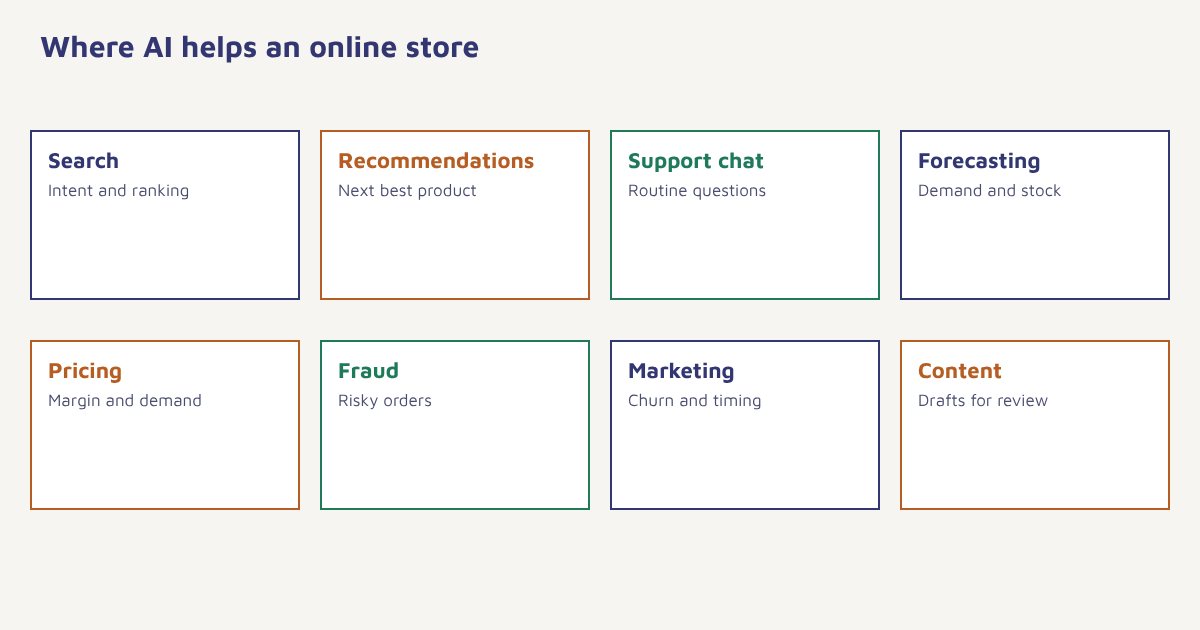
Where AI helps most
| Area | What AI does | Typical benefit |
|---|---|---|
| Search and discovery | Understands misspellings and intent, ranks results by relevance | Shoppers find items faster |
| Recommendations | Predicts items a customer may want. See product recommendation engines | Higher order value and engagement |
| Customer support | Chatbots answer routine questions and route the rest. See WhatsApp chatbots | Faster replies, lower load |
| Demand forecasting | Predicts sales by product and season | Fewer stock-outs and less dead stock |
| Pricing | Suggests price changes based on demand, stock and competition | Better margin management |
| Fraud and risk | Flags unusual orders and payments | Fewer chargebacks and fake orders |
| Marketing | Predicts churn, scores leads, picks send times and audiences | More relevant messages |
| Content | Drafts product descriptions, subject lines and image variants | Faster production |
AI in ecommerce marketing
For marketing teams, the practical gains come from prediction and personalization. Models can estimate how likely each customer is to buy again, to leave or to respond to an offer, and these scores can drive segments and journeys. They can choose a send time for each person, as discussed in our guide to the best time to send email, or choose which of several messages is most likely to work. They can help draft copy, which people then edit. And they can summarise feedback from reviews and surveys so that you hear patterns earlier.
The scores are only as good as the data behind them. Prediction needs history that is joined up by customer, which is why a unified profile matters, as explained in the customer data platform guide. In Flowfox, FoxAI works on the same profile and events used by segments and journeys, so predictions can feed straight into an audience or trigger a message. Related methods such as RFM analysis remain useful baselines to compare against.
| Prediction | Used for | Related guide |
|---|---|---|
| Likelihood to buy | Targeting offers and ad audiences | Behavioral segmentation |
| Churn risk | Early retention outreach | Customer retention rate |
| Lifetime value | Deciding how much to spend to acquire | Customer lifetime value |
| Next best product | Recommendations in email and apps | Cross-selling and upselling |
| Best channel and time | Reaching customers where they respond | Email vs SMS vs WhatsApp |
Generative AI: helpful, with care
Generative tools can speed up work such as writing first drafts of product descriptions, creating subject-line options and summarising reviews. Treat the output as a draft. Models can state wrong details with confidence, repeat generic phrasing and miss your brand voice. Check facts such as sizes, materials and claims, because a wrong detail in a product description can cause returns and complaints. Keep a person responsible for what is published. Also be careful about what you put into third-party tools: do not paste customer personal data into services without understanding how that data is stored and used. The broader topic is introduced in the article on generative AI.
How to start with a small pilot
- Pick one decision. For example, which lapsed customers to include in a win-back, or which items to show in a cart reminder.
- Check your data. Do you have enough history, and is it linked to customers? A few thousand orders is often enough for simple models.
- Set a baseline. Measure how the decision is made today, so improvement is visible.
- Run the AI version for a slice. Use a random group, with the rest on the current method.
- Measure the outcome that matters. Revenue per customer, repeat rate or cost per order, not just clicks.
- Review for errors and fairness. Read examples, look for odd or unfair results.
- Scale what works, drop what does not. Keep a person accountable for each use.
A rule of thumb. If you cannot say how you would tell whether the AI made the decision better, you are not ready to buy it. Start where the result is measurable.
A worked example
Imagine a home-textiles store with 40,000 customers and three years of order history. It wants to reduce discounting. Today it sends a 15 percent coupon to everyone who has not ordered in 90 days. A simple model estimates each lapsed customer’s chance of returning without a coupon. Customers with a high chance receive a content-only reminder about new arrivals. Those with a low chance get the coupon, and a random 10 percent are held out and get nothing at all, to check the model. After two months the store compares revenue, margin and repeat rate for each group. The company and numbers are invented, but the design is a good template: a clear decision, a baseline, a holdout and a result in money, not clicks.
Risks and limits
| Risk | What to do |
|---|---|
| Poor or biased data | Check what the data represents; models repeat past patterns, including unfair ones |
| Wrong or invented output | Have people review customer-facing generated content |
| Over-personalization | Avoid creepy messages; explain why a suggestion appears |
| Privacy | Collect with consent, minimise data and follow rules such as the DPDP Act |
| Vendor lock-in | Keep your data portable and exportable |
| Hidden costs | Include data work, review time and tool fees in the business case |
| False confidence | Models give estimates, not guarantees; keep humans in the loop |
Regulators and standards bodies are paying growing attention to automated decisions. If a model affects prices or eligibility for individuals, take legal advice and document how it works. For a general overview of the policy debate, the article on the regulation of artificial intelligence is a starting point, though rules differ by country and change quickly.
Who should own it?
Name one person responsible for each AI use, with a short written note on its purpose, data, owner and review date. Review the results monthly, check a sample of outputs by hand and keep a way to switch the feature off quickly. Training the team to ask basic questions of any model, such as what data it saw and how it was tested, matters more than learning the technology itself. A small, regular review habit catches drift early, when customer behaviour or the catalogue changes and an older model quietly gets worse.
Common mistakes
- Buying a tool before choosing a problem. Start with the decision.
- Dirty data. Duplicate customers and missing events weaken every model.
- Measuring vanity numbers. Clicks are not profit.
- Publishing unreviewed text. Check facts and tone.
- Replacing people entirely. Support and merchandising still need judgement.
AI is a good assistant and a poor boss. Give it decisions you can measure and check.
Use predictions where they pay. Turn churn, purchase and value scores into segments and journeys.
Read next: marketing automation, conversion rate optimization and the blog.
Frequently asked questions
How is AI used in ecommerce?
AI is used for search and recommendations, support chatbots, demand forecasting, pricing, fraud detection, marketing predictions and drafting content.
What is the best use of AI for a small online store?
Start with a measurable decision, such as product recommendations in cart and post-purchase emails, or win-back targeting, and test it against a control group.
Do I need a lot of data to use AI?
Simple models can work with a few thousand orders linked to customers. More complex uses need more data and cleaner data.
Can AI write my product descriptions?
It can produce useful first drafts, but facts such as sizes, materials and claims must be checked by a person before publishing.
Is AI in ecommerce safe for customer privacy?
It can be, if you collect only what you need, have clear notice and consent, minimise data shared with tools and follow rules such as the DPDP Act.
How do I know if AI is working?
Compare a group that gets the AI-driven decision with a holdout group on revenue, margin and repeat rate, not just clicks.
Will AI replace ecommerce staff?
It automates routine tasks, but judgement in merchandising, support and brand voice still needs people. Most gains come from people and AI working together.